The Bhagavad Gita: A Journey Through the IFS Lens: The Battle Within
The Bhagavad Gita is one of the most beloved scriptures in the world, a conversation of seven hundred verses set inside the great Indian epic of the Mahabharata. This page brings it into a quiet meeting with Internal Family Systems (IFS). What is offered here is not commentary or doctrine, but a way of sitting beside your own inner world with the Gita's voice for company.
You do not need to be a Hindu, and you do not need any background in IFS. A willingness to slow down and listen is enough, so that the ancient dialogue on the battlefield can begin to echo the one happening quietly inside your own chest.
Where the battlefield and the inner family meet
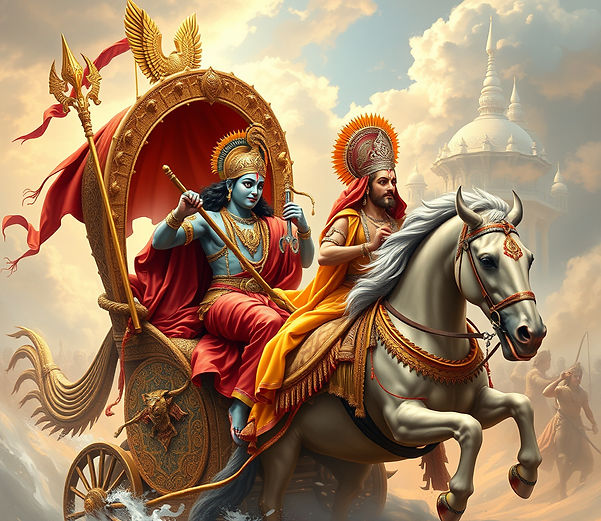
The Bhagavad Gita begins in the worst moment of a good man's life. Arjuna, the greatest archer of his age, stands in his war chariot between two vast armies, about to fight a battle against his own cousins, teachers, and elders. Looking across the field at the faces he loves, he breaks. Grief floods him, his limbs go weak, his mind reels, and he sinks down in the chariot and lets his great bow slip from his hand. He would rather die than act. The entire scripture unfolds from that collapse, because the man beside him in the chariot is Krishna, the divine, serving as his charioteer, and what follows is their long and tender conversation.
Anyone who has practiced IFS will recognize this scene immediately, because it is an inner session caught in its opening moment. Arjuna is a whole system in overwhelm. He is blended with a part so flooded by grief and dread that it cannot move, and it has taken the entire person down with it. What he does next is the model in miniature. He does not force the despair away, and he does not pretend to be fine. He turns to the calm presence beside him and speaks the whole of his anguish, and that presence does not shame a single word of it. The Gita is, in one reading, seven hundred verses of a frozen part finally being heard by something steady enough to hold it.
That steadiness has a place, and the place is telling. Krishna sits in the driver's seat, holding the reins, while Arjuna comes apart. The image of the Self as the one who holds the reins of the chariot runs deep through the Indian tradition, where the body is the chariot, the senses are the horses, and the true Self is the calm hand that guides them. The Gita puts the divine in exactly that seat, right beside the trembling warrior. This is what IFS means by Self, the settled and compassionate presence that can hold perspective when the parts cannot. And Krishna is not summoned from far away. He is already there, already in the chariot, already Arjuna's own. IFS says the same of Self. It is never imported from outside. It was riding with you the entire time.
Partway through, Krishna tells Arjuna something that could be lifted straight into an IFS session. The true Self, he says, is never born and never dies. It cannot be cut by any weapon, burned by any fire, or wounded by anything at all, for it is eternal and untouched. Centuries later, and a world away, IFS arrived at nearly the same sentence: the Self was never damaged and cannot be broken. Two traditions, reaching across an enormous gulf of time and language, describing the one part of you that no wound ever reached.
There is a difficulty here that deserves honesty rather than a soft touch, because a careful reader will feel it right away. Krishna's counsel to Arjuna is to fight. He tells the collapsed warrior to rise and take up his bow, and the enemies waiting on that field are Arjuna's own kinsmen. If we read the battlefield as the inner world, as the Vedantic tradition long has, then Krishna appears to be commanding a war against one's own parts, which is the exact opposite of everything IFS holds. So what are we to make of a sacred text that says fight?
The resolution lives in what Krishna is actually curing. The disease is not Arjuna's feeling. It is his paralysis. Krishna never tells him to crush his grief or slaughter his tenderness. He offers a medicine for collapse, which is to act from a steadier ground instead of being frozen by a flooded part. His famous teaching, that you have every right to your action but no claim on its results, is release from the grip of a part that had hijacked Arjuna with terror about outcomes. Read through IFS, the battle Arjuna must not flee is the return of his own agency, the capacity to show up to his life and take the step that is his to take, which becomes possible only once Self is back in the driver's seat. The bow he lifts again is not a weapon turned against his inner family. It is the recovered ability to move. What must fall on that field is not the tender parts who carry the grief, but the tyranny of the overwhelm that kept the whole system pinned in the dirt.
So the walk offered here is not a call to conquer yourself. It is an invitation to do what Arjuna did: to stop pretending you are not overwhelmed, to speak the whole of it to the calm presence that has been beside you all along, and to let that presence take the reins until you can act again from something deeper than dread. The war on the outer field ends. The one it was always pointing to, the quiet return of the Self to its own chariot, is the only battle the Gita ever truly cared about.
IFS & Bhagavad Gita journey's begin Jan 1, 2027
