Corpus Hermeticum The Key of the Master Explained
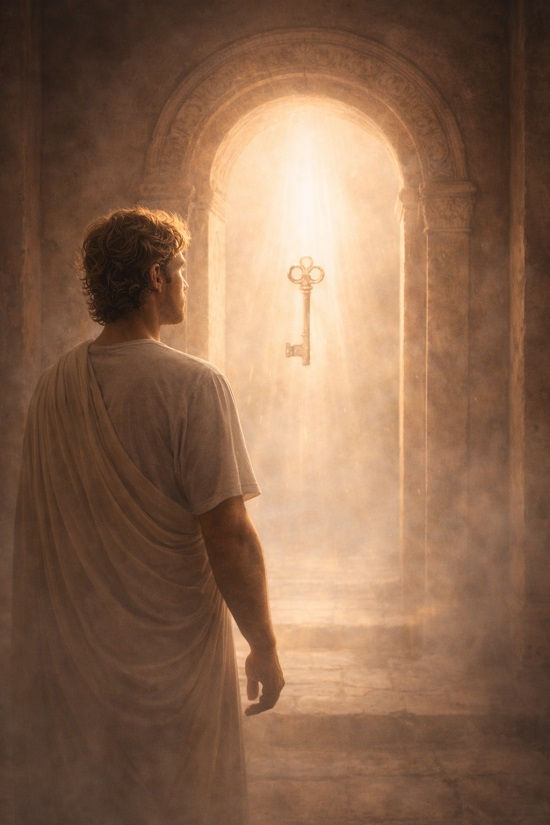
Tractate IX — The Key of the Master
The Turning of the Inner Gate
This Tractate stands at the center of the Hermetic path. If the earlier teachings reveal the nature of Mind, cosmos, and soul, this one reveals the method by which a seeker becomes a knower.
It is the text of transition. The moment where Hermes moves from student to practitioner, from receiver of wisdom to bearer of it.
This is the Master’s Key. Not a doctrine. Not a ritual. A capacity.
The Capacity to Open the Inner Gate
The Master tells Hermes that most people live in a state the text calls double ignorance:
They do not know the truth.
They do not know that they do not know.
This is not condemnation. It is diagnosis.
The Key of the Master is the power that dissolves double ignorance.
It is the ability to:
Pierce illusion
Distinguish appearance from essence
Recognize when a thought is a part speaking
Sense the difference between desire and knowledge
Stand in truth without violent certainty
Discern the real from the reactive
The Master tells Hermes:
Wisdom does not come from accumulating teachings It comes from clearing the lens of perception.
The Key is clarity, not complexity.
The Purification of Perception
The Tractate describes purification in an unexpected way.
Purification is not moral cleansing. It is perceptual refinement.
Every distortion, anger, envy, resentment, obsession, fear, self-importance, blurs the inner eye.
Purification is the gradual dissolving of those blurs so the mind can see what is already present.
The Master says:
The Divine Mind is always speaking. It is the noise of the lesser mind that makes it seem silent.
This is a foundational Hermetic insight.
When the mind quiets, truth does not appear. It becomes visible.
The Virtues of the Hermetic Practitioner
The Master lists the qualities required to wield the Key. They are not dramatic. They are subtle and deeply inward:
Gentleness
Receptivity
Steadiness
Sincerity
The willingness to be wrong
The courage to turn toward one’s own obscurations
The absence of arrogance
The presence of wonder
These are not moral virtues. They are perceptual ones.
They shape the way the mind encounters reality.
To the one who possesses these, understanding unfolds naturally. To the one who lacks them, even accurate teachings remain opaque.
The Master’s Warning
The Tractate includes a quiet but powerful warning:
Do not attempt to teach what you have not yet seen.
It does not shame the student. It protects the sacred.
Hermetic wisdom is not meant to be repeated, performed, or weaponized.
It is meant to be lived until it becomes obvious.
Hermes is told:
Speak only from recognition. Silence is wiser than borrowed truth.
What This Means for You
This Tractate is not about mastering doctrines.
It is about mastering perception.
The Key of the Master is not a tool you acquire. It is a state of being you cultivate.
When your mind becomes quieter, more spacious, less reactive, less entangled in parts, a different kind of understanding begins to flow.
You feel it instead of thinking it. You recognize it instead of constructing it. You receive it instead of forcing it.
This Tractate tells you that your consciousness is capable of accuracy beyond anything your surface identity imagines.
The Key of the Master is already in you. The work is learning how to hold it.
IFS Integration The Key and the System Within
IFS gives you a practical way to cultivate the clarity this Tractate describes.
Parts distort perception.
Self clarifies it.
Parts grasp, react, defend, justify, catastrophize. Self observes, listens, softens, steadies, understands.
This is the Hermetic Key in modern language: the shift from parts-perception to Self-perception.
Reflection Questions
Choose the one your system responds to.
What part of you believes it must control perception to stay safe?
What part misinterprets purification as self-criticism?
What part fears what you might see if your inner world became clearer?
What does sincerity feel like in your body?
Optional Deep Dive
IFS Practices for Holding the Key
IFS Journal Prompt
Invite a part that clings to certainty to speak.
Ask it:
What it is trying to protect
What it fears clarity might reveal
What it longs for underneath its rigidity
Write from its voice without correcting it.
Parts-Art Exercise
Draw two lenses:
One clouded by the emotions and interpretations of parts
One clear, representing the inner seeing of Self
Let your hands show you how each lens feels.
Somatic IFS Practice
Sit still. Place your fingers lightly between your eyebrows, the symbolic location of the Hermetic inner eye.
Whisper inward:
Let me see without distortion.
Notice:
Where your system softens
Where resistance rises
Which parts come forward
Which parts relax
This is the cultivation of the Master’s Key, not by force, but by presence.


Comments