Module 5 — Apotropaic Objects and Symbols | Folk Protection
- Apr 24
- 9 min read
Updated: May 16
Free Course by Everything IFS Academy | Witchcraft Series
Module 5 — Apotropaic Objects and Symbols
Some protections work because they are handled. Others work because they are there.
That distinction matters. Folk protection is not built only from actions, cleansings, spoken words, and materials placed with intent. It also relies on enduring presences: objects, marks, signs, and figures whose job is to stand watch whether anyone is paying attention or not. These are apotropaic forms. The word sounds scholarly, but the instinct behind it is ancient and very plain. An apotropaic object is made to avert harm. It does not wait for ceremony each time trouble comes near. It meets that trouble by existing in the right form.
This is one of the most practical developments in the history of folk magic. Human beings are not always alert. People sleep. They leave the house. They get ill. They become distracted, overworked, heartbroken, or careless. A protection that depends entirely on conscious effort has limits. Folk traditions answered that problem by creating guardians that could keep watch without needing constant human attention. A mark carved into a beam, a hand symbol above a doorway, a painted sign on a barn, a charm hanging in place year after year, a face set to glare outward—these are not decorations that happen to be magical. They are magical technologies of enduring refusal.
That is the heart of apotropaic logic. The object itself carries the work. Its form matters. Its visibility matters. Its history matters. These protections are not usually hidden away like containment devices, and they are not exactly the same as a ward, which is an actively set and maintained boundary around a space. An apotropaic object is more like a sentinel. It occupies a point in the household world and radiates a standing instruction: not here.
Painted and carved protections are among the clearest examples because they turn symbol into household architecture. Across Europe and its diaspora traditions, people marked beams, lintels, barns, hearths, stables, churches, and homes with forms meant to avert harm, confuse malicious force, bless movement, or establish luck and safety over the structure. These markings were often simple enough to be repeated by ordinary hands, but they were never empty. Repetition is part of what gave them authority. A sign passed from one generation to another becomes heavier with use.
The Pennsylvania Dutch hex sign tradition shows this beautifully. These signs are often misunderstood by outsiders as quaint folk art, all bright geometry and cheerful rural flourish. They are art, yes, but not only art. They belong to a system of symbolic protection, blessing, order, and household fortune. A distelfink may be associated with happiness and good luck. A rosette may represent protection and the smooth unfolding of life. Star forms can mark directional completeness, cosmic order, or stable blessing over a place. The exact meanings can vary somewhat by maker and region, but the larger point remains: the image is not random prettiness. It is designed presence.
The same principle appears in older European ritual markings. The daisy wheel, also called the hexafoil, was carved into wood and stone across medieval and early modern buildings in ways that suggest more than ornament. Interlocking circles, petaled rosettes, repeated compass-drawn forms, and other scored marks appear near openings, hearths, storage spaces, and structurally important areas. Their purpose seems bound up with protection, blessing, and the disruption of malevolent movement. A complicated looping figure can work apotropaically by catching, tangling, or halting what approaches. A symmetrical figure can assert order against disorder. A repeated sacred or inherited form can claim a space in the language of continuity.
Runic and runic-adjacent inscriptions participate in this same world, though they must be treated with care and not flattened into internet occult aesthetic. In traditional settings, an inscribed sign often carried force because it joined symbol, speech, memory, and intention. Writing does something that raw material alone does not. It names, fixes, commands, or dedicates. That is why inscriptions have appeared on homes, tools, amulets, and household objects for centuries. The act of marking turns a surface into a statement.
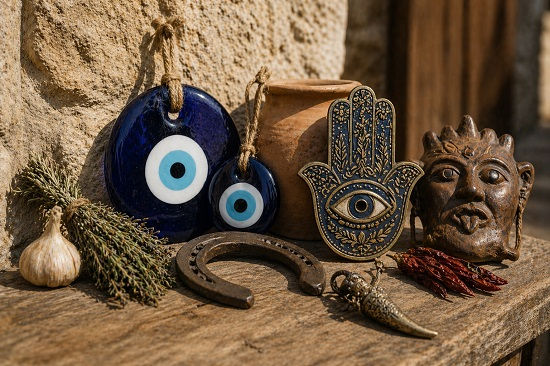
The nazar belongs to a different protective family, one shaped around gaze. The blue eye charm is among the most widely recognized apotropaic objects in the world for good reason. It meets harmful sight with sight. In Mediterranean and Near Eastern protective traditions, the eye is not merely a body part. It is a channel of force. Envy, admiration without restraint, malice, resentment, and fixated attention can travel through looking. The nazar counters that by becoming the watcher that watches back. Its shape matters because it answers the danger in the same language the danger uses.
There is elegance in that. A protection aimed at gaze takes the form of an eye. It does not hide from sight. It intercepts it. The nazar works within a logic of deflection, absorption, and return of harmful visual force, not by becoming invisible but by becoming the thing that meets the look first. That is why it appears in homes, vehicles, jewelry, children's belongings, businesses, livestock settings, and all kinds of everyday places. It is not exotic decoration with a mystical backstory. It is one of the great enduring objects of folk defense.
The hamsa operates differently but with equal depth. A hand is one of the oldest human symbols of agency, command, blessing, refusal, and sacred presence. In North African, Middle Eastern, Jewish, Islamic, and Mediterranean traditions, the hamsa carries that force into protective form. A hand raised outward can bless, halt, shield, or refuse. The symbol works because the hand is already culturally legible as an instrument of power. It wards by confronting. It says stop in a language older than writing.
This is one of the reasons apotropaic symbols endure so well across religious and cultural changes. Their meanings are layered. A hand can be read devotionally, magically, socially, and bodily all at once. A protective eye can operate through folk belief, family custom, shared fear of envy, and regional aesthetics without losing its power. The symbol does not have to belong to only one interpretation. In fact, its strength often comes from carrying several.
The horseshoe is perhaps the most famous protective object in Western folk tradition because it joins material power with symbolic shape. By the time it is hung, it is no longer just iron. It is iron given form by labor, heat, and purpose, then bent into a crescent associated in many traditions with fortune, lunar rhythm, receptivity, and blessing. That combination makes it unusually potent in household lore. The horseshoe is both tool-made and symbolically charged. It belongs to the animal world, the forge, the road, and the home all at once.
The old debate over whether it should point upward or downward is worth taking seriously not because one answer is universally correct, but because the disagreement reveals how folk logic works. In some traditions, the open upward shape catches and holds luck or blessing like a vessel. In others, the downward position pours protection over the entrance like a steady stream. Both readings make internal sense. The object remains protective either way because its power is not based on a single rigid rule. It is based on a larger network of associations people found persuasive and worth preserving.
Found objects also enter the apotropaic world when their shapes seem marked by fate or nature. Naturally crossed sticks, stones with holes, unusual roots, holey flints, and other curious finds often become protectors because they appear selected rather than manufactured. A thing found already bearing a strange form can feel as though the world prepared it before human hands touched it. Folk traditions tend to notice such things. They are treated not just as oddities, but as signs that certain shapes carry power without needing much alteration.
This is where hagstones make the most sense in the course. Their natural hole gives them a dual reputation: they are seeing stones and protective charms. A hole through stone suggests passage and interruption at once. It allows looking through, which links it to discernment, and it marks the object as unusual enough to be set apart. In folk practice, a naturally pierced stone can guard against deception, ill intent, and troublesome influence precisely because it seems to reveal what ordinary sight misses. The protective function here comes from form as much as substance.
Protective marks and sigils bring us back to the power of inscription, but with a sharper focus on the home as a claimed space. A mark says this place is named, watched, sealed, or aligned with a particular force. Crosses have done this in Christian and folk Christian settings for centuries, but the cross is not the only such sign. Pentagrams, before later cultural anxieties colored their reception, carried a serious protective history. Their balanced geometry, enclosed structure, and association with order made them useful safeguards. Solomonic seals, devotional monograms, household sigils, and other inscribed designs all work through a related principle: the mark imposes meaningful form on a vulnerable surface.
A vulnerable surface matters here. A blank threshold, beam, gatepost, or lintel is simply part of a structure. A marked one becomes claimed. That is why inscribed protections can feel so strong even when visually simple. They turn architecture into statement. They transform passage into examined passage. Something has been named here. Something has been warned. Something has been set in place.
Then there are the fierce guardians: grotesques, gargoyles, severed-looking heads, glaring masks, monstrous faces, and frightening figures set at boundaries or mounted onto buildings. These belong to one of the oldest apotropaic instincts of all: meet terror with terror. A hideous face at an entrance is not there to comfort the homeowner. It is there to repel what should not enter. Folk magic is far less sentimental than modern spiritual branding often suggests. Sometimes the proper guardian is not lovely. Sometimes it is ugly on purpose.
There is a deep logic in that ugliness. A frightening face interrupts approach. It startles. It announces that the boundary is defended by something more confrontational than charm alone. In some traditions, a monstrous image wards by scaring away spirits. In others, it absorbs the gaze, confuses hostile attention, or establishes dominion through sheer force of presence. Even when later architecture made such forms ornamental, the older current remained underneath. The face looking outward is part of the house's defense system.
What unites all these objects and symbols is not their style, region, or theological setting. It is their mode of work. They are meant to remain on duty. They do not depend on mood. They do not require the practitioner to be in a heightened state. They hold their station. That is why they are so beloved in real folk practice. Life is busy. Houses need guarding anyway.
By now the distinction should feel clear. Module 3 taught the raw forces carried by certain materials. Module 4 taught why openings and points of crossing demand protection. This module teaches what happens when force and meaning are shaped into visible guardians. An apotropaic object is not just protective stuff placed somewhere useful. It is protection given form, face, symbol, and staying power.
That is why these objects have survived so long. They satisfy something ancient in human beings. We want the house to have eyes, the door to answer back. The beam should carry a sign stronger than bare wood. The boundary needs to look defended, not only be defended. Folk tradition understood that instinct and built with it. The result is a world full of painted stars, carved flowers, glaring faces, raised hands, blue eyes, marked thresholds, and old iron forms that do not sleep. They keep watch because someone once knew that a home should not stand mute against harm.
Internal Family Systems (IFS) & Parts Work Integration Practice
IFS Parts Art & Journaling
Some protections work because they are handled. Others work because they stand watch.
For this practice, take five to ten minutes.
Gather a blank page and whatever you have available: colored pencils, crayons, markers, pen, or pencil.
Begin by asking inside if any part of you wants to create a guardian today.
Draw a simple place where a guardian could stand. It might be a doorway, window, wall, gate, shelf, beam, corner, threshold, or any place something inside you wants protected.
Now let the part that wants protection choose an apotropaic object or symbol for that place.
It might choose:
An eye — watching, deflecting, meeting harmful attention
A hand — stopping, blessing, shielding, refusing
A horseshoe — luck, iron protection, blessing over an entrance
A carved mark or sigil — claiming, naming, sealing, guarding
A star, rosette, or geometric pattern — order, protection, stability
A hagstone or found object — seeing clearly, guarding through unusual form
A fierce face or guardian figure — warning, confronting, scaring away harm
Any symbol the protecting part wants to make
Add the object or symbol where it belongs.
It may go above the door, beside the window, at the edge of the page, in the center, facing outward, tucked into a corner, or wherever the protecting part wants it placed.
As you draw, notice what kind of guardian appears. It may watch, warn, bless, block, glare, confuse, return, hold luck, claim the space, or simply stand there.
When the drawing feels complete, pause and look at it.
Notice what feels different when the guardian is present.
If you want to go deeper, write beneath the drawing:
The part of me that made this guardian wants it to stand watch by…
Let the sentence finish in whatever way comes
When the writing feels complete, put the pen down.
If it feels right, thank the part of you that created this guardian today.


Comments