Seneca Explained
Updated: Oct 24

Seneca Explained
🎧 Audio – Listen on the go: Daniel
Whether you've seen his lines about the shortness of life quoted everywhere and want to know who wrote them, you're curious how a philosopher ended up running the Roman Empire beside Nero, or simply wondering what Stoicism sounds like from a man who admitted he hadn't mastered it, this guide walks through who Seneca actually was and what he taught, in plain terms. Read it straight through or jump to the section you need. There's no right or wrong way to take it in.
Seneca in a Nutshell
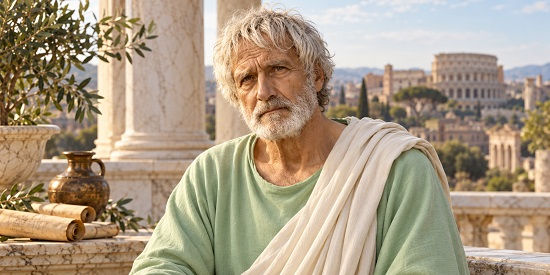
Lucius Annaeus Seneca, known to history simply as Seneca, was a Roman statesman, playwright, and Stoic philosopher, born in Spain around 4 BC and dead by the emperor Nero's order in 65 AD. His life reads like several lives stacked together: senator, exile, tutor and chief advisor to an emperor, one of the richest men in Rome, and finally a condemned man who turned his own forced suicide into a philosophy lesson. No other Stoic lived so close to power, and none left so much writing behind.
His lifelong question was whether philosophy can actually steady a person inside a real life of pressure, loss, and temptation, rather than only in the quiet of a study. His answer was practical to the bone: philosophy is medicine for the soul.
The Life of Seneca
Seneca was born in Corduba, in Roman Spain, into a wealthy equestrian family; his father, now called Seneca the Elder, was a famous teacher of rhetoric. Brought to Rome as a child, he suffered all his life from severe asthma and weak lungs, spent years recovering in Egypt, and later wrote that only the thought of his father's grief had kept him from suicide in his worst stretches of illness. His frail body turned out to be a strange shield: when his oratory in the Senate enraged the emperor Caligula, the story goes that Caligula spared him only because Seneca looked certain to die soon anyway.
The next emperor got him differently. In 41 AD, Claudius banished Seneca to Corsica on a charge of adultery with the emperor's niece, an accusation pushed by the empress Messalina and widely considered political. He spent eight years on the island, writing, grieving, and at one low point flattering the court for a recall in a work admirers wish he hadn't written. The recall came in 49 through Agrippina, Claudius's new wife, who wanted a famous name to tutor her twelve-year-old son. The boy was Nero.
When Nero took the throne in 54, Seneca and the praetorian commander Burrus effectively guided the empire, and the first five years were remembered as some of the best government Rome ever had. The arrangement rotted from the top. Nero murdered his own mother in 59, and Seneca, horribly compromised, helped write the letter justifying it to the Senate. Meanwhile his fortune swelled to a scale that made "the philosopher" a punchline to his enemies, some three hundred million sesterces, with critics asking by what wisdom a preacher of simplicity acquired golden tables and vast estates. Seneca answered the charge in writing: the wise man does not love wealth but prefers it, owns it without being owned, and can watch it leave without flinching. In 62, with Burrus dead and Nero sliding into monstrosity, he tried to retire and hand the money back; Nero refused the gesture, and Seneca withdrew into study anyway. Three years later, accused of complicity in a conspiracy against Nero on thin evidence, he received the order to die. The historian Tacitus left the famous account: Seneca calm among weeping friends, chiding them for forgetting their philosophy, opening his veins, and when the blood ran too slowly from his aged body, taking hemlock and finally suffocating in a steam bath, dictating to secretaries nearly to the end. His wife Paulina tried to die with him; Nero ordered her saved. It was the death of Socrates, consciously restaged, and Seneca knew it.
The Letters and the Essays: Philosophy as Medicine
Before his ideas, a word about the form he gave them, because the form is half the teaching. Seneca did not write systematic treatises for scholars. He wrote to people: essays addressed to a friend drowning in busyness, to his own mother in distress, to his hot-tempered brother, and above all the 124 Letters to Lucilius, composed in his final years for a younger friend and designed to be overheard by posterity. Each letter takes an ordinary occasion, a noisy apartment over a bathhouse, a bout of illness, news of someone's death, and draws the philosophy out of it.
He called this work healing and meant the comparison seriously. Precepts must be repeated, he taught, the way medicine is taken in doses; a letter should leave one usable thought lodged in the mind for the day. And he wrote as a fellow patient rather than a cured man, confessing his own fear, greed, and backsliding on the way to advising against them. That honest, quotable, wound-level voice is why his prose became the most read of all Stoic writing, and every idea below arrives in it.
The Great Ideas of Seneca
Five teachings carry his reputation, and each one is a treatment aimed at a specific human ailment.
Life is long enough, if you know how to use it. His essay On the Shortness of Life opens with a reversal that still stings: people complain that life is short, but life is long, and we make it short by wasting it. He watched Romans guard their money ferociously while letting anyone plunder their time, the one possession that can never be replaced, and he reserved special pity for the "preoccupied," people so buried in busyness, ambition, and other men's errands that they postpone living to a retirement that never truly arrives. Existing is not the same as living, he insisted, and a gray head is no proof of a long life; some people have merely been here a long time. His remedy is ownership: treat each day as a complete life, audit where the hours actually go, and stop paying out the only currency that matters to every claimant who asks.
We suffer more in imagination than in reality. Seneca diagnosed anticipation as the great manufacturer of misery. Most of what torments a person, he wrote to Lucilius, is fear of things that never happen; we are wrecked in advance by rumors, projections, and worst cases, suffering the disaster twice when it comes and once when it doesn't. His counsel was to interrogate fear like a bad witness: ask what the evidence is, notice how often dreaded futures dissolve, and refuse to be miserable before misery is actually required, since the future's troubles will introduce themselves soon enough without a rehearsal of dread.
Premeditatio malorum, the premeditation of evils. This sounds like a contradiction of the last idea, and the difference is the whole technique. Anxious imagination is involuntary, swarming, and treats every fear as a certainty; premeditation is a deliberate, calm exercise in which a person briefly pictures loss, exile, poverty, illness, or death ahead of time, precisely so those events arrive as acquaintances rather than ambushes. Nothing hits harder than the unexpected, Seneca observed.The practiced mind has already said "I knew this could happen," and keeps its footing. It is the Stoic fire drill: a few minutes of controlled smoke so the real alarm finds nobody panicking.
Anger is temporary madness. His treatise On Anger is the ancient world's most complete anatomy of rage, and his verdict is total: anger is a brief insanity, ugly in the face and disastrous in act, and the common claim that it is useful, that it fuels soldiers or motivates justice, gets it backwards, since everything anger does, firmness does better and with aim. Because anger follows a judgment, "I have been wronged and must repay it," it can be intercepted, and his first remedy is simply delay, denying the flash its immediate obedience until it cools. His maintenance practice has outlived the treatise: each night, he tells us, he reviewed his own day before sleep, asking what fault he cured and where he went wrong, a nightly court in which he was both defendant and judge, and he credits it with making his temper gentler year by year.
The consolations. Seneca built much of his reputation on letters to the grieving, and his approach balances two refusals. He refuses to ban grief, breaking with harder Stoics by granting that tears at a loss are natural and that some sorrow is owed; and he refuses to let grief become a residence, arguing that mourning without end honors nobody and that the dead are better celebrated than bled for. His consolation to Marcia, a mother three years deep in mourning her son, gently relocates the loss inside nature's terms: everything we love is lent, not given, and gratitude for the loan outlasts the return. The strangest and most moving of these letters went to his own mother, Helvia, written from his exile on Corsica to console her for losing him, the banished man comforting the bereaved from inside the catastrophe itself.
The Afterlife of Seneca, and the Argument About Him
Seneca enjoyed a survival no early Stoic got: his works came down the centuries in bulk, letters, essays, and a shelf of blood-soaked tragedies, making him for most of Western history the Stoic, the main channel through which the school's ideas flowed. Early Christians embraced him so warmly that Tertullian called him "our Seneca," and someone eventually forged an entire correspondence between Seneca and the apostle Paul, fourteen letters that medieval readers took as genuine. His tragedies taught Shakespeare's generation how to write revenge and horror for the stage, and his personal, confiding prose became a template for the modern essay; Montaigne kept him closer than any other ancient.
The argument about the man never closed, and it is part of his legacy too. From antiquity onward, critics have pressed the gap between the preaching and the portfolio. His defenders answer with his own distinction between praising virtue and claiming it. Two thousand years later readers still split over whether Seneca was a hypocrite, a realist, or simply the most honest record we have of how hard the practice is, and the split is precisely why he stays read: he is the Stoic who looks most like an actual human being.
Want to Learn More About Seneca?
Everything IFS Academy offers a Free Seneca Course, written specifically for everyday people, that teaches everything on this page in full depth, one lesson at a time.
Disclaimer: Everything IFS Academy is an independent educational platform and is not affiliated with, endorsed by, or connected to the IFS Institute or any Stoic school, classical scholar, university, or philosophical organization. This guide is offered for educational and self-reflection purposes only. It does not constitute therapy, mental health treatment, or professional advice. Only a qualified professional who knows your situation can diagnose, treat, or advise you.


Comments