IFS and Shamanic or Indigenous Metaphysics
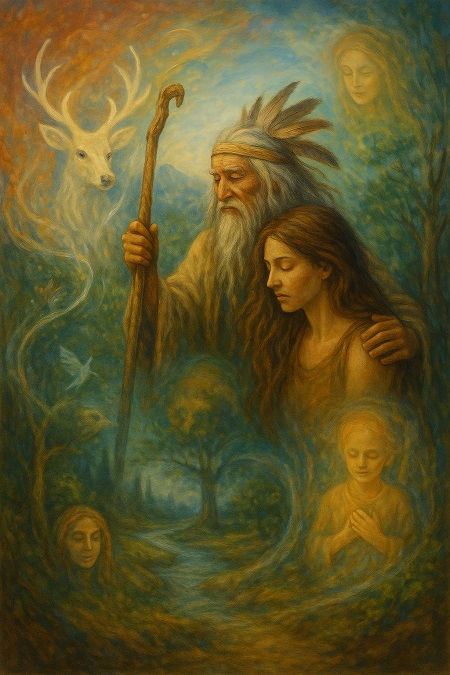
Long before psychology existed, shamans understood the psyche as a living landscape filled with many voices, spirits, and stories. Their role was to restore harmony between them, within a person, a tribe, and the natural world.
Internal Family Systems (IFS), though born in the language of therapy, carries that same rhythm: a healer walking through inner terrain, listening to the lost, the wounded, and the wise.
The Ancient Map of the Soul
In Indigenous and shamanic worldviews, illness is often seen as disconnection. A trauma, a fright, or deep grief can cause parts of the soul to scatter, what many traditions call soul loss.
Healing is the art of retrieval: bringing those missing parts home.
Shamans journey into non-ordinary reality, often guided by spirits or animal allies, to find and return what was lost. The health of the individual is inseparable from the health of the community, the ancestors, and the land.
IFS mirrors this sacred logic in modern form. When a person suffers trauma, parts of their inner system exile themselves to protect the whole. The work of IFS, finding, witnessing, and welcoming these exiles, is a kind of psychological soul retrieval.
The Self, like a gentle shaman, enters the inner world not to dominate but to restore relationship.
Soul Retrieval and Unburdening
In shamanic ceremony, a retrieved soul part often carries the energy of pain or fear it endured. The healer helps release those burdens before reintegration.
IFS follows the same sequence: once an exiled part is found, it’s invited to release its burdens—
memories,
emotions,
beliefs
back to the elements:
fire,
water,
air, or
light.
Clients often describe this as seeing energy lift away or transform. Though the therapist doesn’t label it “spirit work,” the parallel is unmistakable.
Guides, Ancestors, and the Living World
Traditional healers never work alone. They call upon guides, ancestors, and nature spirits for help.
In IFS, similar presences sometimes arise spontaneously. A client may feel a grandmother’s hand on their shoulder, see a protective animal, or sense a presence of light guiding the process. Rather than pathologizing these experiences, IFS treats them as inner resources, symbols of wisdom or grace emerging through the Self.
The land itself can become part of the healing dialogue. Some IFS practitioners invite clients to imagine a forest, river, or mountain witnessing their unburdening. The natural world, in both shamanic and IFS cosmology, is not passive background, it’s an active ally in the return to wholeness.
Timeless Principles, Modern Language
At its heart, both shamanism and IFS share three sacred principles:
All parts are sacred. No spirit or inner voice is evil in essence; it carries pain, fear, or protection.
Healing is relational. Nothing heals in isolation; everything mends through connection, with Self, community, or creation.
Wholeness already exists. The role of healer or therapist is not to create health but to reveal the harmony already hidden beneath the wound.
Modern IFS therapy reclaims these ancient truths in a form accessible to contemporary minds.
Where a shaman once traveled through dream and drumbeat, the Self now journeys through awareness and compassion.
Both paths end in the same place: the soul restored to its natural belonging.
Why the Integration Matters
For spiritually inclined practitioners, integrating IFS with shamanic principles bridges science and spirit without losing respect for either.
It gives ancient wisdom a language modern people can trust, and
gives modern therapy a soul it sometimes forgets.
Clients who might shy away from formal religion often rediscover reverence through this work, feeling their inner healing connected to earth, lineage, and unseen guidance.
IFS, when understood this way, is not just psychotherapy. It is a continuation of humanity’s oldest vocation: the tending of souls.
It honors what Indigenous teachers have always known,
that the human spirit can fracture,
that love can call it home, and
that the world itself participates in our healing when we remember how to listen.



Comments