🧿 Module 5 — Apotropaic Objects and Symbols | Folk Protection
Updated: Sep 8
🧿 Module 5 — Apotropaic Objects and Symbols
The Guards That Do Not Sleep
Some protections work because they are handled. Others work because they are there.
The last lesson armed the crossings with workings that get done: lines laid, washes scrubbed, words spoken. This lesson teaches the other half of the household defense, the enduring presences whose job is to stand watch whether anyone is paying attention or not. The word met at the very start of this course, apotropaic, the turn-away power, describes exactly these: objects, marks, and figures made to avert harm by existing in the right form. The instinct behind them is ancient and very practical. Human beings are not always alert. People sleep, leave the house, fall ill, get distracted, overworked, and heartbroken, and a protection that depends entirely on conscious effort has limits. Folk tradition answered with guardians that need no tending to keep working: the mark carved into a beam, the charm hanging in place year after year, the face set to glare outward. These are magical technologies of enduring refusal.
One distinction keeps this lesson clean. A standing guard is not a ward. A ward, taught properly later in this course, is a boundary actively set and maintained around a whole space. A standing guard is a sentinel: it occupies one point in the household world and radiates a standing instruction, not here. The horseshoe hung in the threshold lesson was the first sentinel this course installed. This lesson fills out its company, and by the end of it two more guards will exist, made by hand: a drawn mark older than most nations, and the rowan cross this course has been promising.
The Marked House
Begin with the marks, because they are the oldest and the most democratic: protections simple enough for any ordinary hand to make, which is part of what gave them their authority. Across Europe and everywhere Europeans carried their customs, people scored protective forms into beams, lintels, window frames, hearths, furniture, and even bed frames, and researchers keep finding them exactly where the last lesson taught that vulnerability lives: at the doorways, the windows, and the fireplaces, the drafty crossing points of the house.
A note on names, since the reading public meets these under a confusing label. Historians and building surveyors commonly call them witch marks, meaning marks made AGAINST witches and harmful forces, protection for the household, never a witch’s own signature. The same phrase got used in the trial era for supposed marks on an accused person’s body, which is an entirely different and darker subject, so this course keeps to the clearer term: apotropaic marks, or simply protective marks.
The daisy wheel
The most common protective mark in the whole historical record is a six-petaled flower drawn with a compass, called the daisy wheel or hexafoil. Its geometry is the message. The design is one continuous tangle of perfect arcs, and the old logic held that a malicious force meeting a line must follow it, so an endless looping figure catches, tangles, and traps what approaches before it can enter. A second reading, just as old, sees the wheel as a small sun, set to dispel darkness. The mark appears on English buildings from the early medieval period into the nineteenth century, singly and in linked chains, grand houses and humble cottages alike.
And here the honest history, because this course tells it every time: the purpose of hexafoils is genuinely disputed. Compass-drawn flowers also appear in geometry manuals, and some scholars suggest a portion of surviving examples were nothing more than apprentices practicing their compass work. The protective reading remains the most widely accepted, and the marks’ stubborn habit of clustering at doorways, hearths, and bed frames argues for it, but a tradition confident in itself can afford to say what is known and what is guessed. This one can.
The Marian marks
Beside the wheels, the second great family of marks is devotional: overlapping letters, most famously a doubled V scratched into beam or stone. The interlocked VV is read as Virgo Virginum, Virgin of Virgins, an appeal to the Virgin Mary to stand protector over the spot, and M marks served the same call. Here is folk Christianity doing exactly what this course described at the start: prayer and protective craft braided into one gesture, cut into the fabric of the house by churchgoing hands.
The burn marks
Strangest of all, the taper burns: teardrop-shaped scorch marks found deliberately burned into beams and mantels, made by holding a candle flame against the wood. The favored reading is protection by inoculation, a controlled touch of fire given to the house so that wild fire, and the forces blamed for it, would pass it by. The custom is noted here for recognition rather than practice, since this course does not teach holding flames to structural timber, and the old households’ fire discipline is the part of their craft most worth inheriting.
The Skill: Drawing the Daisy Wheel
Now the oldest mark gets made by the newest hands. The daisy wheel asks for no artistry at all, only a compass, which is its secret: the tool does the perfection, and the maker supplies the intention, exactly as it worked four hundred years ago.
Needed: a drawing compass from any school-supply aisle, a pencil, and a surface. Where no compass can be found, a pencil tied to a short length of thread held at center serves the way it served before compasses were cheap.
1. Draw a circle. Any size; old examples run from a coin’s width to a dinner plate’s.
2. Keep the compass at the exact same radius. Set its point anywhere on the circle’s rim and draw an arc across the inside of the circle, rim to rim.
3. Move the compass point to the spot where that arc meets the rim, and draw the next arc the same way.
4. Continue around the circle. The sixth arc closes the figure, and the six petals of the flower appear, meeting perfectly at the center, every time, like a small proof that order holds.
5. Set it working with a word as the last arc closes, offered until better ones arrive: “Turn and tangle, catch and keep. Nothing harmful passes here.”
Placement follows the historical record, and the record is a gift to renters: these marks were mostly small, subtle, and tucked at the vulnerable points rather than displayed. A penciled wheel inside a cupboard door, on the underside of a windowsill, behind a headboard, or inside a closet by the main door repeats the old custom exactly. A wheel drawn on paper serves fully too, tucked flat on the ledge above a door frame or folded into a drawer that holds precious things. Households with wood to spare can draw or carve the wheel on a small board and hang it by the entry as an open guard. Hidden or shown, the mark keeps the same watch it has kept for centuries.
The Hex Sign Question
One famous cousin of the compass marks deserves its own section, credited to the people who make it: the painted stars and rosettes of the Pennsylvania Dutch, the German-descended communities of southeastern Pennsylvania, whose great round barn signs are among the most recognizable folk symbols in America. Their vocabulary is a folk art in full: the distelfink, the goldfinch of happiness and good luck; the rosette, tied to protection and a smooth-unfolding life; the great stars marking order and blessing over barn and household. Outsiders named them hex signs in the early twentieth century, and the name stuck to a controversy that never left.
Because here is the honest teaching: the Pennsylvania Dutch themselves have never given one answer about what the signs do. Ask within the community across the last century and two replies come back. Some held the signs carry real blessing and protection, in the old braided folk-faith way. Many others insisted, in the community’s own famous phrase, that the stars are “chust for nice,” just decoration, and bristled at outsiders romanticizing their barns into spellbooks. Scholars have argued both sides ever since. This course takes no vote in another community’s question; it reports the disagreement honestly, admires the signs as their makers’ own, and draws the transferable lesson, which is real: a symbol repeated across generations gathers weight, whichever answer its keepers give, and the line between beauty and blessing in folk life was never drawn sharply in the first place.
The Rowan Cross
Now the debt comes due. The materials lesson introduced rowan, the great defender, and quoted the old Scottish rhyme about rowan and red thread putting witches to flight. The charm that rhyme describes is the equal-armed rowan cross, one of the most beloved protective objects of Scottish, Irish, and northern English tradition, hung above doors, over beds, in byres and barns, and pinned inside coats. Households renewed theirs at the turning points of the year, at the spring and fall festivals when the old calendar held the boundary between worlds thin. It costs nothing, takes ten minutes, and making one connects a modern hand to an unbroken line of hands.
Needed: two rowan twigs of roughly a finger’s length, gathered fallen with the manners taught in the materials lesson, and a length of red thread from the Protection Cupboard. Where rowan does not grow, the Poverty Rule stands: the local guardian tree gives its twigs with equal honor.
1. Trim the two twigs to matching length, snapping or cutting them clean.
2. Lay one across the other at their midpoints to form an equal-armed cross, the four arms even, the shape older than any one faith that used it.
3. Bind the crossing with the red thread: diagonally one way several turns, then diagonally the other, so the thread makes an X over the joint and the twigs cannot shift. Bind snugly, and finish with a firm double knot.
4. Leave a loop of thread if it will hang, and speak it to its work as the knot closes. The traditional rhyme serves perfectly, or plain words in its spirit: “Rowan and red thread, stand for this house. Turn away all that means it harm.”
5. Post the guard: above a door on the inside, over a bed, at a window that faces the street, or wherever the Defense Map shows a thin place wanting a watcher. Tucked or displayed, it serves either way.
Renewal belongs to the making. When a cross grows brittle or a year turns, the old custom builds a fresh one and lets the retired guard leave respectfully, returned to the ground outside or given to a fire with thanks. A guard is never simply thrown out with the peelings; the household that honors its retired protectors teaches every new one what kind of house it serves.
The Concealed Guards
Some standing guards were never meant to be seen at all. The renovation discoveries this course opened with, the objects sealed into the fabric of old houses, cluster into recognizable customs, and the strangest and best documented is the concealed shoe. Researchers have catalogued these finds in the thousands: single, well-worn shoes, very often a child’s, tucked up chimney breasts, under floors, and into walls near openings. Practically nothing was written down at the time; the custom passed hand to hand below the notice of anyone with ink. The favored readings hold that a worn shoe, shaped by its wearer, served as a decoy or stand-in, a piece of the person set to guard the vulnerable gap, and that its very ordinariness was the disguise.
Two teachings come out of the shoes. The first is etiquette: a household that uncovers a concealed object during renovation has inherited a guard, not found junk, and many finders today photograph it, record it, and return it to its hiding place, which is precisely what this course would advise. The second is adaptation, because no one should open a wall to continue a custom. The modern heir to concealment is the household bundle: a small cloth-wrapped parcel, a pinch of salt, an iron nail, a sprig of rosemary, a slip of paper naming the household, tied with red thread and placed in the house’s deep quiet places, the back of the highest closet shelf, the attic corner, the underside of a bottom drawer. Hidden guards for the hidden zones, in the full spirit of the shoes, with the drywall intact.
The Fierce Guards
Then there are the guardians nobody calls pretty: grotesques, gargoyles, glaring masks, and monstrous faces set at boundaries and mounted on buildings, belonging to one of the oldest apotropaic instincts of all: meet terror with terror. A hideous face at an entrance was never there to comfort the homeowner. It interrupts approach, startles, and announces that this boundary is defended by something more confrontational than charm. Folk magic is far less sentimental than modern spiritual branding suggests, and sometimes the proper guardian is ugly on purpose. Even after later architecture made such figures ornamental, the older current stayed underneath: the face looking outward is part of the house’s defense system.
The modern application is cheerfully available. A cast-stone grotesque by the step, a fierce old door knocker, a gargoyle on the porch rail: garden centers sell the descendants of cathedral guardians for the price of lunch, and a household that sets one facing the road with a word of welcome-to-the-post is practicing this current straight. The only rule is the old one: the fierce guard faces OUTWARD, toward what approaches, never inward at the family it keeps.
The Written Guards
Last of the families: the marks that are also words. Writing does something raw material does not; it names, fixes, commands, or dedicates, and the act of marking turns a surface into a statement. A blank lintel is structure, and a marked one is claimed. Crosses have done this work in Christian and folk-Christian households for centuries. The five-pointed star carried a long and serious protective history in the same role, its enclosed, balanced geometry read as order asserted against disorder, long before later cultural anxieties colored its reception. Runic inscription belongs to this family too, and gets treated here with the care it deserves: a genuine tradition in which symbol, speech, and intention joined on a surface, and one deep enough to merit its own dedicated study rather than a borrowed alphabet’s worth of internet aesthetic. For this course’s purposes, the daisy wheel already taught IS a written guard, in the oldest script of all: geometry.
The Guards Ahead
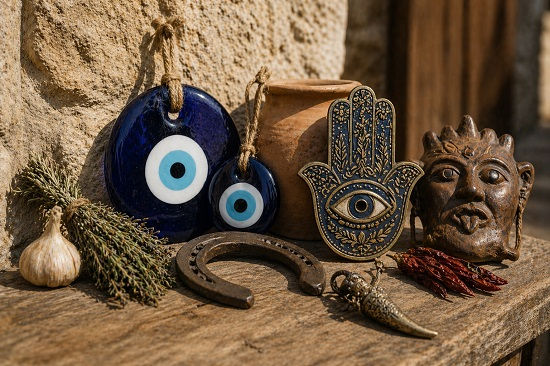
Three famous names are missing from this lesson on purpose, and saying so keeps the map honest. The blue glass eye and the raised hand, the nazar and the hamsa, are the great guards of the gaze, and they belong body and soul to the next lesson, where the evil eye gets its full teaching and those two charms get theirs. The hagstone, the naturally holed pebble that folk Britain prized as a found guard, travels with its keeper and waits in the lesson on carried protection. And the horseshoe, most famous sentinel of all, already hangs; it was taught at the threshold, where it works. A course that never repeats itself can still wave at its neighbors through the window.
Questions That Come Up
⦁ Do the marks have to be visible to work? The historical record answers plainly: most were small, tucked, and hidden, inside cupboards, under sills, behind furniture. Hidden was the tradition’s favorite setting, which makes this the most renter-friendly and skeptic-proof craft in the entire course.
⦁ What about using a Marian mark without the faith behind it? The old marks worked as invocations, and an invocation borrowed without belief is just handwriting. Households outside that devotion have the daisy wheel, which asks for no theology at all, and households inside it have a mark their great-grandmothers would recognize. The craft never graded anyone’s prayers; it only asked that they be real.
⦁ Is drawing on the house cheating compared to carving? Pencil, chalk, charcoal, and scratch all appear in the record; ordinary hands used whatever marked. The intention and placement carry the work. Carve where carving is welcome, draw where it is not, and lose nothing either way.
⦁ Can a household invent its own protective symbol? Traditions did exactly that, slowly, over generations, and a family mark repeated year after year begins gathering the same weight. Start with the inherited forms taught here, and if a household’s own sign grows out of its practice, record it in the Book and let the grandchildren argue about what it means.
Hearth Practice: Posting the Guards
This week the household gains its first made guardians, and the Book records their posting.
1. Draw the daisy wheel, all five steps, and post it at one hidden station: inside a cupboard, under a sill, behind a headboard, wherever the Defense Map wants a quiet watcher.
2. Build the rowan cross, or its local-tree kin, and post it at one open or private station of the household’s choosing.
3. Open a new Book page titled The Standing Guards, and give each guard its record: what it is, where it stands, the date posted, and a small sketch of it, since a drawn record of a drawn guard is exactly the kind of thing the Book exists for. Fill in each newly guarded point on the Defense Map.
4. One looking assignment to finish: spend the week noticing the standing guards already out in the world, the fierce knocker three doors down, the star on the neighbor’s barn, the eye hanging in the taqueria window, the medal on a friend’s keychain. List every sighting in the Book. The tradition is not historical; it is hanging in plain sight on every street, and a trained eye finds it everywhere.
At week’s end, three questions in the Book, in the first person:
⦁ Which of my guards did I hide, which did I show, and what does that choice say about my house?
⦁ What marks or figures did the homes of my childhood carry that I never recognized as guards?
⦁ If my household grew its own mark over the years, what might it look like?
A Home That Answers Back
What unites everything in this lesson is not style or region but mode of work. These protections remain on duty. They hold their station through moods, absences, and busy seasons, which is exactly why real folk practice loved them: life is busy, and houses need guarding anyway. The materials lesson taught the raw forces, the threshold lesson taught the crossings, and this one taught what happens when force and meaning are shaped into visible form: protection given face, symbol, and staying power.
These objects survived so long because they satisfy something ancient. People want the house to have eyes and the door to answer back, the beam to carry a sign stronger than bare wood, the boundary to look defended and not only be defended. Folk tradition understood that and built with it, and now this household builds with it too. A home should not stand mute against harm, and this one no longer does.
And the most famous standing guard on earth has been waiting politely through this whole lesson: a small blue eye, hung in millions of windows across half the world, guarding against a danger with its own ancient name. The evil eye, what it is, why whole civilizations took it seriously, and every classic defense against it, has the next lesson entirely to itself.
Disclaimer: Everything IFS Academy is an independent educational platform and is not affiliated with, endorsed by, or connected to the IFS Institute. While we strive for accuracy, errors can occur, and users are encouraged to cross-reference critical information. The courses in our Witchcraft & Folk Magic Series are offered for educational, historical, and cultural purposes only, presenting folk traditions and beliefs as they have been understood and practiced, without any claim of supernatural effect. They do not constitute therapy, mental health treatment, clinical training, or crisis support, and they should not be used as a substitute for professional mental health care. Folk protection practices are never a replacement for home security measures, medical care, legal assistance, or emergency services, and any practice involving candles, burning herbs, sharp objects, or buried containers should be carried out with ordinary physical safety in mind.
Crisis Support: 🚨 If you are experiencing a mental health crisis, feel unsafe, feel at risk of harming yourself or someone else, or feel too overwhelmed to safely use self-directed practices, please pause this material and reach out for immediate support. Contact a licensed mental health professional, call or text 988 in the U.S. or Canada, or use your local emergency or crisis resources.


Comments