🧿 Module 5 — Why the Pendulum Moves | Pendulums Course
Updated: 3 days ago
Free Course by Everything IFS Academy
Help us reach the people who may need this most by sharing this free course with friends, family, colleagues, online communities, social media or on your own website.
🎧 Audio - listen on the go (coming soon)
Module 5 — Why the Pendulum Moves
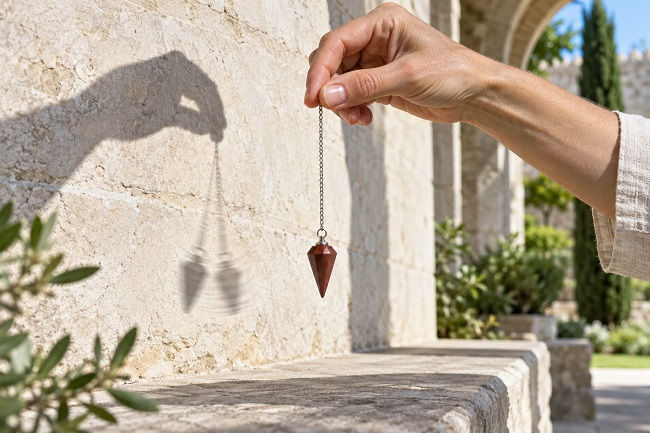
There is an experiment so simple it barely deserves the name, and it has been startling people for two centuries. Hold a pendulum still over a table. Do not move the hand, do not swing the bob, do nothing at all except think, steadily and vividly, the word circle. For a great many people, within a minute, the pendulum begins, unmistakably, to circle. Think line, and in time it straightens into a line. The hand never seems to move. The sensation, almost universally reported, is that the movement comes from somewhere else.
That one strange fact is the doorway to the most argued-over question in the entire dowsing world, the question every newcomer asks first and the one this lesson exists to answer in full: what is moving the bob? The tradition has its answers, science has its answer, and here is the genuinely surprising thing this lesson builds toward: both sides find that little experiment equally wonderful, and a large part of the modern pendulum world has made peace with the laboratory in a way almost no other divination tradition has. Both truths get told whole here, side by side, with neither sneered at and neither sold.
What the Tradition Says
Across its history the tradition has given three great accounts of the moving bob, and most practitioners alive today hold some blend of them.
The Radiesthesia Frame. The classic working theory of the European dowsing world: everything, in this telling, gives off subtle rays or emanations, water under a field, a vein of ore, a substance in a sample, even a person, and certain people are sensitive to them. The dowser's body is the receiver; the pendulum is merely the needle on the dial, an amplifier that makes a faint bodily reception visible as motion. The frame's very name says it, ray-perception, the word Abbé Bouly coined for the practice, and it was Abbé Mermet who systematized it most completely, both figures taught in full in The Origins of Pendulum Divination. The radiesthesia frame is the tradition at its most scientific in spirit: it proposes a physical signal, a physical receiver, and an instrument, and its literature is full of measurements, serial numbers, and rates precisely because it understands itself as an undiscovered physics rather than a mystery.
The Spirit and Higher-Self Frame. The older and, in some communities, the still-living account: the answer comes from an intelligence. In its religious and spiritualist forms, the mover is a guide, an angel, an ancestor, or spirit broadly; in its more inward modern forms, it is the higher self, a wiser layer of one's own being that knows what the everyday mind does not. The pendulum, in this frame, is not a needle but a telephone. This account explains features of the practice the radiesthesia frame handles awkwardly, above all why dowsers ask permission before asking questions and why some questions are traditionally refused, customs taught in full in The Craft of the Question. If the swing is a conversation with someone, then courtesy, consent, and boundaries follow naturally.
The Subconscious Frame. The youngest of the three and the great modern bridge: the mover is one's own deeper mind. In this telling, a person knows far more than they can consciously reach, half-noticed observations, buried memories, feelings not yet admitted, and the pendulum gives that silent layer a way to speak. The answer is real and the source is genuinely other than the everyday self, the frame holds, but the other is within. Practitioners who teach this account often describe the pendulum as a printout of the gut. Why this frame matters so much becomes clear in a moment, because it is the place where the tradition and the laboratory shake hands.
What Science Says: The Ideomotor Effect
Science's answer has a name, a date, and three of the most elegant experiments of the nineteenth century behind it. The answer is called the ideomotor effect, and glossed plainly it means this: ideas can move muscles by themselves, below awareness. Vividly imagining a movement, or expecting one, produces real, tiny muscular activity in that direction, entirely without the feeling of doing anything. The mover of the bob, in this account, is the hand that holds it, and the person attached to the hand is telling the truth when they swear they did nothing, because the doing happened beneath the floor of awareness.
Three names carry the story:
Michel Eugène Chevreul and the blindfold. The celebrated French chemist, whose place in the pendulum's history is taught in The Origins of Pendulum Divination, met the "exploring pendulum" fad of the 1830s, in which a bob was said to swing differently over different substances, and decided to take it apart variable by variable. The swing over a dish of mercury was real; he saw it himself, hanging from his own hand. Then he began removing things. When he rested his arm on a support, the swing weakened. The more completely the arm was supported, the weaker it became. When a glass plate was placed between bob and mercury, the swing faded, strange behavior for a physical emanation, but expected behavior for a belief, since the fad held that glass blocked the influence. So Chevreul ran the decisive version: an assistant added or removed the glass plate while Chevreul could not see, and the pendulum, which had answered so fluently when he knew, fell silent. The swing had been following his expectation all along. His own summary became one of psychology's famous sentences, that so long as he believed the movement possible it took place, and once he discovered the cause he could not reproduce it.
William Benjamin Carpenter and the name. In 1852 the English physiologist gathered the pendulum, the divining rod, and the spiritualist table under a single explanation and christened it: ideomotor action, idea-driven movement independent of the will. Carpenter's framing carried a courtesy the debate has needed ever since, because he never accused the practitioners of fraud and never denied that the movements were real. The movements are real, he argued, and the people are honest; what is mistaken is only the belief that the mover is outside them.
Michael Faraday and the table. A year later, with the table-turning craze sweeping Victorian parlors, the greatest experimentalist of the age built a beautifully simple apparatus: layered boards on rollers placed between the sitters' hands and the tabletop, with an indicator that revealed which moved first. If spirits moved the table, the table would lead and the hands would follow. The indicator showed the opposite, every time. The hands led. The sitters, perfectly sincere, were pushing the table they believed was pulling them.
How a Few Millimeters Become a Swing
One honest objection deserves its own answer: the hand truly does not seem to move, and a wide, confident swing of the bob looks like far too much motion to come from nothing. The resolution is the pendulum itself. A weight on a string is a resonant system with a natural rhythm, and tiny pushes delivered in time with that rhythm accumulate, exactly the way small, well-timed pumps send a playground swing higher and higher. Movements of the fingers and wrist measured in fractions of a millimeter, far below what the mover can feel, are all a pendulum needs, and a few seconds of them build into motion that looks, at the end of the chain, emphatic and alive. The instrument that makes the silent signal visible is, in both the tradition's account and science's, an amplifier. The two accounts disagree only about what is being amplified.
Where the Two Truths Meet
Here is where the pendulum's story takes the turn that makes it nearly unique among divination systems. When the ideomotor explanation reached most traditions' doorsteps, it was treated as an attack. In a striking portion of the modern pendulum world, it was treated as an explanation, and welcomed in.
The reasoning runs like this, and it can be found across contemporary pendulum teaching: if the ideomotor effect is real, then the pendulum is moved by the deeper mind, and the deeper mind is exactly who the practitioner wanted to talk to. The bob becomes the subconscious made visible, a way of asking the silent, observant, feeling part of oneself a clear question and watching it answer in motion. On this reading, Chevreul did not debunk the pendulum; he identified the correspondent. The subconscious frame of the tradition and the ideomotor account of the laboratory turn out to be very nearly the same sentence spoken in two vocabularies, and many working dowsers today will say so cheerfully and keep dowsing.
Honesty requires the rest of the record, and it can be stated plainly and without a sneer. The reconciliation covers questions about what the asker's own mind could know, feelings, preferences, half-noticed impressions. It does not cover the claim that a pendulum can locate hidden physical targets that no one's mind has information about, water behind a screen, an object in a sealed box, a substance under a randomized cup. That claim has been put to controlled tests many times across many decades, and under conditions where ordinary cues and chance are accounted for, dowsing has not demonstrated success beyond what guessing produces. The radiesthesia frame's proposed rays have likewise never been detected by instruments. The tradition's literature contests these results and keeps its case files of remarkable successes; the testing record stands as it stands. A learner deserves both facts in the same paragraph, because both are true: the laboratory has not found the rays, and the laboratory's own explanation gave a large part of the tradition a new and durable self-understanding.
Why the Mechanism Question Shapes Everything Downstream
The reason this lesson sits at the center of the course is that each answer to the mechanism question quietly rewrites the rest of the craft, above all the asking. In the radiesthesia frame, a question is a tuning, and precision matters because the receiver must be pointed exactly. In the spirit frame, a question is addressed to someone, and respect, permission, and refusal become the heart of the practice. In the subconscious frame, a question is only answerable if the asker's own deeper mind could know the answer, which redraws the entire map of what is worth asking and quietly explains why the tradition's elders steer practitioners away from lottery numbers and toward self-knowledge. Three frames, three different ideas of what an answer even is, and one shared conclusion: the craft of asking is where the mechanism question becomes practical. That craft has its own owning lesson, The Craft of the Question, and it is the natural next step from here.
Disclaimer:
Everything IFS Academy is an independent educational platform and is not affiliated with, endorsed by, or connected to the IFS Institute. While we strive for accuracy, errors can occur, and users are encouraged to cross-reference critical information. These courses present divination systems and their traditions for educational, historical, cultural, and self-reflection purposes only. They describe what these systems and their traditions teach and how their readers have traditionally interpreted them; they do not constitute fortune-telling services, predictions, religious instruction, spiritual direction, or an endorsement of any metaphysical claim, and they should never be used as a basis for medical, financial, legal, or safety decisions. They do not constitute therapy, mental health treatment, clinical training, or crisis support, and they should not be used as a substitute for professional mental health care.
Crisis Support: 🚨
If you are experiencing a mental health crisis, feel unsafe, feel at risk of harming yourself or someone else, or feel too overwhelmed to safely use self-directed practices, please pause this material and reach out for immediate support. Contact a licensed mental health professional, call or text 988 in the U.S. or Canada, or use your local emergency or crisis resources.


Comments