🃏 Module 6 — The Lovers, the Chariot, and Strength | Major Arcana Course
Updated: 2 days ago
Free Course by Everything IFS Academy | Divination Series
Help us reach the people who may need this most by sharing this free course with friends, family, colleagues, online communities, social media or on your own website.
🎧 Audio - listen on the go (coming soon)
Module 6 — The Lovers, the Chariot, and Strength
Raised by the great authorities, the traveler now faces what no authority can do on anyone's behalf. Cards VI, VII, and VIII are the journey's first real tests, and they arrive in the order life tends to send them: who to love, what to drive toward, and what to do with the animal inside. This trio is also a threshold. The Lovers and the Chariot bring the worldly line to its crest, the loud triumphs of an outer life going well, and then Strength opens the inner line with a victory so quiet most people would walk past it. This lesson teaches all three in full: the Lovers, the Chariot, and Strength.
What the Three Tests Share
The shared logic here is that each card stages a meeting of two forces, and grades the traveler on how the two are held. The Lovers holds two people, or two roads. The Chariot holds two pulling beasts. Strength holds a woman and a lion. In each picture the test is the same test at a deeper level: can what is divided be brought into one motion without crushing either half? The worldly answer is the Chariot's, by command. The inner answer is Strength's, by gentleness. And the Lovers asks the question that makes both answers necessary in the first place.
The Lovers
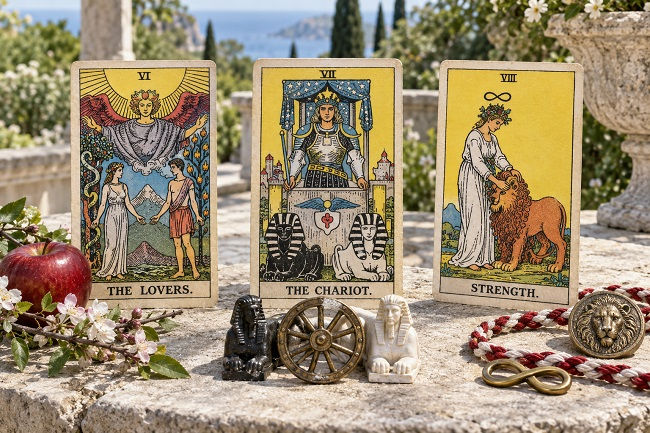
Card VI is the rare trump that is genuinely two cards wearing one name, and honest teaching gives both. In Smith's image, a great angel with flaming hair rises out of the sun, arms spread in blessing over a naked man and woman standing in a garden. Behind the woman grows a fruit tree with a serpent coiled in its branches; behind the man, a tree of twelve small flames. The echo is unmistakable and deliberate: this is Eden, the first relationship, blessed from above and shadowed by the serpent of knowing. The older Marseille pattern paints an entirely different scene: a young man standing between two women, one crowned and dignified, one younger and garlanded, while a small cupid overhead aims his arrow. Not a union at all, but a man at a crossroads, about to be decided for.
Out of those two pictures grew the card's two living traditions, and readers still carry both. The line descending from Smith's Eden reads the Lovers as union, sacred relationship, and deep alignment: the meeting that matters, love as a force that joins two lives into one story, and more broadly the harmony of values, the moment a person and their choice are finally on the same side. The line descending from the Marseille image reads the Lovers as choice itself, the fork in the road, the decision between two real goods that cannot both be kept, with desire's arrow already in the air. Neither school is a mistake; the card simply lived two lives, and the tradition kept both. Many fluent readers braid them, noting that every true union is a choice, the closing of every other door.
The choice reading lands hardest in everyday life. Picture a Devon holding two offers, two cities, two futures, and the cruel honest fact that both roads are real: good people on each, a true life down each, and no version of waiting that does not itself choose. The tradition would say Devon is standing exactly where the Marseille youth stands, and that the card's deepest teaching is that the choosing, not the chosen, is what reveals who someone is.
The Chariot
Card VII is the worldly line's victory lap. Smith shows an armored figure standing tall in a stone chariot beneath a canopy of stars, crescent moons on the shoulders, a walled city receding behind. Harnessed at the front sit two sphinxes, one black and one white, facing slightly apart as if they would happily pull in different directions. And then the detail that generations of readers have built the whole card on: there are no reins. Look as long as anyone likes; the rider's hands hold a wand, not leather. Nothing physical connects the driver to the beasts.
The tradition reads the Chariot as will, victory, drive, and determination: opposing forces held in one harness and pointed at a single destination. The missing reins are the entire teaching. The card is saying that real command of a divided team is not mechanical; the black and the white sphinx, the tradition's image for every pair of contrary pulls inside a person, ambition and fear, heart and head, are steered by focused will or they are not steered at all. The armor and the city walls behind say this victory belongs to the outer world, the conquest of circumstances, the campaign actually won: the degree finished, the company launched, the move accomplished against all friction. Readers traditionally honor this card without romanticizing it, because its triumph has a known edge. Will can hold opposites together, but it cannot make them friends, and a team held by force of will must be held every single hour. That is why the journey's map places the Chariot at the worldly line's end. It is the best the outer way can do, and the next card shows what the outer way cannot.
Strength
Card VIII answers the Chariot with the gentlest picture in the deck. A woman in a white robe, crowned and belted with flowers, bends over a great lion, her bare hands calmly closing, or perhaps calmly opening, its mouth. The lion is not subdued; its tail is not tucked; it leans into her like something that has chosen to be held. Above her head floats the infinity sign, the same unending supply that hovers over the Magician, a kinship taught in full in the closing lesson, Reading the Major Arcana as a Language. No armor anywhere. No weapon anywhere. The card wears the number 8 in this course's deck, and its other seat at 11 in the Marseille pattern, along with the whole story of the famous swap, is taught in full in the lesson on the origins of the trumps.
Readers traditionally take Strength to mean courage as gentleness, inner mastery, and patience over force, and the image argues it by everything it refuses to include. The lion is the tradition's animal inside: appetite, rage, fear, instinct, every force in a person that roars. The Chariot's answer to such forces was harness and will; Strength's answer is bare hands and time. The hands at the lion's mouth, the place of the bite and the roar, say the work is done exactly at the dangerous spot, not by avoiding it, and done so softly the lion never needs to win or lose. The ambiguity readers love, whether she closes the mouth or opens it, is itself the teaching: mastery and trust, restraint and release, turn out to be one gesture. And the infinity sign quietly promises that gentleness, unlike force, does not run out by morning.
In everyday terms, Strength is a Maya in the meeting where everything has gone wrong and every voice has gotten loud, who does not get louder. She stays soft-voiced, stays present, lets the roar pass through the room without joining it, and somehow hers is the version of the conversation everyone ends up inside. Nothing was conquered. The lion simply lay down. The tradition would say that this, not the Chariot's parade, is the journey's first inner victory, and the gate through which the deck's deeper half now opens.
The road past that gate goes quiet and steep, into the lantern, the wheel, and the scales: the lesson on the Hermit, the Wheel of Fortune, and Justice.
Disclaimer:
Everything IFS Academy is an independent educational platform and is not affiliated with, endorsed by, or connected to the IFS Institute. While we strive for accuracy, errors can occur, and users are encouraged to cross-reference critical information. These courses present divination systems and their traditions for educational, historical, cultural, and self-reflection purposes only. They describe what these systems and their traditions teach and how their readers have traditionally interpreted them; they do not constitute fortune-telling services, predictions, religious instruction, spiritual direction, or an endorsement of any metaphysical claim, and they should never be used as a basis for medical, financial, legal, or safety decisions. They do not constitute therapy, mental health treatment, clinical training, or crisis support, and they should not be used as a substitute for professional mental health care.
Crisis Support: 🚨
If you are experiencing a mental health crisis, feel unsafe, feel at risk of harming yourself or someone else, or feel too overwhelmed to safely use self-directed practices, please pause this material and reach out for immediate support. Contact a licensed mental health professional, call or text 988 in the U.S. or Canada, or use your local emergency or crisis resources.


Comments