Therapist as Taoist Leader: Healing Without ForceLeading from Self, Not Control The Taoist ideal of leadership
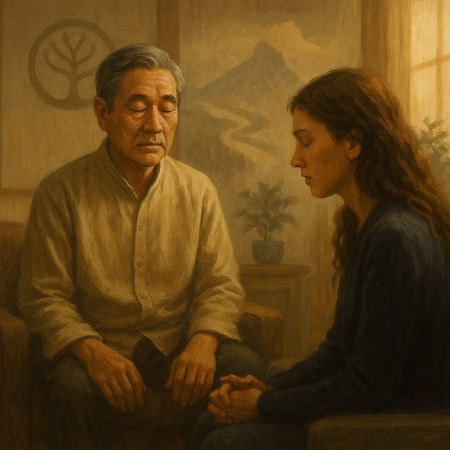
In the Tao Te Ching, leadership is not defined by dominance or charisma. Instead, the best leaders are often invisible — guiding so gently that others feel they’ve led themselves. “When the Master’s work is done, the people say, ‘We did it ourselves.’” This kind of leadership is marked by presence, trust in the process, and deep humility.
In Internal Family Systems, a Self-led therapist holds the same posture. They don’t fix the client. They don’t steer the session with a heavy hand. They follow. They listen. They trust that the client’s system knows its own pace and path, and their role is to hold the conditions where healing can naturally emerge.
This is the Tao of therapy: a leadership that empowers, not overpowers.
Leading without rushing, forcing, or rescuing
Many therapists carry parts that want to help — urgently. These parts may push for insight, rush toward breakthrough, or try to comfort a client out of their pain. While well-intentioned, this kind of intervention can create resistance in the client’s system.
The Taoist therapist learns to lead differently. They model wu wei, effortless allowing, by:
Pausing instead of prompting
Trusting silence instead of filling it
Asking questions instead of offering solutions
Respecting protectors instead of bypassing them
Letting healing unfold without rush or agenda
This doesn’t mean the therapist becomes passive. It means they become aligned, with the client’s timing, with the flow of the inner system, and with their own Self energy.
What Self-leadership feels like in the therapist seat
A therapist leading from Self is calm and unshaken. They are deeply present but not intrusive. They respond instead of react. They notice their own parts, the part that wants to prove, the part that fears failure, the part that wants to soothe too soon, and they ask those parts to step back. From there, they lead with clarity and compassion.
Therapists report that when they do this, sessions go deeper. Clients feel safer. Stuckness begins to shift without pressure. The entire atmosphere of the room changes.
This is not technique. It’s presence.
Taoist leadership in moments of activation
What happens when a client becomes dysregulated? When trauma surfaces, or a protector becomes defensive? Taoist leadership still applies, but now it becomes visible strength rather than silent presence.
The therapist holds steady. Like the Tao, they absorb rather than deflect. They don’t panic. They don’t fix. They stay close and calm, offering regulation not through intervention, but through their being.
This kind of therapeutic presence is not neutral. It’s anchoring. It sends the message: There’s nothing in you I can’t hold.
Training your inner leader as a practitioner
Practitioners interested in leading this way may need to reorient their relationship with productivity, performance, and expertise. Some ways to begin:
Check your pace: Are you trying to make something happen, or allowing it to arise?
Notice your “helper” parts: What part of you wants to solve this? Can it step back?
Practice doing less: What if your presence is enough right now?
Embody stillness: Your nervous system is part of the session. Let it model calm.
Study Taoist texts: Even brief verses from the Tao Te Ching can re-center your lens.
This isn’t just client work, it’s therapist work. It’s a discipline of trust.
Final reflection
To lead like a Taoist in therapy is to believe that healing is not something we deliver. It’s something we make room for. The therapist becomes like the valley, low, receptive, quietly powerful. The client becomes the river, finding their own path, returning to their own truth.
And when the session ends, the client walks away not thinking “my therapist changed me,” but rather, “I touched something deeper in myself.” That is the sign of a Self-led leader. And that is the Tao in motion.


Comments