🧿 Module 4 — The Language of the Swing | Pendulums Course
Updated: 3 days ago

Free Course by Everything IFS Academy
Help us reach the people who may need this most by sharing this free course with friends, family, colleagues, online communities, social media or on your own website.
🎧 Audio - listen on the go (coming soon)
Module 4 — The Language of the Swing
Every language ever spoken has thousands of words. The pendulum has perhaps six. A swing toward and away. A swing side to side. A circle one way. A circle the other. The slanted, in-between movements. And stillness. That is the entire vocabulary, and yet dowsers have carried on conversations with it for centuries, because six words are enough when every question has been shaped to fit them. The whole craft begins exactly here, with learning which movement means which, and the first surprise waiting for every newcomer is that no book can simply tell them. The pendulum's vocabulary is real, but the dictionary, as the tradition teaches it, is personal. This lesson walks the complete response language: the resting positions the conversation starts from, each of the core responses and what readers traditionally take it to signal, how the tradition teaches a new dowser to establish their own set, the extra words some schools add, and the quiet conditions of the craft that practitioners keep so the signal stays clean.
The Neutral and the Search
Every pendulum session in the tradition begins from one of two starting positions, and both are forms of quiet.
The first is the neutral position: the pendulum hanging completely still, the chain held lightly, the bob motionless in the air. This is the tradition's blank page. Old manuals and modern teachers agree on it with unusual unanimity, and the reason is plain once stated: a response only means something if it can be told apart from drift. A bob that was already wandering when the question was asked has answered nothing. Stillness first is the grammar rule underneath the whole language.
The second is the search position, used by part of the tradition rather than all of it: a gentle, deliberate to-and-fro idle that some dowsers set the bob into while a question is forming or while scanning over a map or chart. In this school's telling, the idle swing is the pendulum's engine running in neutral, ready to change direction the moment there is something to say, and a change of motion is easier to read than a start from nothing. Practitioners divide amiably on the point. Stillness dowsers find the idle swing noisy; search-swing dowsers find the dead start sluggish. Both camps agree on what matters: the conversation begins from a known, intentional state, never from accident.
The Core Responses
Here is the vocabulary itself. Each movement below is a full word in the pendulum's language, and each entry teaches what the movement looks like, what readers traditionally take it to signal, and where the famous variability comes in. One thing should be said before the list, because it governs everything in it: the assignments are conventions, not constants. The tradition's near-universal teaching is that each dowser's vocabulary is their own, discovered rather than copied, and two practitioners at the same table may have opposite words for yes. The movements are shared; the meanings are personal.
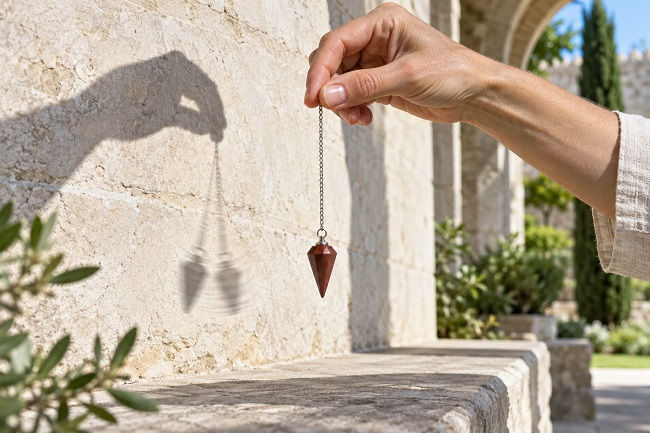
The Vertical Swing. The bob travels in a straight line toward and away from the body. In the most widespread modern convention this is yes, and teachers who use it often point to the echo of a head nodding. It is typically the crispest, most confident-looking movement a pendulum makes, which is likely why so many dowsers' personal vocabularies land here for their affirmative.
The Horizontal Swing. The straight line running side to side, left and right across the body. The same widespread convention reads it as no, the side-to-side of a head shaking. Together with the vertical swing it forms the tradition's most common yes-and-no pair, the two perpendicular lines that make the pendulum's binary heart visible.
The Clockwise Circle. The bob traces a circle running clockwise from the holder's view. Whole schools of the tradition use the circles, rather than the lines, as their primary pair, with clockwise most often assigned to yes, the affirmative, the open. In other dowsers' personal sets the clockwise circle means something else entirely, an emphatic yes, a signal of energy or activity, or simply their no. The circle is the vocabulary's most flexible word.
The Counterclockwise Circle. The mirror movement, circling against the clock. Where circles carry the binary, this is most traditionally the no, the negative, the closed. The ring-over-the-belly folk custom taught in The Origins of Pendulum Divination ran on exactly this pair in many regions, circle against line or circle against circle, with the assignments varying family to family, which makes that old kitchen-table custom a perfect miniature of the whole vocabulary's personal nature.
The Ellipse and the Diagonal. The in-between words. An ellipse is a circle squashed toward a line; a diagonal is a straight swing running at a slant between the vertical and horizontal axes. Readers traditionally take these as the pendulum's qualified answers: leaning yes, leaning no, partly, it depends, a mixed condition. An experienced dowser watching an ellipse will often say the answer is yes but something about the question is off, and will go back and sharpen the asking. The in-between movements are where the six-word language gets its shades of gray.
The Stillness or the Stutter. The bob refuses to move at all, or makes small, jerky, directionless trembles that never resolve into a real swing. The tradition reads this family of non-answers with respect rather than frustration: no answer available, the question cannot be answered as asked, not now. Some dowsers treat a dead stillness after a fair question as the most honest word in the entire vocabulary, the pendulum's way of declining to guess. What a practitioner does next with a refusal belongs to the asking craft, which has its own owning lesson in this course, The Craft of the Question.
Establishing the Responses
If the meanings are personal, how does anyone learn their own? This is the tradition's most-taught procedure, the one nearly every pendulum book opens with, commonly called programming or calibrating the pendulum. Both words are modern; the practice is older than either. It is best understood by watching it done.
Picture a Devon at his kitchen table on a quiet evening, a brass teardrop pendulum in hand, elbow resting on the wood. The tradition gives him two classic methods, and most teachers have him use both.
The first is the asking method. Devon steadies the bob into stillness and simply asks, aloud or silently, show me my yes. Then he waits, keeping his hand as quiet as he can, and watches what the pendulum does. After a long moment it drifts into a slow vertical swing. He stills it and asks again, show me my no, and this time it settles into a circle, counterclockwise. In the tradition's telling, he has not chosen these responses; he has been introduced to them. Teachers in this school often describe the moment as meeting the pendulum's voice rather than assigning it one.
The second is the known-truth method, the cross-check. Devon stills the bob and makes statements whose answers he already knows. My name is Devon. The vertical swing appears. I live in Portugal, which he does not. The counterclockwise circle. I am sitting at my kitchen table. Vertical again. Each known truth and known falsehood is a test question with an answer key, and the method's whole purpose is to confirm that the responses from the asking method hold steady under fire. When they do, the tradition considers his vocabulary established.
Two pieces of lore complete the teaching. The first is that the established set is treated as stable: once a dowser's yes and no are found, the tradition regards them as that practitioner's fixed vocabulary, the same next week and next year, with many dowsers opening each session by quickly re-confirming the pair the way a musician touches a tuning note. The second is the explanation for why sets differ from person to person at all, and here the tradition's schools answer differently depending on what they hold is moving the bob in the first place, a question this course gives its own full lesson, Why the Pendulum Moves. What every school agrees on is the practical rule that follows: a dowser learns their own language and then trusts it, and borrowing someone else's yes is regarded as the surest way to read every answer wrong.
The Extended Vocabulary
Beyond the core six, some schools of the tradition teach one or two additional established responses, and both exist to handle the situations a bare yes and no manage badly.
The first is ask again later, sometimes established as its own distinct movement and sometimes read from the stutter. In the tradition's telling, this response means the question is fair but the answer is not available yet, and the dowser should return to it another time. Practitioners who use it describe it as the pendulum's version of a pending file, and it spares them from forcing a premature yes or no onto a question that genuinely is not ripe.
The second is not permitted to answer, the boundary response. Schools that teach it hold that some questions fall outside what a dowser may properly ask, most often questions intruding on another person's private life, and that the pendulum can be given, or naturally has, a distinct movement that closes the subject. Whatever a practitioner believes about where that boundary comes from, the response's function in the craft is the same: it builds the tradition's ethics directly into the vocabulary, so that the language itself can decline. Which questions the old culture refuses, and why, is the heart of the asking craft taught in The Craft of the Question.
The Conditions Dowsers Keep
The response language comes with a working culture around it, a set of physical and mental conditions that dowsers keep the way any craft keeps its disciplines, and the tradition is strikingly consistent about them across a century of manuals.
The body's conditions come first. The elbow rests on a table or stays tucked against the ribs, so the arm is supported and only the hand is free. The grip on the chain is light, thumb and forefinger, never clenched. The body is still, the surface is steady, and the air is calm, with outdoor dowsers wise to the wind in the way sailors are. Every one of these customs serves the same end: a pendulum can only speak clearly if the hand holding it is quiet, because a noisy hand drowns the signal in scatter.
The mind's conditions matter just as much in the tradition's telling. Dowsers work calm. The literature returns constantly to a state practitioners describe as relaxed attention, interested but not gripping, and the old teachers held that agitation, urgency, and wanting a particular answer all degrade the work. A dowser who is anxious about the answer, the saying goes, has already given it. That observation sits at the border of this lesson and two others, since the wanting problem belongs to the asking craft and the deeper question of why a wanting mind matters belongs to the mechanism. Here it is enough to see the craft culture itself: stillness in the hand, quiet in the room, calm in the practitioner. The six-word language is small, and the tradition's whole discipline exists to make sure that when one of its words finally moves, nothing else in the arrangement could have spoken instead.
Disclaimer:
Everything IFS Academy is an independent educational platform and is not affiliated with, endorsed by, or connected to the IFS Institute. While we strive for accuracy, errors can occur, and users are encouraged to cross-reference critical information. These courses present divination systems and their traditions for educational, historical, cultural, and self-reflection purposes only. They describe what these systems and their traditions teach and how their readers have traditionally interpreted them; they do not constitute fortune-telling services, predictions, religious instruction, spiritual direction, or an endorsement of any metaphysical claim, and they should never be used as a basis for medical, financial, legal, or safety decisions. They do not constitute therapy, mental health treatment, clinical training, or crisis support, and they should not be used as a substitute for professional mental health care.
Crisis Support: 🚨
If you are experiencing a mental health crisis, feel unsafe, feel at risk of harming yourself or someone else, or feel too overwhelmed to safely use self-directed practices, please pause this material and reach out for immediate support. Contact a licensed mental health professional, call or text 988 in the U.S. or Canada, or use your local emergency or crisis resources.


Comments