🃏 Module 5 — The Empress, the Emperor, and the Hierophant | Major Arcana Course
Updated: 2 days ago
Free Course by Everything IFS Academy | Divination Series
Help us reach the people who may need this most by sharing this free course with friends, family, colleagues, online communities, social media or on your own website.
🎧 Audio - listen on the go (coming soon)
Module 5 — The Empress, the Emperor, and the Hierophant
After the first two teachers hand the traveler the halves of power, the road does something every life does: it runs straight into the people in charge. Cards III, IV, and V are the great authorities, the powers that raised everyone before anyone got a vote: the mother, the father, and the institution. Nobody chooses them; everybody is shaped by them; and the tradition says nobody walks the rest of the journey well without understanding what each one actually gives. This lesson teaches the establishment of the world in full: the Empress, the Emperor, and the Hierophant.
What the Three Authorities Share
The shared logic of this trio is generational. Where the Magician and the High Priestess teach the traveler's own inner capacities, these three are the outer powers that hold a young life: nature's abundance, structure's rule, and tradition's keeping. The Empress and the Emperor are read as a pair, the deck's mother and father seated on facing thrones, creation and order ruling together. And the Hierophant stands as the High Priestess's public counterpart, her secret knowing turned into spoken teaching, a mirror named here and explored in full in the closing lesson, Reading the Major Arcana as a Language. Three thrones, three inheritances, and the traveler must receive all three before outgrowing any of them.
The Empress
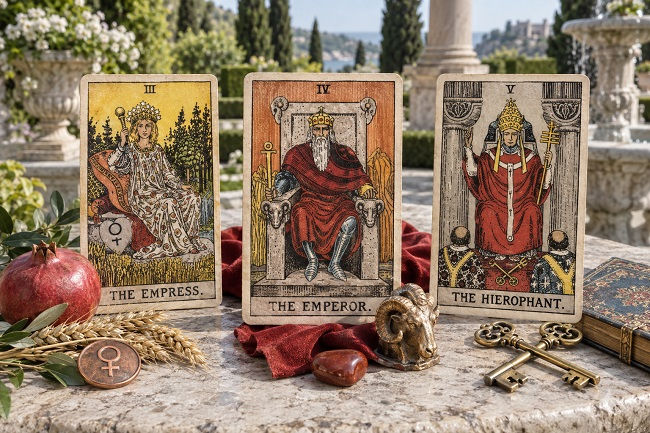
Card III is the most alive image in the deck. Smith paints a crowned woman at deep ease on a cushioned seat in the middle of a garden in full production: a field of wheat ripens at her feet, a river pours through the trees behind her, and everything in the frame is growing. She wears a loose gown patterned with pomegranates and a crown of twelve stars, and leaning against her seat is a heart-shaped shield bearing the symbol of Venus, the old sign of love itself. Nothing about her is rushing. Abundance, the picture says, does not hurry.
Readers traditionally take the Empress to mean fertility, abundance, creation, and nurture, the card of things growing because the conditions for growth are being lovingly held. The imagery earns it everywhere: the wheat is provision, the river is unstoppable flow, the Venus shield says her power is love rather than force, and the sheer comfort of her posture teaches the card's most overlooked meaning, the body and the senses as good things, pleasure and rest as part of creation rather than the enemy of it. The tradition reads her as the great mother in the widest sense: not only literal motherhood, but every form of bringing something to life and feeding it until it can stand, a garden, a business, a family, a book. Her echo of the High Priestess's pomegranates, the hidden made fruitful, is a thread fluent readers love, taught in full in the closing lesson.
In everyday terms, she is a Sam in that rare season when everything planted comes up at once: the garden actually grows, the side project finds its customers, the household hums, the body feels like a friend again. Nothing in that season is forced, and that is the Empress's signature. The tradition would say Sam is not making it happen so much as keeping the conditions generous and letting life do what life does.
The Emperor
Turn the card and the garden ends. Card IV seats a stern, bearded ruler on a massive throne of bare stone, carved at its corners with the heads of rams, in a landscape of red and barren mountains where nothing grows at all. He holds the symbols of rule, and the telling detail hides at his shins: beneath the imperial robe, he is wearing armor. The rams tie him, in the occult tradition's correspondences, to the headstrong first sign of the zodiac, a system with its own course in this series.
The tradition reads the Emperor as order, authority, boundaries, and structure: the builder of the walls inside which the Empress's garden can safely grow. Every choice in the image teaches it. The stone throne says his works are made to last beyond moods and seasons. The barren mountains say his domain is not what grows but what holds, the roads, the laws, the lines on the map. And the armor under the robe says authority is never off duty; whoever takes this seat sleeps lightly so that others can sleep deeply. Readers traditionally call him the father of the deck in the same wide sense the Empress is its mother: every structure that protects by constraining, from a household's rules to a country's borders to the discipline that gets a Devon to the desk every morning whether inspiration showed up or not.
And here the schools genuinely part ways, in a disagreement worth teaching rather than hiding. One long tradition reads the Emperor warmly, as the protective father, the boundary that makes freedom possible, the steady hand a chaotic world needs. Another reads him with a colder eye, as rigidity, control, and rule for rule's sake, the structure that outlives its purpose and starts strangling what it was built to protect. The card holds both readings honestly, because authority itself does; the same wall keeps out the wolves and, left unexamined, keeps out the spring. Fluent readers tend to hold the two shadings as a question the card asks rather than an answer it gives.
The Hierophant
Card V completes the trio with the institution itself. Smith's image shows a papal figure enthroned between two gray pillars, wearing the triple crown and raising one hand in a formal blessing, two fingers lifted, two folded, the old gesture meaning that some things are revealed and some are withheld. His other hand holds a triple-barred cross. At his feet lie two crossed keys, and before him kneel two acolytes, heads bowed, receiving the teaching. This figure spent his first centuries simply called the Pope, and the story of his renaming, along with the whole occult rechristening of the trumps, is taught in full in the lesson on the origins of the trumps.
Readers traditionally take the Hierophant to mean tradition, teaching, institutions, and spiritual lineage: the keeper of the keys, the one whose role is to receive what was handed down and hand it down again, intact. The imagery carries the meaning in its structure: where the High Priestess sits alone before her veil, the Hierophant sits in public with students at his feet, and that is the entire difference between them. Her knowing is wordless and cannot be transmitted; his is codified, spoken, teachable, the mystery turned into a curriculum. The crossed keys are the tradition's claim that the way in can be unlocked, provided one comes through the door the lineage built.
No trump divides modern readers more, and the argument is a living one this card deserves to keep. One school reads the Hierophant with suspicion, as conformity, dogma, and the pressure to believe what everyone around believes; in an age that prizes the individual path, he can look like its opposite. Another school reads him with gratitude, as the wisdom-lineage, the humbling truth that nobody learns alone, that every skill and every insight arrived through chains of teachers stretching back out of sight. Both readings are traditional, and everyday life funds them both: there is the Devon who apprentices under a master and discovers that submitting to a lineage was the fastest road to mastery ever built, and there is the Devon for whom the same institution became a ceiling. The tradition's quiet suggestion is that the card asks which one is happening, and that the answer is rarely the same twice.
Mother, father, and church received, the traveler is raised, and raised people do something inevitable: they start making their own choices. That is where the road goes next, in the lesson on the Lovers, the Chariot, and Strength.
Disclaimer:
Everything IFS Academy is an independent educational platform and is not affiliated with, endorsed by, or connected to the IFS Institute. While we strive for accuracy, errors can occur, and users are encouraged to cross-reference critical information. These courses present divination systems and their traditions for educational, historical, cultural, and self-reflection purposes only. They describe what these systems and their traditions teach and how their readers have traditionally interpreted them; they do not constitute fortune-telling services, predictions, religious instruction, spiritual direction, or an endorsement of any metaphysical claim, and they should never be used as a basis for medical, financial, legal, or safety decisions. They do not constitute therapy, mental health treatment, clinical training, or crisis support, and they should not be used as a substitute for professional mental health care.
Crisis Support: 🚨
If you are experiencing a mental health crisis, feel unsafe, feel at risk of harming yourself or someone else, or feel too overwhelmed to safely use self-directed practices, please pause this material and reach out for immediate support. Contact a licensed mental health professional, call or text 988 in the U.S. or Canada, or use your local emergency or crisis resources.
\
S


Comments