🃏 Module 10 — The Moon, the Sun, Judgement, and the World | Major Arcana Course
Updated: 2 days ago
Free Course by Everything IFS Academy | Divination Series
Help us reach the people who may need this most by sharing this free course with friends, family, colleagues, online communities, social media or on your own website.
🎧 Audio - listen on the go (coming soon)
Module 10 — The Moon, the Sun, Judgement, and the World
Every long road in this deck ends the same way, and it is worth saying out loud before the cards are met: first comes the confusing night, then the clear morning, then the call that wakes everything, and finally the dance at the center of the finished circle. Cards XVIII, XIX, XX, and XXI are not four separate endings; they are one continuous resolution played in four movements, which is why this course teaches them as a single lesson rather than splitting the arc and leaving one card stranded. The traveler who knelt by the Star's pool now has one last night to cross, and everything after it is arrival. This lesson teaches the journey's final arc in full: the Moon, the Sun, Judgement, and the World.
What the Final Four Share
The shared logic of this quartet is dawn, in the largest sense. Each card hands the traveler to the next like runners in a relay: the Moon's path leads through the night toward the place the Sun rises; the Sun's clarity makes a person able to hear what Judgement's trumpet announces; and what the trumpet calls everyone toward is the World. The tradition reads the four as the answer to a question the whole journey has been asking, which is what all of it was for, and the answer arrives in stages, the way real arrivals do: not as one triumphant moment but as a night survived, a morning enjoyed, a summons answered, and a circle closed.
The Moon
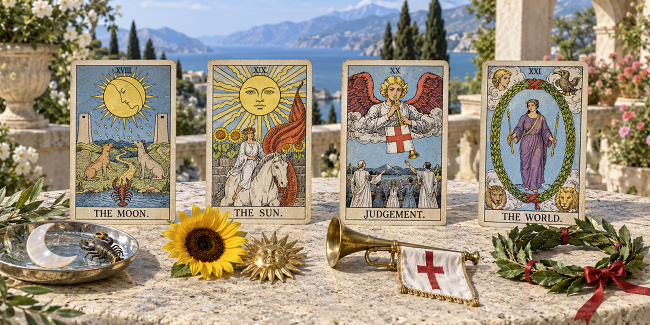
Card XVIII is the strangest landscape in the deck, and the traveler is not even in it. A great moon hangs low, a face drawn inside its crescent, shedding drops of light that fall like slow rain. Below, a winding path runs from the bottom of the card toward distant mountains, passing between two far towers. A dog and a wolf stand on either side of the path, both howling at the sky, the tame animal and the wild one giving the same cry. And at the very bottom, from a dark pool, a crayfish is climbing out onto the land, ancient and armored, drawn upward by the light.
Readers traditionally take the Moon to mean illusion, dream, and the unconscious surfacing: the road walked without clear sight. The imagery teaches each piece. Moonlight is real light, but it shows nothing accurately; shapes loom, distances lie, and the familiar turns strange, which is the card's honest portrait of certain seasons of life, the stretch of anxiety, confusion, or half-knowing when nothing is exactly wrong and nothing is exactly clear. The dog and the wolf say that in such light, the tamed and the wild parts of a person sound identical, every instinct howling at once. The crayfish climbing from the pool is the tradition's image for the deep things that surface only at night, old fears and old memories crawling up from the floor of the mind. And the path is the card's quiet mercy: it runs straight through the picture and out the far side. The Moon is not a place to solve; it is a place to keep walking, trusting the road on the nights the eyes cannot be trusted.
The card's kinship with the High Priestess, whose full entry lives in the lesson on the Fool, the Magician, and the High Priestess, is one fluent readers savor: her crescent moon rests at her feet, and both cards guard the unseen. The difference is the teaching. Her mystery is a stillness to sit before; the Moon is a night to be crossed. One is depth at rest, the other is depth in motion, and the journey requires both.
The Sun
And then card XIX, and the relief is physical. An enormous sun fills the sky, rays streaming, a serene face at its center. Beneath it, a naked child rides a white horse, arms flung wide, holding nothing but a streaming red banner, no saddle, no reins, no fear. Behind them a gray stone wall stands in full daylight, and over the wall lean four great sunflowers, turned toward the light.
The tradition reads the Sun as joy, clarity, vitality, and success, and the meaning hiding inside those words is the one the card's placement teaches: this is earned simplicity. The child is the Fool's innocence come back, but come back on the far side of everything, the openness of someone who has crossed the Moon's whole night and found the morning real. The nakedness, like the Star's, says nothing is being hidden anymore; the missing reins, an echo sharp eyes will catch from the Chariot's hard-won harness, say that what once took all of the will now takes none of it. The wall matters too: it is the same gray stone the whole journey has been built from, towers and prisons and thrones, and here it has become nothing more than something sunflowers grow over. Clarity, the card says, is what the world looks like when the light is finally adequate to it: not a different world, the same one, visible at last.
In everyday terms, the Sun is a Devon in the season when everything finally just works: the health holds, the work lands, the people are easy, the mornings feel like mornings. Devon keeps waiting for the catch, because the Moon taught caution, and slowly realizes there is no catch, there is just the season, and the only task is to be outside in it. The tradition would say the deck spends twenty cards earning this one, and that simple happiness, arriving after everything, is not simple at all. It is the most sophisticated thing in the deck wearing its lightest clothes.
Judgement
Card XX raises the stakes one final time. A great angel fills the upper sky, blowing a trumpet from which hangs a square banner marked with a cross. Below, on a wide gray sea, coffins float open, and the dead are standing up in them, gray-skinned, arms lifted, a man, a woman, and a child in the foreground and more rising behind, every face turned upward toward the sound. The image walked into the trumps from above a thousand church altars almost untouched, the Last Things ancestry taught in full in the lesson on the origins of the trumps. A small note handled here once: the card traditionally spells its name Judgement, with the extra e of the older British spelling, and this course keeps the card's own spelling throughout.
Now the famous unease, dissolved as plain teaching. The tradition does not read this card as doom, condemnation, or anyone's final sentence. Read in the trumps' language of life-passages, card XX is the passage of awakening: the moment a call arrives that is impossible to unhear, and a person rises to what life is asking next. The imagery argues it openly. Nobody in the picture is being judged in the courtroom sense; nobody cowers; every figure is rising, arms open, toward the sound, and the dead standing up is the tradition's boldest image for parts of a person long buried, the shelved ambition, the silenced voice, the postponed life, coming back up at the summons. Readers traditionally name its meanings as awakening, the calling, and reckoning joined to rebirth, and the reckoning half is kept honestly: the trumpet does ask for an accounting, the clear-eyed look back at what the life so far has actually been. But the accounting is in service of the rising. In everyday terms, it is the morning a Sam wakes up and simply knows the era is over and the next thing has a name, the vocation finally admitted, the truth finally spoken, the move finally made, and everyone who hears about it says the same thing: that it sounded like Sam had been called.
The World
And then the last card in the deck, and the deck saves its only dance for it. Card XXI shows a figure suspended mid-step inside a great oval wreath of laurel, bound at top and bottom with red ribbons. The dancer is draped in a flowing purple sash, holds a small wand in each hand, where the Magician held one, and looks back over one shoulder, light-footed, complete. And in the four corners of the sky sit four familiar faces: the angel, the eagle, the lion, and the bull, the same four watchers who sat reading in the corners of the Wheel of Fortune, whose entry lives in the lesson on the Hermit, the Wheel of Fortune, and Justice. At the Wheel they studied while everything turned. Here they have closed their books. There is nothing left to take notes on.
Readers traditionally take the World to mean completion, integration, wholeness, and arrival: not the win of the Chariot or the gladness of the Sun, but the deeper finish in which all the journey's pieces, the teachers and authorities, the trials and endings, the night and the morning, are finally carried as one thing, lightly. The two wands say the great polarity the journey opened with, the doing hand and the knowing hand, is now held one in each palm, balanced. The dance says mastery's final form is not effort but ease.
And the wreath is the card's last, best secret. It is an oval, an open circle, a zero. The shape the dancer stands inside is the Fool's own number drawn large, and the tradition reads it exactly that way: the end of the journey is the beginning's shape, and the circle the dancer celebrates inside is the same circle a certain traveler will step out of, innocent again, somewhere just past the edge of the card. The journey's frame, and the spiral it turns out to be, was taught in full in the lesson on the Fool's Journey; the World is where the frame keeps its promise. The deck does not end. It comes all the way around.
That is the inventory complete: all twenty-two trumps, each taught in full. What remains is the fluency, the pairs, mirrors, and running threads a practiced eye reads across the whole twenty-two at once, and that is the work of the closing lesson, Reading the Major Arcana as a Language.
Disclaimer:
Everything IFS Academy is an independent educational platform and is not affiliated with, endorsed by, or connected to the IFS Institute. While we strive for accuracy, errors can occur, and users are encouraged to cross-reference critical information. These courses present divination systems and their traditions for educational, historical, cultural, and self-reflection purposes only. They describe what these systems and their traditions teach and how their readers have traditionally interpreted them; they do not constitute fortune-telling services, predictions, religious instruction, spiritual direction, or an endorsement of any metaphysical claim, and they should never be used as a basis for medical, financial, legal, or safety decisions. They do not constitute therapy, mental health treatment, clinical training, or crisis support, and they should not be used as a substitute for professional mental health care.
Crisis Support: 🚨
If you are experiencing a mental health crisis, feel unsafe, feel at risk of harming
yourself or someone else, or feel too overwhelmed to safely use self-directed practices, please pause this material and reach out for immediate support. Contact a licensed mental health professional, call or text 988 in the U.S. or Canada, or use your local emergency or crisis resources.


Comments