🃏 Module 2 — Origins and Key Figures of the Trumps | Major Arcana Course
Updated: 2 days ago
Free Course by Everything IFS Academy | Divination Series
Help us reach the people who may need this most by sharing this free course with friends, family, colleagues, online communities, social media or on your own website.

🎧 Audio - listen on the go (coming soon)
Module 2 — Origins and Key Figures of the Trumps
Lay all twenty-two trumps on a table and something strange comes into focus: this is a group portrait. An emperor and an empress. A pope. A street conjurer working a crowd. A hermit with a lantern, a wheel spinning fortunes, Death itself riding through. Whoever assembled these twenty-two images was not painting random mysteries; they were painting everything a fifteenth-century person knew. The powers that ruled them, the forces that toppled them, and the ending that waited for everyone, peasant and pope alike. The trumps are a vanished world looking back, and knowing where each figure walked in from is what turns the deck from a set of pretty pictures into a story with deep roots.
A Parade in Three Registers
The trumps were born inside a card game, in the world taught in full in the Tarot course, and the historians who study the earliest decks have noticed something remarkable about how the sequence is built. Read in order, the twenty-two images move through three great sweeps, the same three sweeps that medieval art used whenever it wanted to say something about the whole of life:
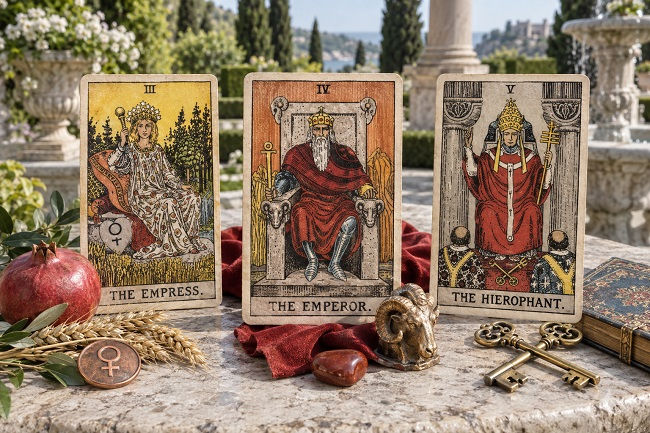
The ranks of man. The sequence opens with a parade of social stations, climbing from the lowly entertainer up through the crowned and mitered heads of the world: the conjurer, the mysterious Papess, the Empress, the Emperor, the Pope. Medieval didactic art loved this kind of ladder, the whole of society lined up from bottom to top.
The conditions of life. Then come the things that happen to everyone on that ladder, no matter their rank: Love, the triumphal Chariot of victory, the great virtues of Justice, Fortitude, and Temperance, the old man often read as Time, Fortune's ever-turning wheel, the Traitor strung up by his foot, and Death, who outranks them all. This was the moral universe of the age painted card by card, the rise, the reversal, and the fall that no crown could escape.
The Last Things. And finally the sequence lifts its eyes past death entirely: the Devil, the lightning-struck tower, the Star, the Moon, the Sun, the trumpet blast of the Last Judgment, and the World, complete. Medieval art called this territory the Last Things, the cosmic finale every soul was headed toward.
Even the name of these cards remembers the parade. Trump comes from trionfi, the triumphs, a word rooted in the procession culture taught in full in the Tarot course. The trumps were, quite literally, a triumph parade dealt into a hand of cards.
The Cast and Where Each Figure Walked In
Almost every figure in the trumps had a long life in medieval imagination before it ever touched a card. Meeting their backstories now means that when each card's full entry arrives later in the course, the image will already feel like an old acquaintance:
The Mountebank behind the Magician. The earliest decks call this figure something like the Bagatto or the Mountebank: a street performer at a little table, working cups and balls for a crowd. The lowest, cleverest rung of the social ladder, a man living entirely by skill. How that street hustler became the deck's grand figure of will is a transformation taught later in this very lesson.
The Papess and her two possible faces. A woman in papal robes, in a century when no such woman could exist. The tradition long pointed to Pope Joan, the medieval legend of a woman who disguised herself as a man and rose to the papal throne, a story Europe told for centuries though historians find no record she ever lived. Scholarship later offered a second, stranger candidate: Sister Manfreda, a real Milanese nun of a sect that believed the papacy would pass to women, who was elected a papess by her followers and burned for it in 1300, and who was kin to the very family whose painted decks carry the earliest surviving Papess. Whether the card portrays the legend, the martyr, or simply allegory itself, no one can prove; the legend and the history sit side by side, and the card is richer for holding both.
The virtues from the church wall. Justice with her scales and sword, Fortitude with her lion, Temperance with her two vessels: these three are cardinal virtues, a standard quartet of medieval moral art, painted on chapel walls and carved over doorways across Europe. Three of the four stepped directly into the trumps looking almost exactly as the art of the age already drew them. (The missing fourth, Prudence, is one of tarot history's favorite small mysteries, and the scholars are still arguing about where she went.)
The Wheel from Fortune's own allegory. A wheel with figures rising on one side and tumbling off the other, often with a serene Lady Fortune at the crank, was one of the most common images of the entire era, descending from the philosopher Boethius and repeated endlessly in manuscripts. Its message was the medieval message: whatever rises will be brought down, so place no trust in thrones.
The Hanged Man from the shame painting. The strangest origin in the deck. In the Italian cities of the era, a traitor who escaped justice would be painted on the public wall hanging upside down by one foot, a humiliation portrait for all to see. The earliest name for this card is simply the Traitor. How an image of public disgrace became one of the tradition's most serene and beloved cards is a story finished in the card's own entry, and it may be the single best example of how far these images have traveled.
The Last Judgment from above the altar. The trumpet-blowing angel and the figures rising from below come straight out of church art, where the Last Judgment filled the largest walls. Of all the trumps, this one walked into the deck with its picture barely changed at all.
Unnumbered, Unfixed, Then Famous
Here is something that surprises nearly everyone: the earliest painted trumps carried no numbers and no titles at all. The luxurious hand-painted cards of the great Milanese decks, whose commission story is taught in full in the Tarot course, are simply pictures. Players knew the ranking by heart, the way card players today know that a king beats a jack without the cards saying so.
And that ranking was not even the same everywhere. As the game spread, different cities kept the trumps in noticeably different orders; the virtues in particular wandered, sitting in one position in one city's deck and another position elsewhere. For a long stretch of the cards' early life there was no single "correct" sequence, only regional habits.
What fixed the order in most of Europe's memory was the Marseille pattern, the widely printed French design taught in full in the Tarot course. Marseille decks put numbers and names on the trumps, and through sheer ubiquity, their sequence became the sequence: the 0 through 21 that this course walks. The familiar numbering, in other words, is not the trumps' birth certificate; it is the version that won.
The Occult Renaming and the New Pictures
Centuries into the cards' life, a new kind of reader arrived: the occult tradition, the movement running from de Gébelin's famous Egyptian legend through the Order of the Golden Dawn, a story taught in full in the Tarot course. What belongs to this course is what those readers did to the trumps specifically, because their fingerprints are all over the cards as most people now meet them:
The renamings. The Papess became the High Priestess, the Pope became the Hierophant, and the humble Mountebank became the Magician. The new names lifted the figures out of medieval Europe and into a timeless temple, recasting a social portrait as a gallery of spiritual archetypes. Most modern decks carry the occult names, and many readers never learn the older ones existed.
The new pictures. In 1909, the artist Pamela Colman Smith drew the twenty-two trumps for the deck taught in full in the Tarot course, and her versions quietly conquered the world. The white rose in the Fool's hand, the pillars flanking the High Priestess, the sun rising behind Death: when people picture these cards today, they are almost always picturing Smith's lines. Her trumps are the default mental images of the Major Arcana, which is why every card entry in this course describes her version first, with the older designs noted wherever the difference genuinely changes the teaching.
The Two-Truths habit this academy keeps applies here as everywhere: the occult tradition's renamed, redrawn trumps are not a corruption of the "real" cards, and the medieval originals are not the "true" meaning hiding underneath. They are two chapters of one continuous life, and the cards as readers know them today were made by both.
The Strength and Justice Swap
One last piece of trump history, and it is the piece that confuses more newcomers than any other, so it gets settled here once for the whole course.
Open a Marseille-pattern deck and Justice wears the number 8 while Strength (there called Fortitude or La Force) wears 11. Open a Rider-Waite-Smith deck and they have traded places: Strength is 8, Justice is 11. Neither is a misprint. The Golden Dawn, mapping the trumps onto their system of astrological correspondences, wanted Strength aligned with the lion sign Leo and Justice with the scales of Libra, and the older numbering put the two cards in the wrong seats for that scheme, so they swapped them. (Astrology itself has its own course in this series; the correspondence is named here only because it is the swap's actual reason.) When the Rider-Waite-Smith deck was published in 1909, it carried the swap onto the most popular tarot deck ever printed, and Strength-as-8 became what generations of readers learned.
But the older numbering never died. The Marseille tradition kept Justice at 8, and the famous Thoth deck, taught in full in the Tarot course, deliberately reverted to it. So both numberings are alive on shelves today, each with centuries or a major deck behind it, and neither is wrong. This course follows the Rider-Waite-Smith numbering because it follows Smith's images, so Strength will arrive as card 8 and Justice as card 11, with each card's entry noting its other seat in one line. A reader who one day buys a Marseille deck and finds the two cards swapped can simply smile, knowing exactly why.
Disclaimer:
Everything IFS Academy is an independent educational platform and is not affiliated with, endorsed by, or connected to the IFS Institute. While we strive for accuracy, errors can occur, and users are encouraged to cross-reference critical information. These courses present divination systems and their traditions for educational, historical, cultural, and self-reflection purposes only. They describe what these systems and their traditions teach and how their readers have traditionally interpreted them; they do not constitute fortune-telling services, predictions, religious instruction, spiritual direction, or an endorsement of any metaphysical claim, and they should never be used as a basis for medical, financial, legal, or safety decisions. They do not constitute therapy, mental health treatment, clinical training, or crisis support, and they should not be used as a substitute for professional mental health care.
Crisis Support: 🚨 If you are experiencing a mental health crisis, feel unsafe, feel at risk of harming yourself or someone else, or feel too overwhelmed to safely use self-directed practices, please pause this material and reach out for immediate support. Contact a licensed mental health professional, call or text 988 in the U.S. or Canada, or use your local emergency or crisis resources.


Comments