🃏 Module 3 — The Fool's Journey | Major Arcana Course
Updated: 2 days ago
Free Course by Everything IFS Academy | Divination Series
Help us reach the people who may need this most by sharing this free course with friends, family, colleagues, online communities, social media or on your own website.

🎧 Audio - listen on the go (coming soon)
Module 3 — The Fool's Journey
Take the twenty-two trumps, set them down in order, and watch what happens. Someone innocent walks in at zero, owning nothing, knowing nothing. They meet teachers, rulers, and lovers. They win victories, lose everything, hang upside down, pass through Death's own card, and stagger out of a collapsing tower. And at twenty-one they are dancing inside a wreath, whole, finished, free. Lined up end to end, the trumps stop being twenty-two separate mysteries and become one story, and the tradition gave the someone at its center a name: the Fool. This lesson teaches the frame that readers call the Fool's Journey, and it is the single most useful thing a beginner can carry into the rest of this course, because once it clicks, every card that follows arrives as a chapter instead of a flashcard.
What the Fool's Journey Is
Stated cleanly: the Fool's Journey is the tradition's way of reading the Major Arcana as one continuous story, in which the Fool is the traveler and the other twenty-one trumps are everything the traveler meets along the road.
The Fool, in this frame, is not one personality among twenty-two. The Fool is the everyman soul, the part of every person that sets out into life not knowing what is coming. Eden Gray, whose place in this story is taught just below, put it in exactly those terms: the Fool as the soul of everyman, moving through the life experiences pictured in the other cards. The remaining twenty-one trumps then sort themselves into roles. Some are people the traveler meets: the teachers, the parents, the keepers of tradition. Some are powers that act on every life: fortune's turning, love's arrival, sudden ruin. And some are passages the traveler must walk through rather than meet: surrender, ending, awakening. One traveler, twenty-one encounters, one road.
The zero is what makes the whole frame possible, and it is one of the deck's quietest pieces of brilliance. Because the Fool carries no real position in the sequence, the card stands both outside the story and inside every moment of it:
Outside the sequence, the Fool is the reader of the story, the soul to whom all twenty-one things happen, belonging to no single chapter because the whole book is about them.
Inside the sequence, the zero lets the Fool stand at any threshold. The tradition often pictures the Fool's energy returning at every new beginning along the road, because zero comes before one, but it also comes after twenty-one, the way a finished circle ends where it began.
A genuinely old detail sits underneath this modern idea: in the trumps' card-game centuries, the Fool was already the deck's odd card out, the unnumbered wanderer that belonged to no rank. The full teaching of the Fool as a card, its imagery, its traditional meanings, and everything else it carries, lives in the lesson on the Fool, the Magician, and the High Priestess. Here, the Fool is simply the traveler the frame requires.
Where the Frame Actually Comes From
Now for the honesty this academy is built on, because the Fool's Journey has its own origin story, and it is much younger than most people assume.
The cards are five centuries older than the frame. The trumps were assembled in the 1400s, in the world taught in the lesson on the origins of the trumps, and for most of their life nobody read them as one traveler's tale. The phrase "the Fool's Journey" was coined in 1970, by a remarkable American named Eden Gray. Gray had lived a whole first life as a Broadway actress before turning, in her later decades, into the most influential tarot teacher of her century; her plain-spoken books carried tarot to an enormous new audience, and in the closing pages of her A Complete Guide to the Tarot she named the idea that would outgrow everything else she wrote: the Fool as everyman, walking the trumps in order.
A decade later, the writer Rachel Pollack deepened the frame into the form most modern readers know. Her Seventy-Eight Degrees of Wisdom read the journey through the psychologist Carl Jung's idea of archetypes, the universal figures and passages that human minds recognize across every culture: the Mother, the Father, the Wise Old Man, the descent and the return. In Pollack's hands the journey became not just a story about the cards but a map of inner growth that the cards happened to picture, and her arrangement of the trumps into three rows of seven, taught in the next section, became the journey's standard map.
So here are both truths, side by side, neither one sneered at. The historical truth: the Fool's Journey is a twentieth-century teaching frame laid over fifteenth-century cards, invented by a former actress and deepened by a brilliant interpreter, and the people who painted the first trumps never heard of it. The tradition's truth: the frame earned its place because it works. The sequence really does read as a life's arc, well enough that the journey is now the most common way the trumps are understood anywhere in the world. A lens can be newer than the thing it focuses and still be the best lens ever made for it. The Fool's Journey is exactly that.
The Three Lines of Seven
Set the Fool aside as the traveler and twenty-one trumps remain, and twenty-one divides perfectly into three rows of seven. The tradition reads those three rows as the journey's three great chapters, each line a different altitude of life. This map is also this course's own structure, because the card lessons ahead follow the journey's joints.
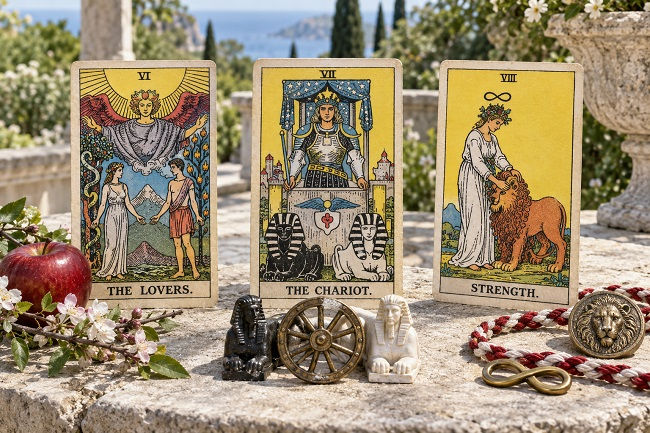
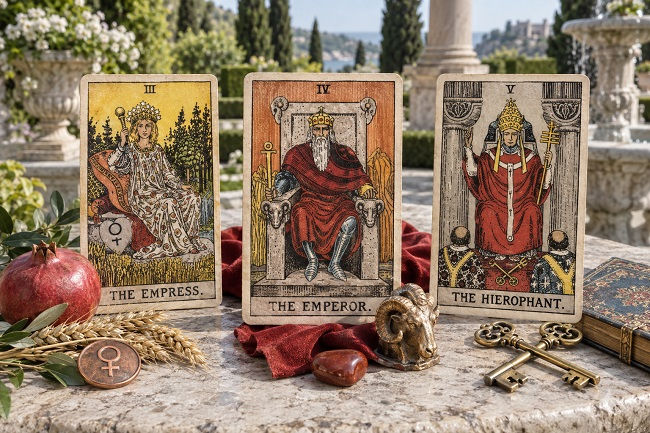
The worldly line (cards 1 through 7): the teachers and powers of outer life. The first row is the world everyone is born into. Here the traveler meets the figures that shape a young life from the outside: the first teachers in the Magician and the High Priestess, the great authorities in the Empress, the Emperor, and the Hierophant, and then the first real tests of an independent life, choice in the Lovers and hard-won victory in the Chariot. By the end of the first line, the tradition says, the traveler has mastered the outer world's lessons. These cards are taught in full across the lessons on the Fool, the Magician, and the High Priestess; the Empress, the Emperor, and the Hierophant; and the Lovers, the Chariot, and Strength.
The inner line (cards 8 through 14): the turn inward, trial, and transformation. The second row turns the journey around. Outer victories stop being enough, and the road bends into territory no chariot can cross: quiet courage in Strength, solitary searching in the Hermit, the spin of the Wheel of Fortune, the reckoning of Justice, and then the deck's great transformation passage, the Hanged Man, Death, and Temperance, in which the traveler surrenders, ends, and is remade. This is the line where life stops being something that happens to the traveler and becomes something the traveler answers for. Its cards are taught in full across the lessons on the Lovers, the Chariot, and Strength; the Hermit, the Wheel of Fortune, and Justice; and the Hanged Man, Death, and Temperance.
The cosmic line (cards 15 through 21): the great forces and the completion. The third row plays for the highest stakes. The remade traveler now faces the forces larger than any single life: bondage in the Devil, demolition in the Tower, and then the long climb home through hope in the Star, the dark night of the Moon, the bright morning of the Sun, the great awakening of Judgement, and finally the World, the dance at the center of the finished circle. Its cards are taught in full across the lessons on the Devil, the Tower, and the Star, and on the Moon, the Sun, Judgement, and the World.
One honest note, in keeping with this lesson's habit: the three-line map follows the Rider-Waite-Smith numbering this course uses, and the numbering itself has the history taught in the lesson on the origins of the trumps. The rows are a teaching map, not an ancient secret, and like the journey itself, they survive because they keep being useful.
How to Walk This Course With the Frame
Here is what the frame actually does for a learner, lesson by lesson. Without it, each new card is an isolated fact to memorize, and twenty-two isolated facts are heavy. With it, every card arrives already half-placed: a newcomer meeting the Hermit can ask where the road is at that moment (deep in the inner line, just after worldly victory stopped satisfying), and the card's character starts assembling itself before its entry is even read. The journey turns memorization into recognition, and recognition is how fluency begins.
The frame also answers, in advance, the question every beginner eventually asks: what happens after the World? The tradition's answer is that the journey is not a straight line walked once. It is a spiral. People circle through its chapters many times in one life, meeting the same stations at new depths, every completed circle opening onto a new zero. What that spiral means for actually reading the cards, the pairs and mirrors and threads a fluent eye sees running through all twenty-two, is the work of this course's closing lesson, Reading the Major Arcana as a Language. The seed is planted here; the harvest comes at the end of the road, which is exactly where the trumps would put it.
Disclaimer:
Everything IFS Academy is an independent educational platform and is not affiliated with, endorsed by, or connected to the IFS Institute. While we strive for accuracy, errors can occur, and users are encouraged to cross-reference critical information. These courses present divination systems and their traditions for educational, historical, cultural, and self-reflection purposes only. They describe what these systems and their traditions teach and how their readers have traditionally interpreted them; they do not constitute fortune-telling services, predictions, religious instruction, spiritual direction, or an endorsement of any metaphysical claim, and they should never be used as a basis for medical, financial, legal, or safety decisions. They do not constitute therapy, mental health treatment, clinical training, or crisis support, and they should not be used as a substitute for professional mental health care.
Crisis Support: 🚨
If you are experiencing a mental health crisis, feel unsafe, feel at risk of harming yourself or someone else, or feel too overwhelmed to safely use self-directed practices, please pause this material and reach out for immediate support. Contact a licensed mental health professional, call or text 988 in the U.S. or Canada, or use your local emergency or crisis resources.

Comments