Deities, Ancestors, and Spirit Allies Explained
Updated: Oct 23

Deities, Ancestors, and Spirit Allies Explained
🎧 Audio – Listen on the go: Harriet
Whether you're feeling pulled toward a particular god and wondering what to do about it, thinking about setting up your first ancestor altar, or simply curious what witches mean when they talk about spirit allies, this guide walks through what working with deities, ancestors, and spirit allies actually is, in plain terms. Read it straight through or jump to the section you need. There's no right or wrong way to take it in.
Deities, Ancestors, and Spirit Allies in a Nutshell
Witchcraft has a social side. Alongside the candles, herbs, and spellwork runs an older current of relationship, in which practitioners work with unseen others: deities, the ancestral dead, and a whole population of spirits tied to land, plants, animals, and the home. Working with them means treating them as persons to know rather than forces to use, beings who are greeted, fed, and consulted. Witches often call this territory spirit work, or simply the relational side of the craft.
The appeal is company. A practitioner with allies brings every working to a table that is already full: a god to petition, a beloved grandmother to consult, a spirit of the hearth keeping watch over the house. For many witches this web becomes the warmest part of the whole craft.
Where Spirit Work Came From
The relational strand may be the oldest layer of human spirituality. Graves furnished with tools, food, and ornaments appear tens of thousands of years before writing, evidence that the living went on caring for their dead long after burial. Ancient Egypt left bread and beer at tombs, Rome held an annual festival to feed the family dead, and ancestor halls remain central to household life across much of Asia today. The gods are nearly as old in the record: every early civilization had its pantheons, and ordinary homes kept shrines, from the Roman lares guarding the household to the hearth worship of Greek family life.
The spirit-filled world is just as widespread. Japanese tradition honors kami in mountains, rivers, and trees, Norse settlers took care not to offend the land-wights of a new shore, and the fairy faith of Ireland and Scotland survived centuries of Christianity as everyday caution and courtesy. Europe's cunning folk and accused witches were said to work with familiar spirits, a detail that fills the trial records. The modern revival draws on all of it: some practitioners join living, unbroken traditions, while others rebuild Norse, Greek, or Egyptian worship from texts and archaeology, and an honest practitioner learns to tell the ancient, the reconstructed, and the newly invented apart.
Do You Have to Believe in Gods and Spirits?
Newcomers often stall on this question, and the craft's answer is unusually relaxed. Some practitioners experience gods and spirits as fully real, independent beings. Others understand them as archetypes, deep patterns the human mind meets in personal form, or as aspects of the psyche given a face and a name. Plenty remain honestly agnostic and let years of practice settle the question, or never settle it at all. These stances sit side by side in the same communities, because the work itself is behavioral: a candle lit, an offering poured, and a respectful word spoken look identical from any of them. The one thing the practice cannot absorb is contempt. Whatever a practitioner believes, the relationship is approached with sincerity, and many report that their sense of what they are relating to keeps evolving across a lifetime.
The Etiquette: Reciprocity, Patience, and Discernment
However different the ally, the same three principles govern every relationship in this territory.
Reciprocity. The engine of the whole practice. Relationships with the unseen are fed the way human ones are, by giving: food and drink, light and incense, song, attention, or acts of service such as tending a grave or cleaning a stretch of riverbank. Practitioners give before they ask and thank after they receive, and small offerings made consistently count for more than grand ones made once.
Patience. Spirit relationships are courtships, built slowly through repeated contact rather than declared in a weekend. Experienced practitioners wait a long time before making promises, because oaths and vows are taken seriously on both sides of the exchange.
Discernment. Not every spirit is wise, honest, or friendly, so nothing is accepted uncritically. Practitioners test what they encounter, confirm through divination or simple time, and feel free to decline, since a healthy ally never demands harm, secrecy from loved ones, or anything that erodes wellbeing.
The 3 Kinds of Unseen Allies
The relationships of the craft fall into three broad circles. Each has its own character, and most practitioners settle into one or two before the web grows wider.
Deities. The gods and goddesses of the world's pantheons, from the Norse and Greek to the Egyptian, Celtic, Yoruba, and Hindu, among many others. This is the most formal of the three circles, approached the way one might approach royalty or a respected elder. The relationship often begins with what practitioners call the call: a deity who keeps turning up in dreams, books, symbols, and chance encounters until the pattern becomes impossible to ignore. Devotion then takes shape through an altar, regular offerings, prayer, study of the deity's myths, and actions in the world that honor what the god stands for.
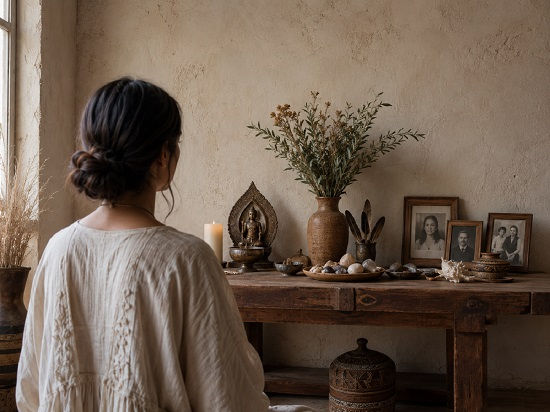
Ancestors. The dead who stand behind a person. Blood kin come first to mind, but the circle is wider: adoptive family, teachers, mentors, and the honored dead of a craft or calling all count in most traditions. Many practitioners consider ancestors the most accessible allies of all, since no introduction is needed and their investment is personal; the family root wants the family branch to flourish. The classic practice is an ancestor altar, often just a photograph, a glass of water, and a candle, refreshed regularly and spoken to out loud, with a share of special meals set aside on meaningful days. Veneration is also selective. The dead who caused harm in life are not owed a seat, and practitioners can honor the lineage as a whole, or reach further back to ancestors they never knew, while keeping out any individual they have reason to exclude.
Spirit Allies. The widest and most varied circle, closer to neighborliness than worship. It includes familiars and spirit guides, helper spirits met through meditation, dreams, or long practice, which the old records describe as working partners rather than pets. Alongside them sits the animist layer of the world itself: spirits of land and place greeted when moving somewhere new, house spirits given a corner and a biscuit in many European folk traditions, rivers and mountains addressed by name, and plant allies known slowly across their seasons. Relating here looks humble and local. A walker greets the woods, a gardener thanks the garden, and small offerings are left wherever the relationship lives.
Open and Closed Traditions
One more distinction shapes who works with whom. Open traditions welcome any sincere outsider: most reconstructed Norse, Greek, and Egyptian polytheism operates this way, ancestor veneration belongs to everyone by definition, and the spirits of local land answer to residence rather than heritage. Closed traditions require initiation, community membership, or birthright, including many Indigenous ceremonial practices and the initiatory paths of African diasporic religions such as Haitian Vodou. These boundaries are not gatekeeping for its own sake; they protect ceremonies that only function inside training, community, and context, often guarded through centuries of persecution. Respect here is concrete: admire without taking, learn from authorized teachers when genuinely called, and enter a closed tradition through its own door or not at all.
Want to Learn More About Deities, Ancestors, and Spirit Allies?
Everything IFS Academy offers a Free Deities, Ancestors, and Spirit Allies Course, written specifically for everyday people, that teaches everything on this page in full depth, one lesson at a time.
Disclaimer: Everything IFS Academy is an independent educational platform and is not affiliated with, endorsed by, or connected to the IFS Institute or any specific witchcraft tradition, religion, spiritual lineage, Indigenous or diasporic community, teacher, or author. This guide is offered for educational and self-reflection purposes only. It does not constitute therapy, mental health treatment, or professional advice. Only a qualified professional who knows your situation can diagnose, treat, or advise you. Spiritual practice can stir deep feelings: if this work ever becomes frightening or destabilizing, pausing and reaching out to a trusted professional is always a sound choice.


Comments