👻Module 1: The Unseen Companions| Deities, Ancestors, and Spirit Allies Course
Updated: Sep 29
Free Course by Everything IFS Academy Witchcraft Series
Help us reach the people who may need this most by sharing this free course with friends, family, colleagues, online communities, social media or on your own website.
🎧 Audio – listen on the go - (coming soon)
👻Module 1: The Unseen Companions
Come in, and sit close to the fire for this one. This course walks through the most tender territory in all of the craft: the relationships witches build with what cannot be seen. Gods and goddesses. The beloved dead. The spirits of animals, plants, and land. It is territory people arrive at carrying grief, hope, curiosity, and sometimes a healthy amount of doubt, and every one of those is welcome here.
One thing should be said plainly before anything else, because it is the most honest thing a teacher of this subject can say. Nobody can hand you a guaranteed conversation with a god or a departed grandmother, and anyone who promises that is selling something. What can be taught, and what this course teaches, is the practice itself: how witches have understood these companions, how relationships with them are commonly built and tended, what the work looks like day to day, and how to do all of it with reverence, discernment, and both feet on the ground. In this practice, the measure of the work is the attention you give, never the messages you receive. Hold onto that sentence. It will steady you through all twelve modules, and it is the difference between a practice that nourishes for a lifetime and one that collapses the first quiet week.
This first module is the map. By the end of it, you will know what witches mean when they speak of unseen companions, the three great categories these companions fall into, the words this field uses so you can read and talk about it without getting lost, a tool for weighing your own experiences honestly, and a way to find your own natural starting point. You will also begin something small that will quietly grow into the backbone of your whole relational practice. More on that at the end.
What “Unseen” Actually Means
The word unseen tends to slide into one of two misreadings, so let’s set both down before they cause trouble. The first misreading hears it as imaginary: a pleasant fiction, a useful metaphor, psychological work in mystical clothing. The second hears it as merely invisible, as if these companions were ordinary beings standing just out of sight, waiting to step into view if you squint hard enough. Witches generally mean neither.
In the way practitioners commonly describe it, an unseen companion is a presence experienced through effect rather than appearance. A witch does not see her gods the way she sees the kettle. She knows them the way she knows her own pulse: not by looking, but by attending.
So what does that attending actually feel like? This is the question every beginner carries and almost no introduction bothers to answer. When practitioners describe experiences of presence, the accounts tend to cluster into four recognizable forms, and knowing them ahead of time means you won’t dismiss a real moment or inflate an ordinary one.
Felt sense. A shift in the room or in the body that arrives without an obvious cause: warmth, weight, a settling, the particular fullness a room has when someone you love is quietly in it. Many practitioners say this is the most common form, and the easiest to miss because it is so gentle.
Dreams. A dream that feels different in kind from the usual nightly churn: more vivid, more ordered, and stubbornly memorable, sometimes carrying a figure, a symbol, or a name. Practitioners across many traditions treat certain dreams as meaningful visits or messages, while holding lightly the question of what they ultimately are.
Signs and synchronicity. Synchronicity is the word this field uses for a meaningful coincidence, one that lands too precisely, or repeats too often, to shrug off comfortably. The same unusual animal three times in a week. A stranger’s sentence that answers the question you asked at your altar that morning. One instance is usually just life. It is the pattern, the repetition, that makes practitioners sit up.
Quiet knowing. An understanding that arrives whole, without reasoning its way in: the sudden certainty of what a difficult situation needs, or the strong sense of being accompanied. Older traditions had lovely words for this; many modern witches simply call it knowing.
Notice what all four have in common. None of them is a booming voice or a figure at the foot of the bed. The unseen companions, as witches describe the experience, tend to speak in the quietest register there is, which is exactly why the craft prizes attention so highly. The skill being built across this entire course is not the ability to make something dramatic happen. It is the ability to notice what is subtle, and to be honest about what you noticed. Both halves matter, and this module gives you a tool for the honesty half before it’s done.
The Three Doors: A Map of the Companions
Witches commonly sort the unseen companions into three broad categories, and this course moves through them in turn: deities, ancestors, and spirit allies. Think of them as three doors off the same hallway. You may walk through one, two, all three, or none at all, and the map matters because what lies behind each door asks for a different kind of relationship.
The First Door: Deities
A deity is a god or goddess: a sacred power of vast scale, honored within one of humanity’s religious traditions, with its own history, personality, domains, and preferences. Hecate met at the crossroads. Brigid in the heat of the forge. Freyja riding in her chariot drawn by cats. A pantheon, another word you’ll meet constantly, simply means the family of deities belonging to one culture or tradition: the Greek pantheon, the Norse pantheon, and so on.
What makes deities their own category is scale and otherness. They are not the witch’s relatives, not her personal guides, not hers in any possessive sense at all. Countless people across centuries have honored the same powers. Approaching a deity is approaching something larger than oneself, and the traditions around that approach, which the deity modules ahead teach step by step, all grow from that one fact.
The Second Door: Ancestors
The ancestors are the human dead connected to your life. Practitioners today usually describe three streams of them, wider than most beginners expect. Blood ancestors are the dead of your literal lineage: the grandmother who taught you to bake, and behind her, hundreds of names you will never learn. Chosen and heart ancestors are the dead bound to you by love rather than birth: the stepfather who raised you, the friend who died too young. And what many practitioners call affinity ancestors, or ancestors of lineage and craft, are the dead whose work or path you inherit: the teacher whose books shaped you though you never met, the poets, healers, or craftspeople whose tradition you carry forward. If your family tree is short, unknown, or painful, hear this early: the ancestor door still stands open, and the ancestor modules later in this course take that up with great care.
What makes the ancestors their own category is the personal thread. A goddess belongs to everyone who honors her. Your grandmother belongs to you. That intimacy changes everything about the relationship, from how it’s approached to what may be asked within it.
The Third Door: Spirit Allies
The third door gathers everything belonging to neither of the first two, and it is the most varied door of the three. Familiars: spirit companions to a witch’s working, sometimes experienced through the body of a beloved living animal, sometimes as a presence with no body at all. Spirit guides: helper presences that practitioners describe meeting at thresholds and turning points. And the spirits of the living world itself, rooted in one of the oldest ideas in human spirituality. Animism is the understanding that all things carry spirit or life: animals, plants, rivers, stones, mountains, perhaps even the old house on the corner. From an animist view come land spirits, the presence of a particular place, and plant allies, individual plants a witch builds a long, patient relationship with over seasons.
What makes the allies their own category is intimacy and specificity. These presences are smaller in scale than deities but often closer at hand, and they tend to be particular to the witch herself, met through her own land, her own animals, her own working life. Two full modules near the end of the course belong to them.
Why the Distinctions Matter
The sorting is not academic tidiness. The shape of the relationship differs behind each door. The way one approaches, what one offers, what one may ask, what one owes: all of it differs, and treating the companions as interchangeable is one of the surest ways to produce bad relationships and worse practice. A witch who calls on her grandmother the way she would call on Hecate has misunderstood her grandmother. Reverse it and she has misunderstood the goddess. You would not greet your oldest friend the way you greet a visiting head of state, and the same social intelligence you already own is the beginning of good relational craft.
Do You Have to Do Any of This? No.
A question lives quietly underneath this whole subject, and it deserves a direct answer before we go one step further. Does a witch have to work with gods, ancestors, or spirits to be a real practitioner of the craft? No. The honest answer is no, and this course will hold that answer steady from here to its final page.
A witch can build a complete, powerful, lifetime-deep practice without any relational work whatsoever. Energy work, spellcraft, divination, ritual observance, the slow study of the wheel of the year, the cultivation of will and attention: none of it requires a god to function, and none of it requires an ancestor at the altar. Witchcraft is a practice, not a religion, and the witch who works only with the elements, only with her own power, only with the patterns of the natural world, is not a lesser witch. She is a witch on a different path within the same craft.
The relational dimension is for the witch who feels the pull: the one who woke from a dream carrying a name she did not plant in her own mind, or whose breath caught on a particular figure while reading the old myths, or who keeps finding the same goddess looking back at her from books she never sought out. It is equally for the merely curious, who want to understand what this dimension actually involves before deciding whether to enter it. Both of you have a full seat here, and so does the skeptic in the back row, who gets her own word later in this module.
What the Practice Gives, and What It Asks
Honesty about the gifts first, because the modern wellness market has done real damage by promising things the gods do not deliver. The relational practice does not deliver favors on demand. It is not a cosmic customer service line where the witch pays in candles and receives a parking spot. The deities are not employees, and the ancestors are not concierges. Any book, video, or seller telling you otherwise has confused devotion with vending, and experienced practitioners of every tradition will tell you the same.
What the practice offers instead, in the telling of those who’ve kept it for decades, is something stranger and steadier. Company, in a sense the modern world has nearly forgotten. The sense of being met by something larger than the ordinary self. Perspective not bound by one lifetime. A longer view, a deeper rooting, and over years, a slow deepening of the whole craft that purely solitary work tends to struggle to reach. Notice that every gift on that list is relational rather than transactional. That is the nature of this work, and knowing it up front will spare you the disappointment that ends most abandoned practices.
What it asks in return comes down to three things, and since this course will return to them constantly, let’s make each one concrete rather than leaving them as pretty abstractions.
Attention. In practice, attention means small, regular, returning presence. Pausing at a photograph of your grandmother for one full breath instead of walking past it. Learning three facts about a goddess whose name keeps catching your eye. Standing under the oak at the corner of your street for a quiet minute on your way home. Five unhurried minutes given regularly outweigh two dramatic hours given once, and every tradition that keeps these practices says some version of the same thing: small and steady beats grand and rare. What blows away in next month’s enthusiasm was never attention; it was excitement wearing attention’s clothes.
Reciprocity. Reciprocity is honest exchange: giving something of yourself in return for what the relationship gives you. In this craft the classic form is the offering, a gift given to a companion, whether a poured cup of water, a lit candle, a song, or an act done in someone’s honor. Offerings are a rich art with their own customs and their own module ahead, so park your questions about the details; for now you only need the principle. Relationships in which one side only takes do not stay relationships, on either side of the veil.
Honesty. Honesty means telling yourself the truth about what is actually happening in your practice rather than what you wish were happening: neither talking yourself out of an experience that genuinely moved you, nor talking yourself into one that didn’t occur. This is the hardest of the three, which is exactly why the next two sections hand you the vocabulary and the tool that make it possible.
Speaking the Language: The Words This Field Uses
Every craft has its working vocabulary, and nothing makes a beginner feel more locked out than watching practitioners toss around words nobody ever defined. Here are the terms you will meet constantly in this course and everywhere else this subject is discussed. Read them once now; they’ll be old friends by the closing module.
Working with. The phrase witches use for having an active, tended relationship with a companion, as in “she works with Brigid.” It signals ongoing relationship, not a one-time ritual and not necessarily worship.
Veneration. Deep, active respect that is honored through practice: tending photographs, speaking names, making offerings. Ancestor work is usually called veneration rather than worship, because respect and remembrance, not divinity, sit at its center.
Worship and devotion. Worship is reverence offered to a being held as divine. Devotion is the ongoing, loving practice that expresses it, and a devotee is one who keeps such a practice. Some witches worship the deities they work with; others hold those relationships as respectful partnership instead. The craft genuinely contains both, and this course never assumes which one is yours.
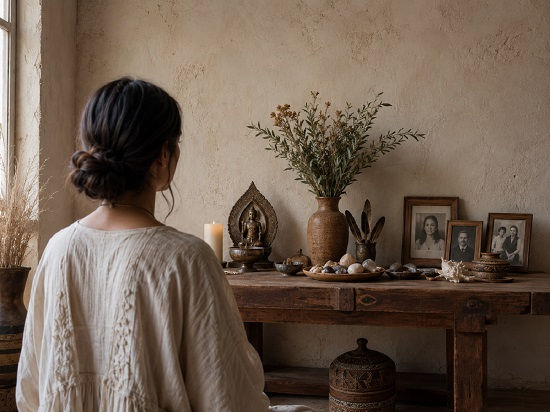
Altar and shrine. An altar is a working surface for practice: a place where things are done. A shrine is a place of honoring dedicated to a particular being: a place where someone is remembered and met. The words blur in casual use, and plenty of witches keep one surface serving both purposes. You’ll learn to build both later in this course; nothing needs assembling today.
Patron deity. A deity with whom a witch has a primary, long-term devotional relationship, sometimes described as the deity of her heart or her path. Some practitioners also use matron for goddesses, though many simply say patron for all. A witch may have one, several, or none, and none is a perfectly respectable answer.
The veil. A poetic shorthand for whatever separates the everyday world from the unseen one. When witches say the veil is thin, at certain places or times of year, they mean the unseen feels nearer and easier to sense. It is imagery, not physics, and it is used constantly.
Personal gnosis, or UPG. Gnosis is an old Greek word for knowledge of spiritual mysteries. Personal gnosis is understanding that arrives through your own experience: a dream, a meditation, a moment of quiet knowing. Modern pagan communities usually call it UPG, unverified personal gnosis, and that humble little word unverified is the community’s own honesty at work. It means: this is real to me, and I cannot prove it to you, and I’m not going to pretend otherwise. When you see practitioners tag a statement with “UPG,” they are practicing exactly the honesty this module keeps asking of you.
The lore. The recorded body of myth, history, and tradition about a deity or practice: the surviving texts, the scholarship, the folk custom. Lore is the shared inheritance against which personal experience gets weighed, which brings us directly to the most useful tool in this entire module.
Your First Tool: The Three-Legged Stool
Here is the question that will visit you a hundred times if you walk through any of the three doors: how do I tell a meaningful experience from something I’m merely hoping to experience? A student who can’t answer that question either dismisses everything and starves the practice, or believes everything and loses her footing. Practitioners have wrestled with this for a long time, and the working answer that has emerged across modern traditions is a kind of three-way weighing that I’ll teach you as the three-legged stool. A stool with three legs steadies; take the legs away and it wobbles. The three legs are your experience, the lore, and time and company.
Use it like this, ideally in writing, because writing slows the mind down to the speed of honesty.
Record the experience first, plainly. As soon as you can, write down what actually happened, in flat, factual language, before interpretation gets its hands on it. “Tuesday night I dreamed of a woman standing at a crossroads holding two torches. I woke at 3 a.m. and the dream would not fade.” What happened and what it means are two separate entries; keep them separate on the page.
Check the first leg: the experience itself. Ask a few honest questions of it. Did this arrive on its own, or was I actively wishing for it? Does it carry weight days later, or is it already fading? Is it asking something of me, or merely flattering me? Practitioners note that meaningful experiences tend to be persistent, a little surprising, and often slightly inconvenient, while wishful ones tend to arrive on demand and tell us exactly what we wanted to hear.
Check the second leg: the lore. Research what tradition actually says. A woman with torches at a crossroads matches Hecate’s oldest imagery, and finding that match after the dream carries a different weight than dreaming it after a week of reading about her. The lore check runs both ways: it can strengthen an experience by corroborating it, and it can gently correct one that contradicts everything a tradition has ever said. Either result is a gift.
Check the third leg: time and company. Wait, and watch for pattern. Does the theme repeat over weeks, through different channels? Meaningful threads tend to keep tugging; passing fancies let go. And when the moment allows, compare notes: practitioners have long noticed that some experiences recur independently across many unconnected people, which the community calls shared gnosis, and that convergence is worth something even if it proves nothing.
Conclude humbly, in pencil. After the three checks, write one sentence of tentative conclusion and let it stay tentative. “This may be something; I’ll keep paying attention” is a complete and honorable finding. The stool does not prove anything, and it isn’t meant to. What it does is steady you, keeping the door open to wonder and the door open to doubt at the same time, which is where a wise practitioner lives.
Watch the stool at work. Linda, new to the craft, dreams vividly of a woman with red hair standing at an anvil. She writes it down flat (leg one: it arrived unbidden, and a week later it still won’t fade).
Reading afterward, she finds that fire and the forge belong to Brigid’s oldest imagery (leg two: the match came after the dream, not before). Over the next month she notices the theme returning: a documentary, a friend’s offhand mention of Ireland, a second dream (leg three: pattern, over time).
Her penciled conclusion: “Something may be inviting my attention here. I’m going to learn more about Brigid and keep watching.” Notice everything Linda did not do. She never declared a goddess had claimed her by Thursday, nor did the sneering inner voice get to delete the whole thing. The stool held it, and that was enough.
One more honest word, because this course promised you honesty. Whether such experiences come from gods and spirits without, or from the deep places of the psyche within, is a question humanity has debated for as long as there have been altars, and this course will not settle it for you. The stool works regardless. It asks only that you be truthful about what you experienced and careful about what you conclude, and those two habits will serve you whichever way your understanding matures.
Finding Your Door: Mapping What’s Already There
Beginners often assume relational practice starts from zero, as if the witch stands in an empty field and must summon company from nothing. Almost nobody actually starts from zero. Most people arrive already carrying threads of connection they’ve simply never named: a dead relative they still talk to in their head, a place that has always felt strangely alive to them, a mythic figure they’ve been drawn to since childhood. The craft’s open secret is that the relational practice usually begins by noticing what is already present, and this mapping exercise is how you take that inventory. All it needs is a notebook and twenty quiet minutes.
A word about that notebook before you begin, because it matters more than it looks. Choose one notebook, or one dedicated document if you’re a keyboard soul, and let it hold everything this course asks you to write, starting with this map. Witches are inveterate keepers of written records, and this one is going to grow module by module into something with a name and a lineage of its own. That story gets told properly later in the course. For now, simply begin it, and write your name in the front.
Set the page for the first door. Title a page “Deities” and list any divine or mythic figures you’ve ever felt drawn to, at any age, from any tradition, however faintly: the goddess whose myth you reread as a teenager, the god whose statue stopped you in a museum. No commitment is being made; a name on this list is an observation, not a vow.
Set the page for the second door. Title a page “My Dead” and list the dead connected to your life across all three streams you learned earlier: blood, heart, and affinity. The grandmother, the lost friend, the author whose work made you who you are. Beside each name, jot one sentence about the thread that ties you.
Set the page for the third door. Title a page “The Living World” and list the animals, plants, and places that have felt significant or alive to you: the tree you climbed as a child, the river you always walk to when life goes sideways, the animal that keeps appearing in your years. Places count even if you’ve moved away from them.
Read the whole map and mark the warm spots. Now read all three pages slowly and notice where you feel warmth, pull, grief, or aliveness as you read. Underline those entries. Nobody else’s list matters here; a map with one underline is as valid as a map with twenty.
Write the finding. At the bottom of the map, finish this sentence in your own words: “The door that seems to stand most open for me right now is...” That finding is data for your journey through this course, nothing more binding than that. Plenty of witches discover their expected door was not their open one, and the map is allowed to surprise you.
Keep this map where you can find it. The modules ahead will send you back to it more than once, and its real payoff arrives near the end of the course, when you’ll read it again with twelve modules of eyes.
A Word for the Skeptic, and for the Nervous
Some of you have read this far with one eyebrow up, and that eyebrow is welcome here. Some practitioners understand the companions as fully real, independent beings. Others understand them as archetypes, the deep patterns of the human psyche wearing ancient faces. Many hold both at once, or decline to decide, and the craft has room for the entire spectrum. Nothing in this course requires you to sign a statement of belief, and a practice kept with an agnostic heart is still a practice honestly kept. Lighting a candle for a grandmother you love needs no metaphysics at all to be worth doing.
And to the nervous one, worried she’ll do all of it and feel nothing: hear this now, at the start, rather than learning it the hard way. Quiet is normal. Practitioners with decades at the altar describe long stretches where nothing perceptible stirs, and the old traditions never treated silence as failure or rejection. If dramatic experiences were the point, this would be a course in thrill-seeking rather than relationship. You already know from human love that the deepest relationships are mostly made of undramatic, faithful showing up. It works the same on both sides of the veil, and every module ahead assumes it.
A Map of the Teachings Ahead
Here is the whole road, laid out so you can see where this course is taking you. Unlike a reference book, this one is best walked in order, because each lesson hands you tools the next one uses, and your notebook grows page by page along the way.
Orientation
The Unseen Companions. The map of the three doors, the words this craft speaks, and your first tool for weighing your own experiences honestly.
Four Ways of Seeing. How witches understand what the divine actually is, four very different answers, and a written method for finding your own.
Meet the Gods
The Call. The two doorways into deity work, the signs of a genuine call, the ledger that tests them over time, and the courteous first hello, polite decline included.
The Major Pantheons. A guided walk through the great traditions a Western witch is most likely to meet, and how to choose one world for a season.
Offerings, Devotion, and the Art of Reciprocity. What to give, how to give it, the small devotional space any home can hold, and the principle this whole practice stands on.
Open and Closed. Which traditions welcome all comers, which are closed, why that matters, and the five-question tool that keeps a practice honest for life.
Connect With Your Ancestors
The Ancestors. Who the dead of your line actually are, the three streams they arrive in, and the story-gathering that cannot wait.
The Ancestor Altar. Building the tended place, step by step, and the thirty-second daily rhythm that turns a shelf into a relationship.
The Hard Lines. The lesson for wounded family trees: who belongs on the altar, who doesn't, and how this work stays safe and sovereign.
Find Your Spirit Allies
Familiars and Spirit Guides. The working companions of the craft, how the meetings actually happen, and the test that tells a true ally from a wishful one.
Land Spirits, Plant Allies, and the Living World. The spirits of place, the practice of one returned-to spot, the courteous harvest, and the living land under every city street.
Make It a Lifelong Practice
Building and Sustaining the Relational Practice. The shape that lasts for decades, the silences, the endings, and the secret your notebook has been keeping since week one.
Witch Practice: The Week of Small Attention
You’ve drawn your map; now walk one path on it, gently, for seven days. This practice applies everything this module taught, and it asks for five minutes a day.
Choose one thread. From your map’s underlined entries, choose a single one: one figure, one of your dead, one place or plant or animal. Just one; the discipline of one is part of the practice.
Give it five minutes of attention daily, for seven days. Attention only. Look at the photograph and remember one true story. Read a little of the myth. Stand with the tree and actually notice it: bark, sound, season. You are not asking for anything, not listening for anything, not attempting contact of any kind. You are simply showing up, the way you’d sit companionably with an old friend who doesn’t need conversation.
Log one honest line each evening. In your notebook, one line: what you gave attention to and anything you noticed, including nothing. “Day four: read about Brigid’s wells. Nothing stirred; pleasant anyway” is a perfect entry, and so is “Day six: the oak again. Hard to explain, but I was glad to be there.” You are building the twin habits this whole course runs on: small faithful attention, and flat honest recording.
On the seventh day, sit with the stool. Read your seven lines and take whatever you find through the three-legged stool from this module, then answer a few questions in your own first-person words: What did giving attention actually feel like, day after day? What surprised me about this thread I chose? Did anything ask for a second week? Write the answers under the log.
That’s the whole practice, and don’t let its smallness fool you; it is the entire relational craft in miniature. A witch who can give five undramatic, honest minutes a day to one thread of her map has already begun the real work of this course, and everything ahead, the callings and pantheons and altars and offerings, will stand on exactly this foundation.
Next, we take up the great question this module set aside: how witches across traditions have understood what the divine actually is. Four very different answers await, and one of them is likely already yours without your knowing its name. Bring your notebook.
Disclaimer: Everything IFS Academy is an independent educational platform and is not affiliated with, endorsed by, or connected to the IFS Institute. While we strive for accuracy, errors can occur, and users are encouraged to cross-reference critical information. The courses in the Witchcraft & Folk Magic Series explore witchcraft, folk magic, and related spiritual and cultural practices for educational and personal-interest purposes only. Nothing in them guarantees any particular result, and no ritual, spell, correspondence, or practice is offered as a substitute for professional medical, psychological, legal, or financial advice. Practices that involve fire, candles, herbs, plants, or other physical materials carry real risks such as burns, allergic reaction, or toxicity, and any practice is undertaken at your own discretion and risk. They do not constitute therapy, mental health treatment, clinical training, or crisis support, and they should not be used as a substitute for professional mental health care.
Crisis Support: 🚨 If you are experiencing a mental health crisis, feel unsafe, feel at risk of harming yourself or someone else, or feel too overwhelmed to safely use self-directed practices, please pause this material and reach out for immediate support. Contact a licensed mental health professional, call or text 988 in the U.S. or Canada, or use your local emergency or crisis resources.


Comments