👻Module 3: The Call: How a Deity | Deities, Ancestors, and Spirit Allies Course
Updated: Sep 29

Free Course by Everything IFS Academy Witchcraft Series
Help us reach the people who may need this most by sharing this free course with friends, family, colleagues, online communities, social media or on your own website.
🎧 Audio – listen on the go - (coming soon)
Module 3: The Call: How a Deity Arrives
The most urgent question a beginner brings to relational practice is almost always the same one: is a deity calling me, and how would I know? The question deserves a direct answer rather than a mystical evasion, so here is the shape of this whole module in two sentences. There are two doorways into deity work, not one, and being approached is only the more famous of them. And the signs practitioners read as a genuine call have a learnable character that separates them from the noise of ordinary longing, along with a method for telling the difference that you’re going to build with your own hands before this lesson ends.
Notice, too, something kind hiding inside the question itself. Asking it at all is a sign of something: not necessarily of a calling, but of a readiness to be in relationship with whatever is going to arrive. Bring that readiness, your notebook, and the three-legged stool you built in the opening lesson. All three get used today.
The Two Doorways
Modern witchcraft has absorbed, somewhere along the way, a slightly romantic notion that a real witch sits patiently at her altar waiting for a goddess to descend and choose her, and that going out looking is somehow second-best. This notion would have puzzled most of the practitioners who came before us. The ancient household did not wait. People honored the deities relevant to their lives: the goddess of the threshold crossed every day, the god of the harvest the family depended on, the deity a grandmother had served. Particular devotion sometimes deepened around one or two figures over time, but the starting point was active. The witch went toward the gods; she did not loiter, hoping to be noticed.
So hold both doorways as fully legitimate from the start. Sometimes a deity does seem to arrive first, unbidden, with a persistence the witch never invited and cannot easily ignore; the first half of this module teaches you to weigh exactly that. And sometimes the witch goes looking, moving through the myths and pantheons until something catches in her the way a hook catches in fabric; the second half teaches that path. Neither is more authentic. In the experience of long practitioners, the relationship that follows is what determines whether the work is real, never the shape of how it began.
What a Call Tends to Look Like
When practitioners describe being approached, the accounts run through the same four channels of unseen experience you learned at the very start of this course, now wearing deity-shaped clothes.
Signs and synchronicity: a name keeps appearing, in a book opened for an unrelated reason, in a conversation overheard at the next table, in a podcast the witch is not sure how she landed on, while recurring imagery starts threading through ordinary life, owls and ravens and snakes, bees, spinning wheels, crossroads, antlers, whichever symbols belong to the figure in question. Dreams: the deity appears directly, or her symbols show up clearly enough to be unmistakable. Felt sense and misfit emotion: tears at the sound of a name the witch barely knows, an inexplicable pull toward a pantheon she has no cultural connection to, or a shift in the air of a room when a particular myth is read. And quiet knowing, which in this context often arrives as recognition: a myth read for the first time producing the strange sensation of being remembered rather than learned.
Across traditions, practitioners agree on the texture that makes such contact worth taking seriously: stubbornness. A genuine approach, in their telling, does not blow in and blow out; it returns, unsolicited in ways that are hard to fake, since the witch never planted the seed or orchestrated the encounter. And it tends to be gently insistent. The signs rarely arrive politely once and then wait forever for an answer. They keep coming, and they escalate softly, the way a friend stands a little closer when the first hello didn’t register.
What Is Probably Not a Call
Now the unglamorous half of the teaching, which protects beginners from the most common mistake in all of deity work. The modern witchcraft space is full of people who saw an owl once and have decided they are now dedicated to Athena. A single striking coincidence is not a calling.
Neither is one dream, or a pull that arrives on Monday and is gone by Friday. The desire to be called, so urgent in a beginner who wants the practice to feel as significant as it sounds in the books, can begin to read signs into everything, and at that point the witch is no longer perceiving; she is performing a longing. Hear this clearly: that is not a moral failure. It is an extremely common stage, and nearly every honest practitioner will admit to having passed through it. Recognizing it, rather than building a devotional practice on top of it, is precisely the discernment this dimension of the craft teaches.
A cousin of this mistake has its own name in the community, and the name is worth carrying: confirmation shopping. That’s asking the question over and over, of cards, of coincidence, of anything, until it finally produces the answer you wanted, then keeping that one. Many practitioners do use divination to sit with a suspected call, and used honestly it can be a fine companion to the methods below. Used hungrily, pulling until the hoped-for goddess appears, it is not discernment at all. Ask clearly, record what comes, and step away. Clarity needs room to breathe.
The Time Test, and the Calling Ledger That Runs It
The simple test practitioners lean on is time. A real call, in their experience, persists; a wishful one decays. Signs that keep arriving without cultivation, that grow more specific rather than less, that survive an honest attempt to ignore them, point to something genuinely there. Signs that fade the moment the looking stops were being fed by the longing itself. Both findings are useful, and both bring the witch closer to what is real for her.
But time only works as a test if the evidence gets recorded, because memory is the least trustworthy witness in this whole business; three scattered coincidences remembered fondly at month’s end feel like a flood, while a genuine flood half-forgotten feels like a trickle. So working witches keep what this course will call a calling ledger, and here is how to build yours.
Dedicate the page. In your notebook, title a fresh page “Calling Ledger” and rule yourself a simple habit: anything that might be a sign goes here, on the day it happens, and nowhere else. One ledger, even if you suspect two different deities; patterns sort themselves out on paper.
Log each entry in one flat line. Date, what happened, and one honest tag: sought or unsought. “March 4: cat followed me the length of Harper Street, third stray this week. Unsought.” “March 9: dreamed of a woman in a cloak of feathers; woke moved. Unsought.” “March 11: noticed amber earrings in a shop window, but I was actively thinking about her. Sought.” The tag is where your honesty lives; guard it.
Add nothing else in the moment. No interpretation on entry days; interpretation is a monthly job, not a daily one. A ledger that editorializes as it goes becomes a wish journal by week two, and you already know what wish journals produce.
Review on a schedule, with the stool. Once a month, read the whole ledger cold and take it through the three-legged stool exactly as you learned it, asking the call-shaped versions of its questions. For the experience leg: how much of this arrived unsought, and is it getting more specific? On the lore leg: do these signs actually belong to the deity I suspect, checked against her documented symbols and character rather than against internet mood boards? And for time and company: has the pattern survived a full month, including the weeks I wasn’t looking? Then write one penciled sentence and close the book.
Let three months have the final word. Practitioners’ common counsel is unhurried: three months, six, even a year for a big decision. Nothing about a genuine relationship spoils in that time. If the ledger thins to nothing once you stop feeding it, you’ve learned something valuable at the price of a few pages. If it thickens on its own, unsought column filling, entries sharpening, you may be standing in front of the first doorway after all, and the next section teaches the courteous way through it.
Watch the ledger work once. Marie starts hers after a feather-cloaked dream she can’t shake. Over ten weeks the unsought column gathers quietly: stray cats, amber twice, a lecture on Norse poetry she attended for entirely different reasons. Her monthly review against the lore turns up something she didn’t know when the dream arrived: cats, amber, and the feathered cloak all belong to Freyja’s oldest imagery. The match came after the entries, not before, which is exactly the direction that carries weight. Marie’s penciled sentence: “Something here isn’t decaying. Time to do the reading.”
When the Signs Hold: Research Before Ritual
Suppose the ledger survives its months and the pattern stands. The first move now is research, not ritual, and pagans joke that they are “people of the library” for exactly this reason. A deity has a name, a tradition, a body of myth, symbols, domains, and often a set of historical preferences.
Approaching a goddess one hasn’t bothered to study is approaching a stranger while talking over her: a clumsy first move that careful witches avoid. The reading needn’t be exhaustive before any hello is spoken, but a witch should know who she is addressing, and these seven questions organize the knowing. Give each one a little space in your notebook under the deity’s name.
What does this deity rule? Domains first: the territories of life and world she holds. They’re the skeleton everything else hangs on.
What are her stories? Read at least two or three of the actual myths, in a decent translation or a faithful retelling, not summaries of summaries. The stories carry her character the way anecdotes carry a person’s.
What are her symbols, animals, and places? This is also your cross-check against the ledger: do the signs you logged actually belong to her documented imagery, or did the internet’s mood boards blur three goddesses into one aesthetic?
What did her historical worshippers offer, and what did they never offer? Note the answers for later; the whole art of offerings has its own lesson ahead, so gather facts now and save the how-to.
How was she traditionally approached? Any customs about manner, timing, sacred days of the month or year, and anything the tradition records as disrespectful. Courtesy is built out of exactly these details.
Does her energy, as documented, match what’s been arriving? Practitioners advise this sanity check: if what visits you feels gentle and hearthlike while the deity you suspect is documented as storm and battle, either the identification is off or there’s more reading to do.
Is her tradition open to outsiders? Some traditions welcome newcomers and some are closed, held within specific cultures and initiations. The question matters enough to own an entire lesson later in this course; for now, simply make it a standing item on the checklist, and if the answer looks complicated, park the approach until that lesson.
On sources: myths and reputable retellings first, scholarship where you can get it, and books by experienced practitioners of that specific tradition next. Living devotees are a source too; most people who’ve served a deity for years genuinely enjoy answering sincere questions about her. Content-mill websites that assign every goddess the same three crystals rank last, and it’s fine to enjoy them the way one enjoys gossip, as long as nothing is built on them.
The First Hello: A Small Introduction, Done Well
After the research, the first step at the altar is deliberately small: an introduction, never a wedding. Grand gestures can come later if the relationship grows into them; what matters at the start is courtesy and clarity, and the whole thing takes five minutes. Here is the common shape.
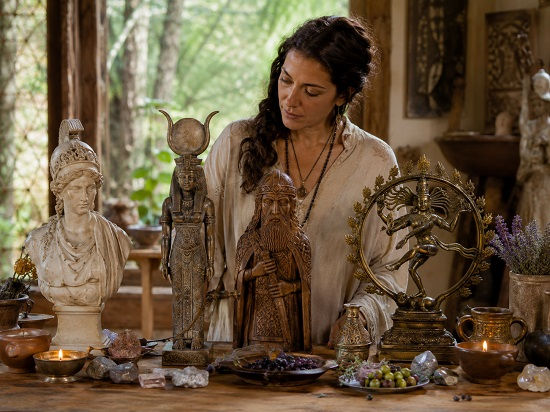
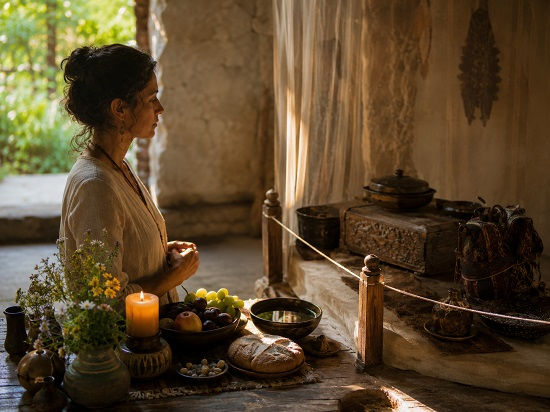
Choose a quiet moment and a simple setting. A clean surface, a single candle, and if the research suggested something she’s associated with, that one thing beside it: a stone, a sprig, a cup of water. Nothing needs buying, and a full altar is not required for a hello; building devotional space properly is a later lesson’s craft.
Light the candle and settle. A few slow breaths, until you’re actually in the room rather than in your plans for the room.
Say who you’re addressing, and who you are. Aloud, clearly, once. Names matter on both sides of an introduction.
Say why you’ve come, in one or two honest sentences. You noticed something; you’re opening a door; you’re not promising anything yet. That’s the whole content of a first hello.
Sit for a few minutes, then close simply. Stay a little while in ordinary attentiveness, expecting nothing, exactly as you practiced in your first week of this course. Then thank her for the moment, put out the candle, and go back to your evening. Done.
For the witch who freezes at step three, here are words to borrow until your own arrive, shaped for Hecate but easily refitted to any name your research has readied you for:
“Hecate, lady of the crossroads, I am [your name]. I’ve seen what may be your hand in my days, and I’ve done you the courtesy of learning your stories. This candle is my hello. I promise nothing tonight but attention, and I bring that gladly.”
Notice what the words do and refuse to do. They name both parties, they’re honest about uncertainty (“what may be your hand”), and the only thing pledged is attention, which is the one thing a beginner can honestly pledge. Afterward, log the evening in your ledger like any other entry, and let the relationship unfold at the pace of the time test, not the pace of your excitement.
Going Looking: The Seeker’s Path
Now the second doorway, for the witch nobody seems to be tapping on: going toward the gods yourself, as most practitioners across history did. The method is a funnel, wide to narrow, and your notebook already holds its starting material.
Start from your territories. Reread the map you drew in the opening lesson, especially the underlined warmth. What are you drawn to in the natural and human world: the sea, the forge, the crossroads, the field, the deep wood, the dawn, the threshold, the underworld? Each territory has deities who hold it, and the pull toward a territory is itself information. A witch drawn to thresholds finds her way toward figures like Hecate or Janus; one drawn to the forge, toward Brigid or Hephaestus or Goibniu. Write your two or three strongest territories at the top of a fresh page.
Glance at your heritage, without obligation. Look at your own ancestral lines with curiosity. No rule requires a witch to work with the gods of her ancestors, and this course will never impose one, but practitioners often report a quiet ease in relationships the bones already half-remember, and heritage can be a fine place to browse first. The full tour of the major pantheons arrives in the very next lesson, and it will make this browsing much easier.
Read myths wide and shallow, then watch your body. Read broadly across the traditions your territories and heritage suggest: a myth here, a profile there, nothing deep yet. You are not shopping for the goddess with the prettiest story or the best aesthetic; you’re listening for the one the body responds to before the mind has finished the page. Breath that catches, skin that prickles, the odd sensation of remembering rather than learning: practitioners treat that bodily catch as the seeker’s equivalent of a knock.
Shortlist, then funnel into the same road as everyone else. Two or three names, no more, on a page of their own. From here the seeker’s path joins the approached witch’s road exactly: the seven research questions, then, if one name keeps its warmth through the reading, the small introduction, then the ledger and the patient months. The doorways differ; the road is one
The Dedication Question: Not Yet
A question arrives almost immediately in either doorway: should I dedicate? Formal vows, initiation, a declared devotional commitment that locks the relationship in? The honest answer for nearly every beginner is that dedication is premature, for the same reason a new friendship doesn’t require a marriage. Where the dedication question comes at all, it comes years in: after the relationship has shown itself real, after the witch knows what the deity actually asks of her, after both sides have weathered silences as well as closeness. Rushing a vow is a way of trying to manufacture significance the relationship hasn’t yet earned, and while the deities of the open Western traditions are, by long report, patient with overeagerness, they’re also said to honor practitioners who take their time. Take your time. This course will still be here.
The Polite Decline
Sometimes the harder version of the whole question arrives: a deity does seem to be choosing the witch, and the witch does not want the relationship. This happens far more often than the breathless devotional literature admits. The figure may come from a tradition that feels distant or strange, or carry an intensity the witch is not ready to live alongside, and the signs may be unmistakable while her honest answer remains not this one, not now, not me.
So learn this early, because it’s the part nobody teaches: declining is a real option, and treating it as one is part of taking deity work seriously. A witch may say no. Saying not yet is equally hers, and so is asking, with genuine curiosity, why me, and what am I not seeing? By the common report of practitioners who have made such declines, the gods of the open Western traditions respect clear communication and do not punish honesty. What tends to go badly is the half-decline: claiming to refuse while keeping the door cracked, saying no while still wearing the symbols and rereading the myths nightly, performing reluctance while continuing to reach. Either step through the door or close it, courteously, and mean what you say.
Words for each, spoken once at a lit candle, until your own arrive. The clean decline:
“I see you, and I’m honored to have been seen. My honest answer is no; this is not a relationship I can carry. I close this door with respect, and I wish you well of those who can.”
The not-yet:
“I see you, and I’m not ready. I’m not saying never; I’m saying not now. If this is real, it will keep, and if you return in a kinder season, I’ll listen then.”
The inquiry, for the witch who wants to understand before answering:
“I see the pattern, and I don’t yet understand it. Why me? I’m going to keep my ledger and do my reading, and I ask your patience while I do.”
After any of the three, behave accordingly: the decliner puts the symbols away and lets the reading go; the not-yet witch and the inquirer keep their ledgers honestly. That congruence between word and behavior is the whole difference between courtesy and performance.
The Timescale of an Answer
One last thing worth knowing at the beginning: most relationships with deity do not resolve in the first week, the first month, or even the first year. The beginner who expects immediate certainty, yes, definitely this goddess, definitely the patron of my whole practice from now on, is usually disappointed by how slowly the answer actually arrives, and the slowness is not withholding. The relationship itself is the answer, and relationships take the time relationships take. What matters at the start is never certainty but sincere, steady attention: the witch who keeps showing up with her small courtesies, keeps reading the myths, keeps her ledger honestly, gets her answer in due season. The one who demands certainty by the end of the month rarely gets the relationship at all. When a call is real, practitioners will tell you, it can be trusted to make itself clear. Your job is to keep the door open and the candle lit, and to wait without rushing.
Witch Practice: One Afternoon at Each Doorway
This week you’ll stand briefly in both doorways, whatever your current situation, and leave with your notebook two pages richer.
Open your Calling Ledger. Set up the page as taught, whether or not anything is currently knocking. If suspected signs already exist in your life, backfill them honestly, with their real dates and honest sought-or-unsought tags. If nothing is knocking, the empty ledger is itself the honest record, and empty pages have a way of not staying empty across twelve modules.
Take the seeker’s afternoon. Give one unhurried hour to the funnel, starting from your own map’s territories: browse toward two or three deities who hold your strongest territory, and read one actual myth of the one who pulls hardest. As you read, watch the body, not the aesthetics.
Write the shortlist page. Title it “Names I’m Curious About” and record what the afternoon produced: each name, its territory, and one sentence on what the body did. “Nothing caught” is a valid and useful entry; so is one name underlined twice. Bring this page with you into the grand tour of the pantheons just ahead, where it will start earning its keep.
Close with the doorway question. One reflective line at the bottom, in your own first person: which doorway feels like mine right now, and what would change my mind? Date it, close the notebook, and let the months do what only months can.
Next comes the tour every seeker needs and every approached witch eventually wants: the major pantheons a Western witch is most likely to meet, walked respectfully, with their great figures introduced by name. Bring your shortlist.
Disclaimer: Everything IFS Academy is an independent educational platform and is not affiliated with, endorsed by, or connected to the IFS Institute. While we strive for accuracy, errors can occur, and users are encouraged to cross-reference critical information. The courses in the Witchcraft & Folk Magic Series explore witchcraft, folk magic, and related spiritual and cultural practices for educational and personal-interest purposes only. Nothing in them guarantees any particular result, and no ritual, spell, correspondence, or practice is offered as a substitute for professional medical, psychological, legal, or financial advice. Practices that involve fire, candles, herbs, plants, or other physical materials carry real risks such as burns, allergic reaction, or toxicity, and any practice is undertaken at your own discretion and risk. They do not constitute therapy, mental health treatment, clinical training, or crisis support, and they should not be used as a substitute for professional mental health care.
Crisis Support: 🚨 If you are experiencing a mental health crisis, feel unsafe, feel at risk of harming yourself or someone else, or feel too overwhelmed to safely use self-directed practices, please pause this material and reach out for immediate support. Contact a licensed mental health professional, call or text 988 in the U.S. or Canada, or use your local emergency or crisis resources.

Comments