👻Module 8 — The Ancestor Altar and the Daily Relationship | Deities, Ancestors, and Spirit Allies Course
Updated: Sep 29

Free Course by Everything IFS Academy Witchcraft Series
Help us reach the people who may need this most by sharing this free course with friends, family, colleagues, online communities, social media or on your own website.
🎧 Audio – listen on the go - (coming soon)
Module 8: The Ancestor Altar and the Daily Relationship
The altar is the anchor. A relationship without a place to gather tends to drift; that’s true of the friend never invited over and the family member seen only at funerals, and it’s equally true of relationships with the dead. Without a specific place where the ancestors are tended, the practice goes diffuse: the witch thinks of her grandmother now and then, speaks the name in passing, carries her in some general way, and the relationship never deepens, because it has nowhere to live. The altar changes that. It gives the dead a place in the home, hands the witch a focal point for her tending, and grants the relationship a site: one surface, one corner of ordinary life, belonging to the work and only to the work. Last week’s practice ended with a name, the one you most want to know better, and three pages of your dead beside it. This lesson builds their place, step by step, and then teaches the daily rhythm that turns a surface into a relationship.
Where the Altar Lives
Placement matters more than beginners realize, and three pieces of common counsel cover most of it. First: in wide custom across traditions, the ancestor altar is kept distinct from any deity space, separate surface, separate attention. The reasons run practical, mixing offerings to the dead with offerings to the gods muddles the practice on both sides, and deeper, since the dead and the deities occupy different registers and are owed different approaches; you learned the difference in register last lesson, and the separate surfaces simply honor it. Second: choose somewhere consistent and calm that you pass regularly, a living room corner, a hallway shelf, the cleared top of a bookcase, a dresser, since an altar you see is an altar you tend, and one buried in traffic and clutter gets neither peace nor attention.
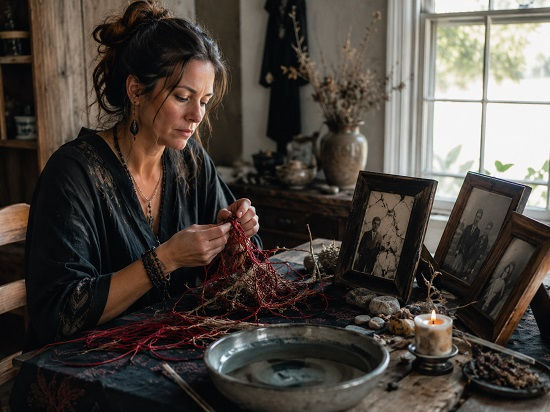
Third, the bedroom question, which every beginner eventually asks. Some traditions hold firmly that the dead should not share the sleeping space of the living, that the bedroom belongs to rest, intimacy, and dreaming, and some practitioners add that altar-adjacent sleep gets strange. Other traditions and plenty of working witches are relaxed about it, and keep bedroom altars contentedly for years. A witch in a studio apartment or a single rented room may have no other option, and the practice still works; the common compromise is a corner that doesn’t directly face the bed, and by broad experience that’s enough. What matters more than any placement rule is the quality of attention the place receives. And a comfort for the witch in a shared or skeptical home, continuing what you learned when you built your first devotional space: an ancestor altar is the most naturally discreet altar there is, because framed family photographs with a candle and a small glass beside them read, to every eye that doesn’t know otherwise, as exactly what they also are, a family remembering its own.
What Goes On It
Simpler than the books suggest, and as always in this course, nothing requires money. The common furnishings:
Photographs, or names on paper. Clear images of the specific dead you’re honoring, framed when possible. Where no photograph exists, and for the long line behind the named ones, the name written in your own hand on a slip of good paper serves fully; the dead are honored by being named, and paper carries a name as faithfully as film carries a face.
Their belongings, where you have any. The grandmother’s ring, the grandfather’s tool, the teacher’s annotated book, the small heirloom passed down. Objects that lived with the dead carry presence in a way nothing newly bought can match. None to hand? The altar is complete without them.
A glass of clean water. The essential piece; its own section follows.
A candle. White by wide tradition, though not required; colors that mean something to you or to a particular ancestor are welcome. The electric candle remains fully honorable where flame isn’t safe, exactly as you learned before.
A small plate or bowl for food offerings, and, if you like, a cloth beneath everything; white is the broad custom, any clean set-apart cloth serves.
A touch of the season. A sprig of evergreen in winter, petals in spring, a small fruit in autumn: optional, and it keeps the altar in living relationship with the year.
And the standing rule over all of it: simple beats elaborate. An altar demanding twenty minutes of weekly curation becomes a dreaded chore; one that refreshes in thirty seconds is one that actually gets tended, and by every tradition’s counsel the ancestors are not impressed by spectacle. They are met by attention. One more real-life note, because someone is already wondering: cats and dogs investigate altars, and the practitioners of the world’s tending traditions mostly take it in stride. Keep flames out of reach of tails, refresh whatever gets disturbed, and let the household be a household.
Who Belongs On It
The witch’s choice, entirely, and this matters enough to say slowly. The altar holds those whose presence you welcome: the ones you loved, the ones whose counsel you’d actually seek, the ones you want to know better, beginning with the name your last practice chose. Animal companions belong wherever you grieve them, exactly as the beloved-dead stream taught. And the altar grows over time; a witch who begins with three photographs often finds, a year in, that a fourth has earned its place, a great-grandmother grown real through the tending, a lineage elder whose work now shapes her practice, a friend whose absence she’s ready to hold in this register rather than only in grief.
The altar can also be curated, and hear this as permission with weight behind it: not every dead relative who shares your DNA is owed a place in your home. Some ancestors don’t belong on the primary altar, or don’t belong yet, or don’t belong ever, and a witch may keep certain figures at distance or off entirely. What to do when the family line contains real harm, how to honor a line without hosting its unsafe members, has the next lesson of this course entirely to itself, and it will be handled with the care it deserves. For now: the altar is yours. The relationship is chosen on your side as well as theirs.
And the altar can be paused. When life overwhelms, when a season demands everything else, the practice can rest: cover the altar with a cloth, set the photographs gently aside, and let the door close for a while. By the counsel of long practitioners this is neither abandonment nor failure; it is closing a door that will open again, and knowing how to pause is precisely how a practice survives decades instead of burning out in years. The work exists to hold the witch, never to become one more thing she’s failing at.
The Water
Now the foundation, worth its own quiet moment. Clean water, refreshed daily where possible or as often as your life honestly allows, is the single most universal offering to the dead across the world’s traditions: it appears in the African traditional religions and their diaspora, in the East Asian household practices, in the older European folk customs, nearly everywhere the dead have ever been tended. The explanations vary by tradition, the dead are thirsty, water is the simplest gift the living hold, water carries presence and keeps the way clear, and the practice underneath the explanations barely varies at all.
So: a small clear glass or simple bowl, filled fresh, set on the altar, replaced before it goes stale. That is the whole of it, and hear the scale of that plainly. If a witch does nothing else, ever, beyond keeping clean water on her ancestor altar and refreshing it faithfully, she is keeping a real practice with her dead, whole and sufficient. The water is not a placeholder for some better offering that ought to arrive someday. In many traditions it is the central offering itself. The photographs and candles and heirlooms are the setting; the water is the practice. When you refresh it, the old water goes to the earth outside, to a potted plant, or to running water, and as you learned with the deeper powers and their gifts, what is given to the dead stays given: neither drunk by the living nor tipped thoughtlessly away.
Building the Altar, Step by Step
Choose the place and clean it well. Using the placement counsel above. Plain, thorough cleaning consecrates it at this stage, exactly as it did your first devotional space.
Lay the cloth and set the faces. Photographs and name-slips toward the back, arranged so each one can be seen, belongings among them where you have any.
Place the working pieces in front. The water glass, the candle, the offering plate: the things your hands will touch daily sit nearest your reach.
Fill the water, light the candle, and say the first hello. Aloud, plainly, in your own words or these, until yours arrive:
“This place is yours now. You who are named here, and the long line behind you: you are remembered in this house. I’ll be back tomorrow.”
Ten minutes, start to finish, and notice what the words promise: remembrance and return. Nothing else. No contact is claimed, no answers demanded; the whole practice stands on the two things a living person can actually give her dead, and those are attention and constancy.
The Daily Tending: Thirty Seconds That Build Everything
Here is the rhythm the whole relationship runs on, and it is deliberately small. Each morning or each evening, whichever your life keeps best:
Refresh the water, old to the earth or the plant, fresh to the glass.
Light the candle for a moment, watch the flame catch, and put it out before you leave the room; a breath or two of flame is plenty.
Speak a name or two, by way of greeting. “Morning, Grandma. Morning, Sam.” That register, truly.
Thirty seconds, and by the long report of every tending tradition, those seconds compound like nothing else in this craft. The witch who lights the candle every night for five years holds a relationship with her dead that the witch of lavish quarterly ceremonies simply does not, because, as the traditions consistently teach, the dead respond to faithfulness and to being remembered, and elaboration is usually a substitute for the steady tending that would have served better. You already know this principle by name: the smallest promise you can keep, kept. The ancestor altar is where that promise does its deepest work.
Speaking With Them: The Longer Sitting
Beyond the daily half-minute, the practice holds room for real conversation, and beginners overcomplicate this more than anything else in ancestor work. The approach every tending tradition converges on is the simplest one: out loud, at the altar, in plain language. Sit or stand, refresh the water, light the candle, and talk. Tell them what’s happening in your life, the hard week, the coming move, the worry about your mother’s health, the small joy of what bloomed in the garden. Ask for their steadiness on whatever you’re navigating, in the homely register you learned last lesson, asking an ancestor for an ancestor’s kind of help. Thank them for what they gave, the difficult lessons along with the easy ones. Address them directly, because within the logic of the practice, that is exactly what one does:
“Grandmother, I miss you. I’m trying to figure out what to do about this job. Help me see what I’m not seeing.”
Notice the diction, and take the counsel every tradition gives here: your actual voice, the one you’d use with anyone you loved. Not stylized, not archaic, not decorated; nobody’s grandmother ever wanted to be addressed in mock-medieval English, and the shared judgment of practitioners everywhere is that plain speech is what serves. Then comes the part the books skip: the listening. Stay a few minutes when the talking is done, in the same expecting-nothing attentiveness you’ve practiced since your first week. Practitioners describe what listening to the dead is like for them, and it is rarely a voice; more often a felt sense, a quality of attention seeming to come back, or a clarity that arrives quietly in the days after the conversation rather than during it. Let it be whatever it is for you, including, some days, nothing at all.
Signs, and the Honest Witch
What practitioners report as response, across traditions and generations, runs in a familiar register by now: subtle. A sudden unprompted memory with unusual clarity, the witch washing dishes and abruptly back in her grandmother’s kitchen. Dreams in which the ancestor is unmistakably themselves, voice and face and particular way of being present. A scent with no source, her perfume, his tobacco, the soap from that bathroom. Objects seemingly moved, a warmth or steadiness near the altar after a conversation, a welling of emotion that doesn’t match the moment it interrupts.
And now the teaching that keeps all of it honest, in exactly the shape you’ve carried since the first lesson. None of these is proof, in the way the modern mind sometimes wants proof; they are what the traditions call signs, and a wise witch neither seizes each one nor swats it away. Your stool and your flat honest logging serve here precisely as they’ve served everywhere else. What experienced practitioners describe is accumulation: signs gathered lightly across months and years, until somewhere along the way the accumulation becomes trust, and the trust is itself the relationship, the way you know a friend is still in your life through a season of not seeing her. And for the witch whose altar simply stays quiet, hear the oldest comfort in this practice, held by every tradition that keeps it: the tending counts entire, response or no response. Remembering the dead was never a means to an experience. In every culture that ever kept this work, the remembering is itself the relationship, and the witch who keeps the water fresh has not failed at anything; she is doing the very thing the practice is.
The Year of the Dead
Beyond the daily rhythm, the year offers seasons of deeper attention, and the deepest sits at the autumn turning. In the streams the modern Western witch most commonly inherits, late October and early November have long been the dead’s own season: Samhain in the Celtic-derived line, All Saints and All Souls in the Christian one, the stretch when the veil, in the old image you know well by now, is said to run thin. Whether a witch holds that literally or as a useful picture, the season invites what the rest of the year doesn’t, and the altar traditionally answers: more candles, the foods the dead loved, photographs not usually out brought forward for the season, and longer sittings, more telling, more listening. Smaller markers thread the rest of the year: birthdays of the beloved dead, anniversaries of their deaths, the family holidays they’d have presided over, and, in some traditions, the solstices and equinoxes. Over years, every tending witch develops her own calendar of the line, and yours begins in this week’s practice.
One boundary to carry with you, from the lesson on open and closed, because the dead’s season is where beginners most often stumble into it. Día de los Muertos and Obon are not generic ancestor festivals free for the borrowing; they are specific cultural and religious observances belonging to specific communities, with their own forms, meanings, and dates. Study them, admire them, let their seriousness raise your standard for how your own line deserves tending at your own markers, and leave their iconography, language, and forms with their people. Your practice is yours. Their practice is theirs. Both are real.
Witch Practice: The First Week of Tending
This is the week the pages become a place. Everything below sizes to any home and any budget, and the whole week costs a glass of water a day.
Build it, for them. Set up your ancestor altar this week using the steps taught, beginning with the name your last practice chose and adding whichever warm names from your three stream pages belong there now. Small is correct; three faces and a glass of water is a complete altar.
Keep the thirty seconds, seven days running. Water, flame, a greeting by name, morning or evening at the hour your life will actually keep. This is the smallest promise again, now standing at its most important door.
Hold one longer sitting midweek. One unhurried conversation: tell them one true thing about your life as it is right now, in your own voice, and stay a few listening minutes after. Log it that evening like any other entry, flat and honest, including “nothing noticed, glad I sat.”
Start your calendar of the line. A notebook page titled “Days of My Dead”: the death anniversaries and birthdays you know from your stream pages, the family days that matter, and the autumn season marked as the year’s deep point. Ask your story-keeper for the dates you’re missing; it’s a perfect second question for that visit.
Close the week in writing. One honest reflection: what did it do to the house, and to me, to have a tended place for them in it? Date it, and keep tending; from this week on, the thirty seconds simply belongs to your days, and the lessons ahead will treat it as running.
One threshold remains in the ancestor teachings, and it is the one this course has been carefully saving: the family lines that hold real harm, the ancestors a witch cannot safely welcome, and how the work of tending survives, and even heals, when the tree itself is wounded. That is the next lesson, and it will be handled gently.
Disclaimer: Everything IFS Academy is an independent educational platform and is not affiliated with, endorsed by, or connected to the IFS Institute. While we strive for accuracy, errors can occur, and users are encouraged to cross-reference critical information. The courses in the Witchcraft & Folk Magic Series explore witchcraft, folk magic, and related spiritual and cultural practices for educational and personal-interest purposes only. Nothing in them guarantees any particular result, and no ritual, spell, correspondence, or practice is offered as a substitute for professional medical, psychological, legal, or financial advice. Practices that involve fire, candles, herbs, plants, or other physical materials carry real risks such as burns, allergic reaction, or toxicity, and any practice is undertaken at your own discretion and risk. They do not constitute therapy, mental health treatment, clinical training, or crisis support, and they should not be used as a substitute for professional mental health care.
Crisis Support: 🚨 If you are experiencing a mental health crisis, feel unsafe, feel at risk of harming yourself or someone else, or feel too overwhelmed to safely use self-directed practices, please pause this material and reach out for immediate support. Contact a licensed mental health professional, call or text 988 in the U.S. or Canada, or use your local emergency or crisis resources.

Comments