👻Module 7: The Ancestors | Deities, Ancestors, and Spirit Allies Course
Updated: Sep 29
Free Course by Everything IFS Academy Witchcraft Series
Help us reach the people who may need this most by sharing this free course with friends, family, colleagues, online communities, social media or on your own website.
🎧 Audio – listen on the go - (coming soon)
Module 7: The Ancestors: Who They Are and Why They Matter
Almost every human culture, across almost every century of recorded existence, has tended its dead. The forms vary enormously, and a short walk through them is worth taking, because it changes what a beginner thinks she’s doing when she starts. In the traditional religions of Africa, the ancestors hold a central place: household and community life is shaped by ongoing relationship with them, and their counsel is sought for the decisions that matter. Across East Asia, the ancestral altar in the home and the regular offerings kept there have been everyday practice for thousands of years; families still clean the graves at China’s Qingming festival, welcome the ancestors home at Japan’s Obon, and set the careful Jesa table in Korea. Four thousand years ago in Mesopotamia, families gathered for the kispum, offering bread, water, and beer to the family’s dead by name. Hindu shraddha rites tend the departed across generations, understood as duty and loving care that aids their journey. In Mexico, Día de los Muertos brings the dead back into the family kitchen for two days each year, with marigolds and favorite foods and the photographs gathered on the ofrenda.
Indigenous nations across both American continents tend their dead in ways belonging to their specific peoples, and the tending itself is constant. Even Christianity carries the thread: the communion of saints, in its older and more serious forms, is ancestor practice in everything but name, the holy dead attended, asked, kept in living relationship, while European folk custom kept its own quieter threads of the old tending running under Christian forms for centuries, visible to anyone looking carefully.
Hold all of that in one hand, and then look at modern Western culture, because here is the module’s first real teaching: we are the outlier. The strangeness is the absence, not the presence. The position that says the dead are simply gone, that the living and the dead occupy sealed categories, that the right relationship to a deceased grandmother is a funeral and then a long polite forgetting: that position is barely two centuries old in any thorough form, and almost everyone who came before, in almost every place, would find it bewildering. A witch beginning ancestor work is not doing something fringe or newfangled. She is rejoining the oldest and most widely shared spiritual practice the human species has.
What the Forgetting Cost
When a culture forgets its dead, specific things go missing, and naming them explains why this work matters beyond sentiment. Guidance goes first: the slow, grounded counsel of those who lived through what the living are now living through. Identity thins next, the sense of being rooted in something older than one’s own short life and small set of choices. Rootedness itself follows, the feeling of being placed in a long line, held by it and accountable to it. And last goes a quiet kind of protection older cultures took for granted: the settled sense that the dead who loved the living are still nearby, still watching out in small steady ways that never announce themselves.
Much of the groundlessness modern people describe, the floating quality, the unanchored feeling, the sense of a life happening in a vacuum, is connected to this severance. Not all of it, and ancestor work is no cure-all; honest teaching says both. But the connection is real, and practitioners who take this work up consistently describe the same recovery: a life that feels held from behind. Bringing the dead back into ongoing practice is one of the deepest recoveries available to a witch, and one of the simplest to begin. The threshold is low. The depth available across a lifetime of tending is profound.
The Three Streams, Walked Slowly
At the very beginning of this course, when you drew your first map, you met the ancestors as three streams. Here those streams get their full walking, because each one holds more than the map could show, and because your notebook is about to grow three of its most important pages.
The Blood Stream
Blood ancestors are those related by biological lineage, known or unknown. The parents and grandparents you can name, and behind them the great-grandparents you may never have met, the names surviving only on a faded record somewhere, and the long line running back behind those into a depth that quickly outruns every document. Sit with the arithmetic for a moment, because it teaches something. Four grandparents; eight great-grandparents; sixteen great-great-grandparents, and very few people alive could name all sixteen. Twenty generations back, the doubling has passed a million places in the family tree, and almost no one who filled them appears in any record that survives. That is normal. It is the situation of nearly everyone alive, and it matters that a beginner know it before she starts, so the not-knowing never feels like disqualification.
Because here is what remains when the names are gone, and it is the bedrock of blood-line work: the structural fact. You are the living descendant of everyone in that line who survived long enough to bring the next generation. An unbroken chain of survival runs back behind you into prehistory, each link a person who lived through famine, plague, displacement, war, and ordinary hardship long enough to hand life forward, and had any one of them fallen too soon, you would not be standing where you stand. Ordinary, and extraordinary, both at once. The ancestors are not abstract even when their names are lost; they were specific people, and you carry their continuation in your very existence. Working with the line begins from that fact, and needs nothing else to begin.
The Lineage Stream
Lineage ancestors, the stream your first map called the ancestors of affinity and craft, are kin through the work rather than the body: the line of practitioners, teachers, and makers whose inheritance you now carry. For a witch that may mean the elders of the craft itself, the writers and teachers who rebuilt these paths in living memory, the individual elders of her own branch where she has one. It reaches wider than the craft, too. The author whose books formed the person you were becoming, the artists and organizers of a community you belong to, the queer elders who lived through what a younger generation no longer must, holding the line through darker times: all of these are lineage dead, and by wide practice they can be honored alongside the blood line or entirely instead of it.
The Beloved Dead
The beloved dead, the stream your map called chosen and heart-bound, are the specific dead who shaped you personally, whatever the family tree says. The close friend gone too young, whose absence still turns up every season. One grandmother actually loved, singled out from a difficult family. A mentor who saw you clearly, maybe first, and is no longer alive to be told what that meant. And yes, the animal companions who belonged to your life in that intimate way; by broad modern practice they belong in this stream too, and no one gets to argue a witch out of who she grieves. The beloved dead are not an abstract class. They are particular, with names and faces and the specific shapes of who they were, and nobody else can say who belongs in this stream for you. Your altar, when you build it in the next lesson, will reflect your actual life, never a tidy abstract tree.
When the Blood Line Isn’t Home
Some witches cannot reach their blood line in any meaningful way, and this deserves plain address rather than a footnote. Some are adopted, holding no information about biological family, or holding information that does not feel like home. Some come from lines so harmful that beginning the work there would not be safe; the next lesson in this course is devoted entirely to that situation, and it will not be handled in passing here. And some are simply estranged, by circumstance or choice, for whom a blood altar would ring hollow. Not one of these witches is shut out of ancestor practice. The chosen streams are fully real, and for some practitioners they are the primary line for the whole of the work, never a backup or a consolation. An adopted witch may keep her adoptive family as exactly what they are, the family that raised her. A witch from a harmful line may build entirely from chosen kin, and the practice will hold her every bit as well. A line is not less real for being chosen; in some lives it is more real, chosen because it was chosen, kept because it was kept, rather than inherited by the accident of birth.
What the Ancestors Are Not
Now the clarity that saves beginners years of confused expectations, because the line between ancestor work and deity work blurs easily in early practice. Ancestors are not deities. They were human beings, with the ordinary scale of human knowledge and the ordinary mixture of wisdom and foolishness any life produces, and in the shared understanding of nearly every tradition that tends them, death does not automatically upgrade anyone. Dying confers neither wisdom nor omniscience, and not even, necessarily, more lovingkindness than a person managed while alive. The grandmother who was sharp and judgmental in life is, by long practitioner report, best expected sharp and judgmental still, in whatever way the dead persist; the friend who was funny and kind remains funny and kind. Personality, wisdom, and limits tend to come along.
So the register of approach differs, and learning the difference is real skill. A goddess is asked, in her proper register, for what falls within her domain. An ancestor is asked, in a homelier register, for what an ancestor can give: mostly the steady presence and settled counsel of someone who knew you, who knows the line, who now sees from a slightly different vantage. What an ancestor never gave in life, she cannot hand you from beyond it; the grandmother who never solved being loved cannot counsel your marriage, and the mentor who never beat his own creative blocks cannot dissolve yours. What she can give is much, and it is not unlimited. Treat the ancestors as gods and the result is disappointment, followed by the slow erosion of a genuine relationship under expectations it was never going to meet. Treat them as exactly what they are, your people, still yours, and the relationship has room to become what it actually can be.
The First Skill of Ancestor Work: Gathering the Stories
Here is the skill this module hands you, and it may be the most time-sensitive teaching in this entire course: gather the stories while the story-keepers live. Every family has one or two, the aunt who remembers everyone, the oldest uncle, the grandmother herself, and every year the craft’s practitioners repeat the same regret in almost the same words: I waited too long to ask. The names, the photographs with no captions, the reasons the family left the old country, the grandmother’s grandmother’s first name: these live in aging memories, and a single unhurried conversation can save what no archive holds. This is ancestor work of the most literal kind, and it needs no altar, no belief, and no metaphysics at all. Here is the method.
Choose the keeper and ask for the visit. Identify the living relative who holds the most memory and ask plainly for an hour: “I’ve been wanting to know more about the family. Could I come sit with you and hear some of the stories?” In the wide experience of everyone who tries this, the keepers are honored to be asked; most have been waiting years for someone to want it.
Bring a way to keep it. A phone’s voice recorder, asked about openly: “May I record so I don’t lose any of it?” Notes if recording isn’t welcome. Bring any unlabeled old photographs you can find; photographs unlock memory like nothing else.
Ask questions that open rather than close. Names and dates shut people down; stories open them. Five that work, in the long experience of family historians: Who is the oldest relative you actually remember, and what were they like? What stories did your parents tell about their parents? Which stretch was the hardest the family ever came through? What did the family always eat, sing, say, or do? And, near the end: who do you wish you’d asked more questions?
Then do the one thing interviewers find hardest: stay quiet and let the silences do their work.
Close with thanks, and write it down that night. Thank the keeper, truthfully, for what they’ve carried. That same evening, while it’s warm, write the names and stories into your notebook; memory of a conversation fades faster than the conversation deserves.
And for the witch with no keeper left to ask, hear this clearly: you are the keeper now, and the method turns inward without losing a thing. Sit with your own memory, one beloved dead at a time, and write one full story of each as only you can tell it: how she laughed, what he always said, the afternoon that shows exactly who they were. In every tradition that tends the dead, the telling of the stories is itself part of the tending; practitioners often say the dead are kept alive in the telling, and whatever else may be true, the teller is changed by it. A curious witch can also spend one evening with the public records, the census pages and ship manifests and parish registers now searchable from any kitchen table; treat it as an optional door, not an obligation, and let one evening be one evening.
Why Witches So Often Begin Here
A last teaching before the practice, and it explains why many teachers of relational craft point beginners to this door first. Deity work can be overwhelming at the start: the scale of the gods, the seriousness of approach, the whole question of calls and pantheons you’ve just spent four lessons learning to navigate. The ancestors are closer. You already have them, every stream of them, and no discernment is needed to establish that: the blood line is yours by simple fact, the lineage line by recognition, and the beloved dead because you loved them. The relationship starts from ground that never needs building from nothing.
And tending the dead well builds the exact capacities everything else in relational craft runs on. A witch who has kept an ancestor altar for a year, who has practiced attending to presence that cannot be seen, who has noticed what steady offering does to her own attention and the texture of her days, is far better prepared for deity work than one who attempted the gods first with no relational ground beneath her. The listening transfers, and so do the reciprocity, the patience, and the honest recording you’ve kept since your first week. Ancestor work is, in many ways, the apprenticeship of the whole relational craft, and witches who begin here consistently find the rest arriving more easily than they expected. In the understanding nearly every human culture has kept, the dead were never far, and the long modern silence was the strange thing, not the tending. What that tending looks like in a real home, the altar, the daily rhythm, the words, is exactly where this course goes next.
Witch Practice: The Three Pages and One Story
This week you build the foundation the next lesson’s altar will stand on, and you save something that can’t wait.
Build the three stream pages. Return to the “My Dead” page from your very first map and grow it into three: one page per stream, titled in your own words. On the blood page, every name you can gather, and beneath the last of them one line acknowledging the unnamed line running back behind, in whatever words are yours. The lineage page holds the dead of your craft, work, and communities. And the beloved page takes your particular dead, animal companions included. Beside each name across all three, one short line: what this one gave me.
Gather one story. If a story-keeper lives, make the ask this week; the visit can come later, but the ask goes out now, because this is the one teaching in this course that genuinely cannot wait. If no keeper remains, become one: choose a name from your beloved page and write their story in full, an actual telling, a page or more, as only you can tell it.
Mark the warm names. Read all three pages slowly, the way you once read your first map, and underline where you feel warmth, pull, or grief with life in it. These are the names most ready for tending.
Close with the tending question. One dated line at the bottom: “The one I most want to know better is...” Bring that name, and these pages, to the next lesson. The altar you’ll build there is for them.
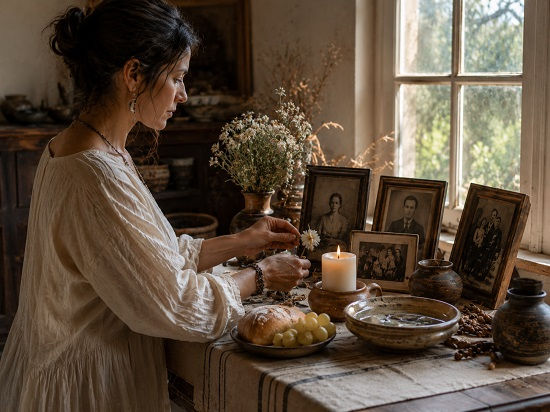
Next, then, the tending itself: the ancestor altar and the daily relationship, built step by step, photographs and water glasses and the words that go with them, in any home and on any budget. The pages you just wrote are its foundation.
Disclaimer: Everything IFS Academy is an independent educational platform and is not affiliated with, endorsed by, or connected to the IFS Institute. While we strive for accuracy, errors can occur, and users are encouraged to cross-reference critical information. The courses in the Witchcraft & Folk Magic Series explore witchcraft, folk magic, and related spiritual and cultural practices for educational and personal-interest purposes only. Nothing in them guarantees any particular result, and no ritual, spell, correspondence, or practice is offered as a substitute for professional medical, psychological, legal, or financial advice. Practices that involve fire, candles, herbs, plants, or other physical materials carry real risks such as burns, allergic reaction, or toxicity, and any practice is undertaken at your own discretion and risk. They do not constitute therapy, mental health treatment, clinical training, or crisis support, and they should not be used as a substitute for professional mental health care.
Crisis Support: 🚨 If you are experiencing a mental health crisis, feel unsafe, feel at risk of harming yourself or someone else, or feel too overwhelmed to safely use self-directed practices, please pause this material and reach out for immediate support. Contact a licensed mental health professional, call or text 988 in the U.S. or Canada, or use your local emergency or crisis resources.


Comments