🧿 Module 3 — The Pendulum Itself: Bobs, Chains, and Materials | Pendulums Course
Updated: 3 days ago
Free Course by Everything IFS Academy
Help us reach the people who may need this most by sharing this free course with friends, family, colleagues, online communities, social media or on your own website.

🎧 Audio - listen on the go (coming soon)
Module 3 — The Pendulum Itself: Bobs, Chains, and Materials
Walk into any crystal shop and the pendulum case glitters like a jewelry counter: faceted amethyst points, polished rose quartz drops, brass teardrops on fine chains. Now consider this: a hex nut from a hardware store, tied to a length of kitchen string, is, by every functional standard the tradition itself holds, the same instrument. Old dowsing manuals say so outright, and seasoned dowsers delight in proving it. Anything with a little weight, hung so it can swing freely, is a working pendulum.
And yet practitioners choose with real care. They handle a dozen pendulums before buying one. They keep favorites for decades, retire one for another, and pass instruments down like heirlooms. That apparent contradiction, an instrument that can be anything, chosen as though it were everything, is not carelessness on the tradition's part. The reasons behind the choosing are a genuine body of lore, and they are this lesson's teaching: what a pendulum is made of part by part, what the materials and shapes are, what the tradition says each one brings, and how dowsers select, keep, and care for the instrument at the center of their craft.
The Anatomy of a Pendulum
Every pendulum, from the museum piece to the hex nut, has the same few parts, and the trade has names for each.
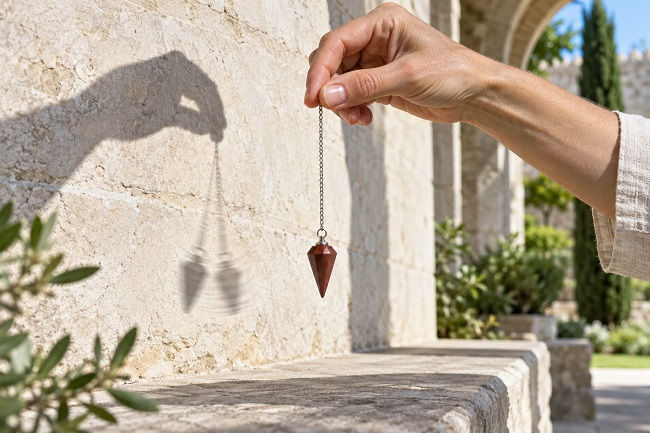
The bob is the weight itself, the body of the instrument, borrowing its name from the plumb bobs of builders and surveyors. Most bobs taper to a point at the bottom, a small but consequential feature: the point gives the swing a precise tip to read, which matters most when a pendulum is worked over a map or a chart, where a difference of a finger's width can mean a different answer.
The chain or cord is the pendulum's suspension, usually a few inches of fine chain, braided cord, or thread. At its top, many pendulums carry a handle bead or fob, a small ball or cap that gives the fingers something definite to grip so the hold stays consistent.
Two variables in this anatomy carry most of the lore. The first is weight. Dowsers traditionally describe a light bob as quick, eager, responsive to the smallest signal, and a heavy bob as steady, deliberate, harder to disturb by a shaking hand or a breeze. Many practitioners keep one of each, the way a carpenter keeps more than one hammer. The second is length, meaning how far down the chain the fingers hold. A short hold gives a tight, fast, small swing; a long hold gives a wide, slow, dramatic one. Most working dowsers settle somewhere in the span of a few inches, and the tradition treats the exact spot as personal, something each practitioner discovers rather than copies. One figure in the pendulum's history, the Cambridge archaeologist T. C. Lethbridge, whose story belongs to The Origins of Pendulum Divination, went so far as to build an entire system on precisely measured cord lengths, which shows how seriously the tradition can take this single variable.
The Materials
What a bob is made of is the first thing the eye notices and the subject of the tradition's richest instrument lore. Four families cover nearly everything in use.
Crystal and Stone Pendulums. The modern era's favorites, and the ones filling that shop case. Clear quartz leads the family; the tradition regards it as the all-purpose stone, clear in both senses, suited to any question. Amethyst is traditionally associated with intuition and spiritual matters, and many practitioners reach for it when the question feels inward. Rose quartz carries the tradition's associations with the heart, matters of love and relationship. Dozens of kin follow, each carrying the meanings the wider crystal lore assigns to its stone, and a pendulum buyer is often really choosing a stone first and an instrument second. It is worth saying plainly that these associations belong to the tradition's own system of correspondences, taught here as what practitioners hold rather than as established properties. A Devon who buys an amethyst point because the question on his mind is a spiritual one is practicing that correspondence lore exactly as the tradition teaches it.
Metal Pendulums. The old working world of dowsing belongs to metal, and above all to brass. Open a dowsing society catalog from the last century and brass teardrops dominate the page. The tradition's telling gives brass two virtues: it is not magnetic, which old dowsers prized because they held that a magnetic bob could be pulled by something other than the answer, and it is regarded in the lore as energetically neutral, an instrument that brings no associations of its own to the question. Copper appears with its own lore of conductivity, prized by practitioners who frame dowsing in terms of energy flow. Steel exists but sits lowest in the traditional ranking, precisely because it can be magnetized. A field dowser's brass pendulum, dull, dented, and forty years old, is the unglamorous aristocrat of this family.
Wood Pendulums. The quiet third family, and the choice of a particular temperament. Wood is light, warm in the hand, and traditionally regarded as the most neutral material of all, carrying neither the stone lore of crystals nor the conductivity lore of metals. Practitioners who work the health and food branches of the craft often favor wood for exactly that reason, the way a chef might insist on a neutral oil. Pear, beech, and fruitwoods turn beautifully on a lathe, and most wooden pendulums are simple turned teardrops, instruments with nothing to say about the question except the answer.
Everyday Pendulums. The folk family, and the oldest of the four. The wedding ring on a thread, the locket, the pendant necklace pressed into service, the washer, the key, the hex nut. The ring-and-thread custom of divining a baby's sex, taught in The Origins of Pendulum Divination, lived for centuries entirely inside this family. The folk truth it preserves is the one this lesson opened with: anything that swings can serve. Many longtime dowsers tell the same story in different forms, that their first pendulum was a necklace borrowed in a moment of curiosity, and some never see a reason to upgrade. The tradition honors these improvised instruments rather than looking down on them, because they prove the craft was never really about the object.
The Shapes and Designs
Across all four material families, a handful of shapes recur, and two of them carry famous design lore of their own.
The Teardrop and the Plumb Bob. The workhorse forms, between them covering most pendulums ever made. The teardrop is the smooth, rounded drop tapering to a point; the plumb bob form is its more angular cousin, lifted directly from the surveyor's toolkit. Both exist for the same plain reasons: they hang true, they swing evenly in every direction, and the point reads precisely. When the old dowsing societies pictured a pendulum in their journals, this is the silhouette they drew.
The Faceted Point. The crystal-shop standard: a six-sided stone point, usually with a faceted shoulder, hanging from a few inches of chain. The shape is largely a product of how crystals are cut and what the modern market finds beautiful, and there is honesty in saying so. It swings as well as any teardrop, the point reads finely, and for the newest generation of practitioners this shape simply is what a pendulum looks like.
The Mermet (Chambered) Pendulum. The most distinctive design in the tradition, a hollow metal bob, usually brass, that unscrews to reveal a small internal chamber. The chamber holds what dowsers call a witness: a physical sample connected to the search, a few grains of the mineral being sought, a drop of water, a fragment of something belonging to a missing object's owner. In the tradition's telling, the witness tunes the instrument to its target, the way a scent gives a tracking dog its trail. The design takes its name from Abbé Alexis Mermet, the celebrated French priest-dowser whose story is told in The Origins of Pendulum Divination, and it remains the signature instrument of the practice's serious working branch, the pendulum equivalent of a professional's tool.
The Isis Pendulum. The tradition's great exotic: a turned metal design of stacked discs above a rounded body, its name and styling drawn from Egyptian imagery. Its lore comes from the French radiesthesia school, which developed an elaborate teaching that shape itself matters, that a pendulum's geometry produces an effect of its own, independent of material. Within that school, the Isis design is held to be a powerful general-purpose emitter and receiver. Taught honestly, this is design lore from one influential branch of the tradition rather than a settled fact even within dowsing as a whole, and plenty of brass-teardrop dowsers regard it with a friendly shrug. But the Isis form endures because it makes a claim no other pendulum makes: that the shape is doing some of the work.
Choosing a Pendulum
How does a practitioner actually pick one? The tradition's customs here are remarkably consistent across books, schools, and generations, and they are best seen rather than listed.
Picture a Maya at a Sunday market stall, a tray of pendulums in front of her. The stallholder, a longtime dowser, does not begin with materials or prices. She tells Maya to look at the tray and notice which one her eye keeps returning to. That is the tradition's first custom, often summarized as the pendulum chooses you: the instrument that draws the eye or the hand, for reasons the chooser cannot quite explain, is traditionally held to be the right one. Maya keeps coming back to a small brass teardrop, plainer than everything around it. The stallholder then has her hold it still over the tray and simply wait, watching for it to move on its own, a custom many practitioners use as a kind of handshake test, taking an easy, lively response as a sign of a good match. The teardrop drifts into a slow circle, and the stallholder smiles and tells her that a heavier one will steady her hand as she learns, but that this one has already answered her.
Everything in that scene is the tradition's selection lore in miniature: attraction first, response second, practical fit third. None of it is being prescribed here, and a reader should notice that the entire ritual quietly contradicts the hex-nut truth this lesson opened with, since a craft in which any weight serves has no functional need for a chosen instrument. The tradition holds both ideas at once without embarrassment. The instrument does not matter, dowsers say, and mine matters to me. Most crafts with old roots contain a tension exactly like this one, and it tends to mark the places where a practice means more to its practitioners than its mechanics alone can explain.
Care and Cleansing Lore
Once chosen, a pendulum enters the tradition's customs of keeping, and these customs are where the instrument lore connects to the wider world of practice culture.
The central idea is what might be called the energetic-residue frame: the tradition holds that a pendulum accumulates influences from handling, from places, and from heavy questions, and that an accumulated instrument answers less cleanly. Whether a practitioner takes that frame literally or treats it as a ritual of respect, the customs it produces are the same, and they form a small canon repeated across the literature:
Moonlight. Leaving the pendulum on a windowsill overnight, traditionally under a full moon, the gentlest and most popular clearing custom.
Salt. Resting the bob on or in dry salt, the old purifier of European folk practice, with the practical caution, repeated even within the tradition, that salt and water can damage some stones and metals.
Breath and intention. A single deliberate exhalation over the bob with a clearing thought held in mind, the quickest custom and the favorite of practitioners who clear before every session.
Running water. A brief rinse under a stream or tap, again with the tradition's own warning about which materials tolerate it.
Storage carries its own quiet lore. The small drawstring pouch is nearly universal, and an old strand of the tradition specifies silk, held to insulate the instrument from stray influences between uses. A dowser's pendulum living in its pouch in a coat pocket, cleared on the windowsill at the full moon, is practicing a domestic liturgy that would have been recognizable a century ago.
What deserves a plain final word is why the tradition bothers. The care customs are doing more than maintenance. They mark the pendulum as an instrument set apart from ordinary objects, they give the practitioner a ritual of beginning and ending, and they encode the tradition's core conviction that the quality of an answer depends on the condition of the whole arrangement, instrument included. A hex nut on a string can do the job, the lore agrees. But the lore also understands something true about human beings: we work differently with things we treat as mattering. The whole of this lesson's apparent contradiction resolves there, and it is the most honest single insight the instrument lore has to offer.
Disclaimer:
Everything IFS Academy is an independent educational platform and is not affiliated with, endorsed by, or connected to the IFS Institute. While we strive for accuracy, errors can occur, and users are encouraged to cross-reference critical information. These courses present divination systems and their traditions for educational, historical, cultural, and self-reflection purposes only. They describe what these systems and their traditions teach and how their readers have traditionally interpreted them; they do not constitute fortune-telling services, predictions, religious instruction, spiritual direction, or an endorsement of any metaphysical claim, and they should never be used as a basis for medical, financial, legal, or safety decisions. They do not constitute therapy, mental health treatment, clinical training, or crisis support, and they should not be used as a substitute for professional mental health care.
Crisis Support: 🚨
If you are experiencing a mental health crisis, feel unsafe, feel at risk of harming yourself or someone else, or feel too overwhelmed to safely use self-directed practices, please pause this material and reach out for immediate support. Contact a licensed mental health professional, call or text 988 in the U.S. or Canada, or use your local emergency or crisis resources.


Comments