Module 5 — The Thought Record | CBT Course
- 22 hours ago
- 7 min read
Free Course by Everything IFS Academy | Therapeutic Modalities Series
Module 5 — The Thought Record
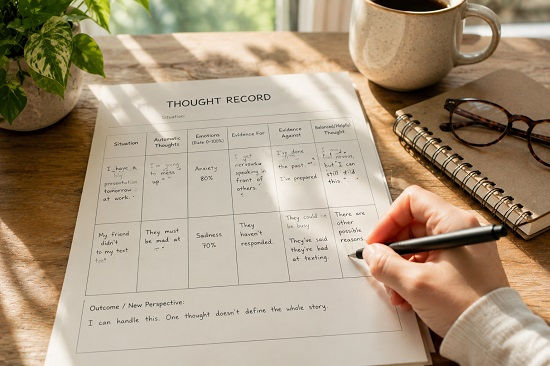
If CBT has one signature tool, the one most people picture when they imagine the therapy in action, it is the thought record. It is the page where a swirling, overwhelming moment gets slowed down, broken into parts, and laid out where it can finally be looked at. This lesson teaches what a thought record is, how it is built, and what each part is for. It is the structure that the rest of the cognitive tools live inside.
What a thought record is
In one line, a thought record is a structured worksheet that takes a single distressing moment and separates it into its parts so each one can be examined on its own.
It goes by several names. In clinical settings it is often called the Dysfunctional Thought Record, or DTR. Elsewhere it appears as a thought log, a thought diary, or simply a thought sheet. The names point to the same idea: a page with columns, filled in one at a time, that turns a tangled emotional experience into something orderly and visible.
The power of a thought record is not that it contains any single clever question. It is that it imposes structure on a moment that, left alone, would just spin. A racing mind moves too fast to inspect. A worry chases its own tail. A thought record stops the chase by forcing each piece into its own box, where it has to sit still long enough to be seen for what it is.
Why writing it down matters
A fair question is why any of this needs paper, when a person could in theory do it all in their head. The answer is the entire reason the tool exists.
Trying to examine a distorted thought purely in the mind tends to fail, because the same anxious machinery doing the examining is the machinery that produced the thought. The mind loops, jumps ahead, and quietly reshapes the evidence to fit the fear. Writing breaks that loop. It moves the experience out of the swirling internal space and onto a page, where it becomes an object rather than a storm. On paper, a thought that felt enormous and total often looks smaller and more specific. Writing also slows everything to the speed of a pen, which is far slower than the speed of a spiral, and that slowing is itself calming. In short, a thought record externalizes the cycle so it can be worked on from the outside.
The seven columns
The classic thought record has seven columns, filled in left to right. Each one does a distinct job, and together they walk a hot moment from raw distress to something clearer.
1. Situation. The bare facts of what happened: who, what, when, and where. Just the trigger, recorded plainly, with no interpretation mixed in yet. "Manager said my report needed work, in front of the team, at 2pm."
2. Automatic thought. The interpretations that fired in response, captured in the person's own words. Often several appear, and one of them carries the most emotional charge. That one has a special name, covered in the key terms below.
3. Emotion and intensity. The feelings the thought produced, each given an intensity rating from 0 to 100. The number is not decoration. It creates a baseline measurement, so that any later shift can actually be seen rather than guessed at. "Shame 85, anxiety 70."
4. Evidence that supports the thought. The honest facts that genuinely back the hot thought up. This column keeps the exercise fair, because the goal is never to bully a thought into submission, only to weigh it.
5. Evidence that does not support the thought. The facts that the distorted thought conveniently left out. Gathering this evidence is a CBT skill in its own right, called examining the evidence through Socratic questioning, CBT's method for putting a thought to the test. The thought record provides the column; the questioning skill provides what fills it.
6. Balanced alternative thought. A new thought that accounts for all the evidence, both columns, and lands somewhere fair and believable. Building this thought draws on cognitive restructuring, CBT's skill of reworking a distorted thought into an accurate one. Again, the record holds the space, and the restructuring skill does the shaping.
7. Re-rate the emotion. The original feelings, scored again from 0 to 100. Comparing this number to the one in column three reveals whether the work shifted anything, and by how much. A drop from 85 to 40 is the whole exercise made visible.
Two of these columns, the evidence work and the balanced thought, rely on skills that are large enough to deserve their own lessons. The thought record's job is to give those skills a home and a sequence, so they are applied in the right order rather than all at once in a panicked rush.
Self-monitoring: the wider habit
A thought record is one example of a broader CBT practice called self-monitoring, the simple act of tracking inner experience over time rather than only in a crisis.
Self-monitoring can be as light as keeping a daily mood log, noting the situations that preceded a dip or a spike. Done over a week or two, this kind of tracking starts to reveal patterns that are invisible from inside a single bad day. Certain people, places, times, or thoughts turn out to set the cycle off again and again. Seeing those patterns laid out is often the first time a person realizes their distress has a shape at all, and a shape can be worked with in a way that a vague cloud cannot.
Key terms
Hot thought. The single automatic thought most tightly connected to the strongest emotion in a given moment. A thought record may capture several thoughts, but the hot thought is the one worth running through the rest of the columns, because it is the one carrying the emotional weight.
Intensity rating. The 0 to 100 score given to an emotion. Its purpose is comparison. Without a before and after number, any change in feeling is just an impression, and impressions are easy to dismiss. The rating turns a felt shift into something measurable.
In everyday life
Consider Priya, who hears her manager say her report "needs work" in front of the whole team and feels the floor drop out from under her.
Left in her head, the moment is just a wave of shame and a single conviction that feels like fact. On a thought record, it becomes something she can actually handle. In the situation column she writes the plain event. In the automatic thought column she finds the hot thought sitting underneath the others: "I'm terrible at my job and everyone can see it." She rates the emotions, shame at 85 and anxiety at 70, fixing a baseline.
Then the columns do their slow work. The evidence supporting the thought is honest: the report did contain a few errors, and the comment was public. But the evidence against it, drawn out by examining the situation fairly, is substantial: her manager approved her last two reports, "needs work" is routine feedback rather than a verdict on her worth, one remark is not "everyone," and she was given more responsibility only months ago. Weighing both columns, a balanced thought takes shape: "This report had some fixable problems, and the feedback was about the work, not about me as a person. I've done strong work before and I can revise this." She re-rates her feelings. Shame falls to 40, anxiety to 35. Nothing about the external situation changed. The report still needs revising. What changed is that a thought masquerading as a life sentence was caught, written down, weighed, and answered, and the page shows the difference in plain numbers.
Common questions
Does a thought record have to be written down, or can it be done in the head? It can certainly be run through mentally once the steps are familiar, and many people eventually do an informal version on the fly. But writing is strongly recommended, especially early on, for the reasons that make the tool work at all. The mind in distress is too fast and too biased to examine itself cleanly. Paper slows the process, holds each piece still, and keeps the anxious mind from quietly rewriting the evidence as it goes. The writing is not busywork. It is most of the medicine.
What if the emotion or the thought is hard to name? This is common and not a failure. Sometimes only the feeling is clear at first, and the thought has to be coaxed out by asking what the feeling seems to be saying. Other times the reverse is true. A rough word is perfectly fine to start with, since the goal is not a perfect label but a usable one. Even writing "some kind of dread" and "a thought about not being good enough" gives the record enough to work with, and clarity often arrives partway through filling the columns.
How is a thought record different from ordinary journaling? Journaling is usually open and expressive, a place to pour out whatever is present, which has its own real value. A thought record is structured and targeted. It is not trying to capture the whole day or vent a feeling. It takes one specific moment, isolates the hot thought inside it, and runs that thought through a fixed sequence designed to test and rebalance it. Journaling explores. A thought record investigates.
How often is a thought record meant to be used? There is no fixed quota. Many people use one whenever a particular thought hits hard enough to derail them, treating it as a tool reached for in the moment rather than a daily chore. Used regularly during a difficult stretch, it also doubles as self-monitoring, surfacing the recurring triggers and patterns mentioned earlier. The aim, as with all of CBT, is for the structure to become familiar enough that its logic starts running on its own, even on the days no page gets filled out.
Below this lesson, you'll find an CBT practice built around the exact skill you just learned, along with a few ways to begin noticing and practicing it in everyday life this week.
Disclaimer: Everything IFS Academy is an independent educational platform and is not affiliated with, endorsed by, or connected to the IFS Institute. These courses, lessons, skills, and practices are offered for educational and self-reflection purposes only. They do not constitute therapy, mental health treatment, clinical training, or crisis support, and they should not be used as a substitute for professional mental health care.
Crisis Support: 🚨 If you are experiencing a mental health crisis, feel unsafe, feel at risk of harming yourself or someone else, or feel too overwhelmed to safely use self-directed practices, please pause this material and reach out for immediate support. Contact a licensed mental health professional, call or text 988 in the U.S. or Canada, or use your local emergency or crisis resources.


Comments