Module 4 — Color Correspondences | Candle Magic Course
- May 6
- 11 min read
Updated: May 15
Free Course by Everything IFS Academy | Witchcraft Series
Module 4 — The Color Correspondences
Does Color Actually Matter?
The question arrives early in every witch's candle practice, usually within the first few workings, and it tends to feel small. The witch wants to do a love spell, and what she has on hand is a white chime. She wants to do a prosperity working, and the only green candle in the drawer is half-burned from a previous spell. She is going to do the working anyway. So how much does the color actually matter?
The honest answer is: it matters more than beginners think and less than rigid practitioners insist. Color is one of the most powerful design choices in candle magic, and also one that the white-substitute rule will rescue when the witch finds herself without options.
Color is frequency. The witch chooses color the way a musician chooses a key, not as decoration, but as the tonal field the spell will broadcast on. A working in green broadcasts on a different frequency than the same working in red. The intention may be identical. The frequency is not. The candle's color suffuses the flame's intent, and as the wax burns, the witch is broadcasting her working on the frequency of that color into the world. The wrong color is not a fatal flaw. It is the wrong note. The working will still play, but it will play out of tune, and the witch with a developed ear will hear the difference.
Where the Modern Color System Comes From
The contemporary correspondences are largely a 20th-century synthesis drawing on medieval grimoire color associations, planetary magic, folk traditions of various lineages, and color symbolism inherited from ceremonial magic. Some correspondences are genuinely ancient and cross-cultural; red has carried associations of blood, passion, life force, and danger across nearly every documented human culture, and there is no candle tradition that disagrees with red for those purposes. Other correspondences are more recent consolidations, sorted into their current shape by the same paperback-era writers who systematized so much of modern witchcraft. The system is a working system rather than an unbroken ancient tradition. It works. It just was not handed down whole from antiquity.
The Core Colors
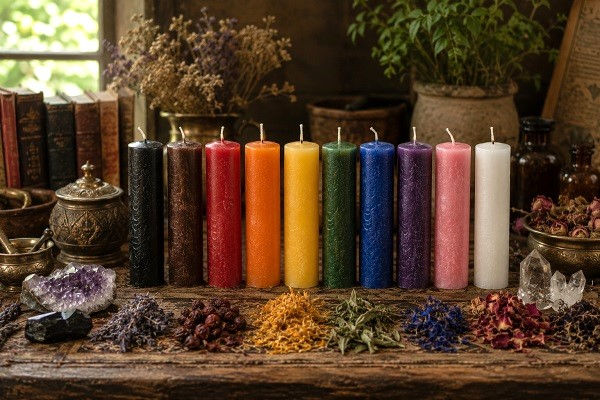
What follows is the working color system most modern witches use. Each color carries its own register of what it does best.
White — The Universal Candle
White carries purity, clarity, peace, spirit connection, new beginnings, cleansing, healing, and truth. Where most colors specialize, white generalizes — it is the color of clean energy without a particular flavor, which is exactly why it can substitute for any other color when the witch does not have the right one on hand. A white candle lit for a love working is not a worse love working; it is a love working in the simplest possible key. The substitute rule is not a fallback for emergencies only — it is a real principle of the system, and witches in difficult circumstances or sparse supplies have practiced effective candle magic on white candles their whole lives. White is also the primary color for spirit contact, ancestor work, deity invocation, and any working where the witch wants the energy clean and uncomplicated. When she is not sure what color the working calls for, white is rarely the wrong answer.
Black — Protection, Banishing, Shadow Work
The most misunderstood color in candle magic. The witch new to the practice often arrives carrying cultural baggage: black is sinister, black is for hexes, black candles are dangerous. Almost none of this is true. Black carries protection, banishing, absorbing negativity, shadow work, endings, and the breaking of curses. In traditions that practice baneful work, black does appear, which is part of where the cultural baggage came from. But in the much wider field of practical candle work, black is the color that absorbs and transmutes difficult energy. It is the color the witch reaches for when she needs protection against threat, when she is doing inner work with parts of herself she has been avoiding, when she needs to release something she has been holding too long, when something needs to end.
A witch who refuses to use black candles out of superstition limits her practice severely. Black does work that no other color can do.
Red — Action, Passion, Vitality
The most active color in the entire palette. Passion, sexual love, courage, vitality, physical health, strength, life force, fire, action. Red carries the blood, it is the color across cultures of life beating in the body, of desire that wants something now, of action without hesitation. The witch reaches for red when the working is about lust, sexual attraction, physical energy, healing of the body, motivation, swift action, or the kind of force that breaks through obstacles. Red is not subtle. Red is not patient. Red is the candle for working that needs to move.
What red is not is the color of gentle love. Romantic love that is sweet and tender, friendship love, the love that holds and nurtures rather than wanting and pursuing that belongs to pink.
Pink — Affection, Self-Love, Tenderness
Pink is red softened by white — affection rather than passion. Friendship, gentle love, self-love, tenderness, emotional healing, inner-child work, nurturing, kindness. Pink is what the witch chooses for relationship healing when two people who already love each other have hurt each other. It is what she chooses for opening her own heart, for self-compassion work after a hard period, for friendship spells, for any love working that is not about sexual desire. The distinction between red and pink determines whether the working calls forth fire or warmth. Both have their place. They are not interchangeable.
Orange — Creativity, Breakthrough, Momentum
The bridge color between red's force and yellow's mind. Creativity, joy, encouragement, confidence, quick success, sudden change, concentration, opportunity. Orange is the color of sunrise, things beginning, things opening, momentum building from nothing. Where red is the working that wants to push through, orange is the working that wants to unblock the project that has stalled, the creative work that has gone flat, the moment that needs a burst of fresh energy. Career breakthroughs often call for orange. So do creative blocks. So does the working when the witch needs encouragement more than she needs power.
Yellow — Mind, Communication, Clarity
The color of sunlight and thought. Communication, intellect, memory, solar energy, learning, travel, happiness, mental clarity. Where orange is the burst of beginning, yellow is the steady warmth of clear thinking. The witch lights yellow for study, for tests, for difficult conversations that need clear expression, for business communication, for travel work, for any spell that wants the mind sharp and the words right. Yellow is also a solar color not the major solar magic that gold carries, but the everyday solar of mental brightness and waking-life clarity.
Green — Prosperity, Growth, Heart-Healing
One of the two or three most-used colors in modern candle work, mainly because prosperity magic is one of the most-requested types of working in the entire tradition. Green carries prosperity, money, growth, fertility, luck, abundance, heart-healing, and nature work. There are two threads in green: the green of growing things and the green of cash and both are honored in the candle tradition. They are not in conflict; they are the same energy expressed in different dimensions of life. The witch lights green for the harvest, for the seed, for the bank account, for the heart that needs to open like a leaf to sun. Green is also a heart-chakra color in systems that use chakras, and shows up in healing work that is specifically heart-related emotional healing of grief, restoration of love after loss.
Blue — Peace, Truth, Intuition
Blue spans a wider range than most colors, and the witch should pay attention to which blue she is reaching for. Blue carries peace, calm, sleep, truth, healing, communication (especially emotional communication), intuition, water-element workings, and spiritual insight. Light blue is for gentle workings sleep, peace, soothing of anxiety, calming of an overheated situation. Deep blue is for the more serious end of the same color family truth-telling, psychic work, wisdom, the kind of spiritual insight that asks the witch to sit with hard things. The shade matters here in a way it does not for most colors. A pale dreamy blue and a deep navy blue are nominally the same color and do quite different work.
Purple — Spirituality, Mastery, Deep Knowing
The color of spirituality at altitude. Psychic development, wisdom, deep intuition, royalty, mastery, ambition at the highest levels, connection to the divine. Where blue's intuition is gentler and more relational, purple's intuition is the kind that connects the witch to spirit, to deity, to her own deepest knowing. Meditation candles are often purple. Spirit work candles are often purple. Ambition spells that ask for meaningful achievement rather than mere worldly success often call for purple the working that wants real mastery rather than just gain. Purple is the crown chakra in chakra systems, and that placement is consistent with how the color reads in candle work: the energy at the top, where the witch reaches up.
Brown — Grounding, Home, Everyday Stability
The everyday color. Grounding, home, animals, stability, practical matters, earth element, endurance. Brown is what the witch lights for house blessings — the candle on the kitchen counter the week she moves into a new place for pet healing when the dog or cat is unwell, for stabilizing work when life feels unsteady, for any spell that is about rooting down rather than reaching out. Brown is less dramatic than the rest of the palette, which is part of why beginners often skip it. There is no flash to brown, no glamour. There is also a quiet reliability. The witch who works brown for grounding and home over time finds it does its work consistently. The unflashy color is often the most dependable.
Gold — Solar Magic at Full Force
One step beyond yellow. Where yellow handles intellect and communication, gold handles solar magic at full force masculine divine energy, success at the highest levels, recognition, fame, lasting wealth, sun-god energy. Gold is the color of major career workings, of long-term success, of invoking solar deities. The witch lights gold when the working is not asking for mere success but for the kind of achievement that sticks the recognition that endures, the wealth that lasts past the immediate need, the authority that comes from doing real work in the world.
Silver — Lunar Magic and the Reflective Light
The lunar counterpart to gold. Lunar magic, feminine divine energy, intuition, psychic work, reflection, dream work, moon-goddess energy. The witch reaches for silver during moon rituals, for feminine-divine invocations, for deepening intuition, for psychic development, for the work that wants the cool reflective light rather than the bright direct sun. A silver candle on the altar during full moon work is traditional and works the way it has always worked.
Gray — Neutralizing and Balance
The least-used color in the palette, but it has its place, and the witch who never uses it is sometimes missing the right tool for a specific job. Gray carries neutrality, balance, neutralizing difficult energy, canceling unwanted workings, and stalemate. The witch who has done a working she now wishes she had not done can sometimes neutralize it with gray. The witch facing a situation where two opposing forces are pulling at her can sometimes use gray to bring balance. Gray is not for drawing or banishing in the usual sense; it is for neutralizing, which is its own kind of magical work.
Reading Shades Within a Color Family
Beyond the named colors, there is the matter of shade within each color family. Deep red and pink belong to the same color in chemistry but do completely different work in candle magic. Dark blue and light blue similarly diverge. The witch develops her eye for shades through use — she begins to feel whether a particular candle on the shelf is the pale calming blue or the deeper truth-telling blue, whether a red is the lust-and-action red or the gentler red that softens toward pink. Buying candles in person lets her pick specific shades. Buying online requires trusting seller descriptions, which vary in accuracy. After a few months of practice, most witches stop relying on category names and start choosing by what the actual color looks like in their hand.
Multi-Color Candles
Double-action candles are two-color candles designed for reversal and transformation work — the candle is poured in two layers, with the order mattering. Black over red reverses harm sent by another back to its source. Red over black removes a negative situation and replaces it with passion and life. White over black cleanses negative energy into purity. The witch reads the layers from top to bottom: the upper color is what the working does first, and the lower color is what the working becomes once the first layer has done its work.
Reversible candles, often red with black underneath or vice versa, are specifically built to take a curse, hex, or harmful working sent at the witch and return it to its sender. The construction is the same as a double-action candle, but the use is specifically defensive. Seven-color candles carry one band per day of the week or one per planetary energy, burned progressively across the working — one band per session, snuffed before the next color begins, the candle marking its own progress through a seven-day or seven-stage spell.
Multi-color candles are dressed in layers, each color receiving herbs and oils that match its role in the working. The full how-to for these forms arrives later in the course where each can be taught at the depth it needs.
Personal Associations and Mature Divergence
The traditional color system is a starting place rather than a cage. Over years of practice, some witches develop personal color associations that differ from the tradition. A witch for whom blue has come to feel like prosperity, because she grew up in a house where blue meant abundance, can use blue successfully for prosperity workings — even though the textbook would tell her to reach for green. The witch's own meaning is part of what charges the candle. Traditional correspondences are right far more often than they are wrong, which is why they are taught first, but the witch's developed personal sense of color is part of her craft, and overriding tradition with her own informed sense is one of the marks of mature practice.
The line between informed personal adjustment and beginner avoidance matters here. A witch who has worked the traditional system for years and developed an alternative sense of color is making a mature choice when she diverges. A witch who has never used the traditional system and is just choosing colors she likes the look of is not adjusting; she is skipping the foundation. Personal adjustment is a master move. Personal preference unmoored from tradition is a beginner's shortcut, and it shows up in the working.
Choosing the Frequency
The witch standing in front of her candle drawer is not picking a color that matches her aesthetic. She is choosing the frequency on which her working will broadcast. Color is the language the spell speaks before any other word is added. Treat the choice with that gravity, and the rest of the working has a clean key to play in.
Internal Family Systems & Parts Work Integration Practice
IFS Parts Art
Color is one of the first languages a candle spell speaks.
For this practice, take five to ten minutes, or longer if desired. Gather a blank page and whatever you have available: colored pencils, crayons, markers, pen, or pencil.
Think about the candle colors from this lesson:
White,
Black
Red
Pink
Orange
Yellow
Green
Blue
Purple,
Brown
Gold
Silver
Gray
Notice which color, or colors, your parts feel drawn toward today. Choose one color, or more if desired.
Let the part connected to that color show you the kind of energy, support, protection, expression, or change it wants to receive. You can use words, symbols, textures, darker marks, lighter marks, repeated lines, shapes, or anything else that feels right.
When the image feels complete, pause and look at it.
If you want to go deeper, write a few notes beside the color that stood out most. You might write about what the color feels like, what it seems to offer, or why a part of you may be reaching for it.
When the writing feels complete, put the pen down. Take a final moment to acknowledge and thank the parts of you that showed up for this practice.


Comments