Module 6 — Death in Buddhism | Death in the World's Religions Course
- Jun 14
- 10 min read
Free Course by Everything IFS Academy | Death and Dying Series
Module 6 — Death in Buddhism
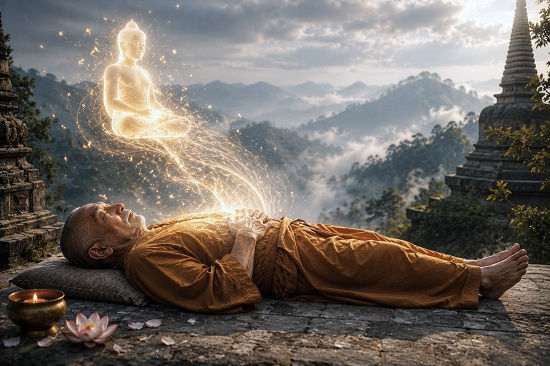
This lesson opens the Buddhist map of death, and it corrects the single most common thing people think they know about it. Ask almost anyone what Buddhists believe and the answer comes back: reincarnation. The truth is stranger and far more interesting. Buddhism teaches rebirth while denying the very thing most people assume gets reborn, and resolving that riddle is the doorway into the whole tradition. This lesson teaches the riddle and its answer, the realms a being can be born into, why the last moment of a life matters so much, and then the territory where Buddhists genuinely differ among themselves, the part that confuses newcomers most, laid out plainly, school by school.
Death as the First Teacher
Buddhism began with an encounter with death. The tradition tells that Siddhartha Gautama, the sheltered son of a ruling family in ancient India some twenty-five centuries ago, was deliberately kept from every unpleasant sight, until, on rides outside the palace, he saw four things that undid him: an old person, a sick person, a corpse, and a wandering seeker. The first three taught him what his palace had hidden, that aging, sickness, and death come for every living being without exception. The fourth showed him that some people stake their lives on understanding why, and on finding freedom inside that fact. He left the palace, sought, and awakened, becoming the Buddha, a title that simply means the one who woke up.
So death is not an awkward subject Buddhism handles at the margins. Death is the reason the religion exists. And the truth the Buddha placed at the foundation of everything is anicca, impermanence: all conditioned things, every object, every feeling, every relationship, every life, arise and pass away. Nothing that comes together stays together. Buddhists are not taught this to darken their days but to align them with reality, because, in this teaching, nearly all human anguish comes from gripping things that were never grippable. Everything else in this lesson stands on that ground.
Rebirth, Not Reincarnation
Now the riddle. Reincarnation, as most people picture it, means a soul, a fixed inner passenger, leaving one body and boarding another, the same traveler changing vehicles. Buddhism teaches that there is no such passenger. The teaching is called anatta, not-self: when a person looks for the permanent, unchanging self inside, what is actually found is a flowing process, thoughts, sensations, memories, intentions, consciousness, all in constant motion, with no fixed core sitting behind them. A person is real the way a river is real: genuinely there, never the same water twice.
So what is reborn? The tradition's classic answer comes from a conversation preserved for two thousand years, in which a king named Milinda pressed exactly this question on a Buddhist sage named Nagasena. The sage's image has been used ever since: one candle lighting another. The flame on the second candle is not the same flame as the first, no glowing substance leaped across the gap, and yet it is not unrelated either; the second flame exists entirely because of the first and inherits its character. The sage's verdict on the new life: neither the same, nor another.
What continues, then, is not a soul but a stream: the momentum of consciousness, carrying its karmic charge, its habits, tendencies, and unfinished causes, condensing into a new life the way the first flame's heat becomes the second flame. What does not continue is a fixed passenger, because, in this teaching, there never was one, even within a single lifetime; the person at seventy is already the candle lit by the candle of the person at seven. This is why Buddhists prefer the word rebirth to reincarnation, and the distinction is not pedantry. It IS the teaching. Buddhism's whole diagnosis is that beings suffer by clutching a self that was never solid, and its account of death simply refuses to smuggle that self back in at the last minute.
Karma and the Six Realms
What steers the stream from one life to the next is karma, a concept whose full general teaching belongs to this course's Hinduism lesson; what matters here is Buddhism's own distinct version of it, and the distinction sits in one word. The Buddha taught that karma is, at its heart, intention. Action matters, but the moral charge of an action lives in the volition behind it: a harm done by accident and a harm done by design are different karma entirely, and a mind marinating for decades in resentment, or in kindness, is laying down karma with every passing thought. Buddhist karma is therefore less a courtroom ledger than a momentum of mind. A being is, quite literally in this teaching, being shaped at every moment into what it repeatedly intends.
That momentum, at death, finds its level among the six realms of rebirth, the tradition's classic map of where a stream of consciousness can land.
The god realms. Long, blissful existences enjoyed by beings of abundant positive karma. Their famous hazard is complacency: lives so pleasant that no one in them feels the urgency to awaken, until the karma funding them runs out.
The demigod realm. Powerful beings consumed by envy and rivalry, forever measuring themselves against the gods above them and fighting for standing.
The human realm. The precious one. Enough pain to wake a being up, enough freedom to do something about it. Buddhist teaching is emphatic that a human birth is the rarest of fortunes, the realm from which awakening is most possible.
The animal realm. Existence governed by instinct, fear, and survival, with little room for understanding.
The hungry ghost realm. Beings of immense craving, classically pictured with enormous bellies and pinhole mouths: endless wanting that can never be filled. The image is craving itself, given a body.
The hell realms. Births of intense suffering produced by intense hatred and cruelty, and, as everywhere on this map, temporary. When the karma that produced such a birth is exhausted, the stream moves on. Nothing in the six realms is forever.
One honest note belongs here, because Buddhists themselves say it: many teachers, ancient and modern, also read the six realms psychologically, as states a human mind visits in a single week, the heaven of comfort, the hunger of addiction, the hell of rage. Some Buddhists hold the realms as literal destinations, some as profound psychology, many as both at once. Either way, the teaching's force is identical: mind is the builder, and what a mind practices is where a being lives.
The Moment of Death
All Buddhist schools share a striking belief: the quality of the mind at the moment of death matters enormously. The dying mind is the launching state of the stream, and a consciousness leaving in peace, clarity, or devotion inclines toward a very different rebirth than one leaving in terror, confusion, or rage. The final mind-moment is the last intention of the life, and intention, as taught above, is the engine of karma.
Everything Buddhists do around the dying flows from this one belief, and it explains scenes that move even outsiders. The room is kept calm. Voices are kept low. Loved ones are encouraged not to wail or clutch at the dying person, however much their hearts are breaking, because the tradition teaches that distress in the room becomes distress in the departing mind. Instead there is chanting, reminders of the person's generosity and goodness, sacred names spoken softly. In this teaching, helping someone die peacefully is not mere kindness. It is the last and perhaps greatest practical gift one being can give another.
Where the Schools Differ
Here is where newcomers get lost, because one Buddhist book says rebirth is instant, another describes a forty-nine-day journey, and a third talks about a paradise in the west. None of them is misinformed. They belong to different schools of Buddhism, and this section is the cleanup. Each school is taught here on its own terms, named, so a reader who resonates with one knows exactly which Buddhism to explore next.
Theravada: immediate rebirth. Theravada, the tradition of Sri Lanka and much of Southeast Asia and the school closest to the early scriptures, teaches that rebirth is immediate. The last moment of consciousness in this life conditions the first moment of consciousness in the next, directly, with no intermediate state in between, one candle lighting the next with no gap. Care therefore concentrates on the quality of the dying mind itself, and after death the family generates merit, good karma through generosity and ceremony, dedicated to the departed's benefit.
Tibetan Buddhism: the bardo and the forty-nine days. The Vajrayana tradition of Tibet teaches the opposite of a gap-free transition: an intermediate state called the bardo, lasting up to forty-nine days, in which the stream of consciousness travels between death and rebirth. The tradition maps it in detail. At the moment of death there is said to dawn a luminosity, the mind's own deepest clear nature, and a practitioner who recognizes it can be liberated on the spot. Those who do not recognize it pass through a phase of visions, peaceful and wrathful appearances that are, the teaching insists, projections of one's own mind, and then into the bardo of becoming, where the consciousness is drawn toward its next birth. This is the territory of the famous Tibetan Book of the Dead, a guidebook traditionally read aloud to the dead across the forty-nine days, coaching the traveler at every fork: do not be afraid, recognize what appears as your own mind, choose well. The tradition also trains the living in phowa, a practice for directing consciousness at the moment of death, and it customarily leaves the body undisturbed for some days after death so the departing consciousness is not jarred. In no other school is death so thoroughly rehearsed, and Tibetan teachers say the rehearsal is the point: the bardo is easiest to navigate for a mind that has met its contents in advance.
Pure Land: calling on Amitabha. Pure Land Buddhism, the most widely practiced form of Buddhism across East Asia, rests on the story of Amitabha, a buddha who vowed that any being who calls on him with sincere faith will be reborn in his Pure Land, Sukhavati, the Land of Bliss, a realm without the obstacles and torments of ordinary existence, where awakening becomes almost effortless. The practice is the recitation of his name, nianfo in Chinese, nembutsu in Japanese, carried through daily life and gathered up at the deathbed, where the tradition teaches that Amitabha himself comes to welcome the dying. Mei's grandmother, a lifelong Pure Land Buddhist, spent her final evening with her family softly reciting the name with her, exactly as she had asked, and the tradition holds that a person who dies that way is not falling but being met. Pure Land's special genius is its honesty about human limits: for beings too burdened to climb to liberation by their own strength alone, it teaches, there is a vow strong enough to carry them.
Zen: the great matter, right now. Zen, the meditation school of China and Japan, famously declines to elaborate maps of the afterlife at all. Its phrase for death is simply the great matter of birth and death, and its teaching is that the place to resolve it is this very moment, since, impermanence being what it is, every moment is already a birth and a death. Zen masters traditionally wrote a short death poem at the end, often wry, often luminous, meeting death with the same awake simplicity the school spends a lifetime training, and more than one master answered the question of what happens after death with a plain "I don't know," not as ignorance but as the most honest and fearless place to stand. A reader drawn to spare, unflinching presence over cosmology will find their Buddhism here.
One map, four emphases: the stream is the same in every school; what differs is the route, the vehicle, and how much of the territory each school chooses to chart.
Nirvana and Parinirvana
Every realm in this lesson, however high, is still the wheel. Buddhism's final goal is off the wheel entirely: nirvana. The word means blowing out, extinguishing, and what is extinguished is not the person but the three fires of greed, hatred, and delusion. A being in whom those fires have gone out is awake, free, and done with the causes of rebirth. The Buddha lived forty-five years after his awakening, teaching, walking, aging, fully alive with the fires already out.
What happens when such a being dies is called parinirvana, the complete or final nirvana: the stream's momentum is spent, and no new candle is lit. Asked where an awakened one goes at death, the Buddha famously refused both available answers. He compared it to a flame going out and asked, in effect, where the flame goes when it goes out, east, west, north, south? The question, he taught, is wrongly framed; the categories of existing somewhere and being annihilated both fail. Parinirvana is not a heaven, because no one travels anywhere, and it is not destruction, because what ends is only burning. The tradition's own settled description is deliberately spare: the deathless, the unbinding, the highest peace. Buddhism, which began with a sheltered prince devastated by a corpse, ends its map with a freedom it insists is real and declines to furnish.
Around a Buddhist Deathbed
Belief becomes visible at the end, and across the schools the bedside looks recognizably alike. The room is kept peaceful and the dying mind protected, per the teaching on the last moment. There is soft chanting, scripture, or the recitation of sacred names, matched to the family's school. In Tibetan and many Mahayana communities, the body is left undisturbed for a period after the last breath, traditionally up to three days, out of care for the consciousness believed to be in transition. And in Tibetan and East Asian traditions alike, the family observes the forty-nine days, holding ceremonies, often every seventh day, to generate and dedicate merit to the traveler, with the final service marking the journey's completion. The grief in these rooms is as real as grief anywhere. What the teaching adds to it is a job: for forty-nine days, love still has something to do.
Below this lesson, you'll find an IFS & Parts Work Practice along with a few ways to begin noticing and applying it in everyday life this week.
Disclaimer: Everything IFS Academy is an independent educational platform and is not affiliated with, endorsed by, or connected to the IFS Institute. While we strive for accuracy, errors can occur, and users are encouraged to cross-reference critical information. These courses, lessons, skills, and practices are offered for educational and self-reflection purposes only. They do not constitute therapy, mental health treatment, clinical training, or crisis support, and they should not be used as a substitute for professional mental health care.
Crisis Support: 🚨 If you are experiencing a mental health crisis, feel unsafe, feel at risk of harming yourself or someone else, or feel too overwhelmed to safely use self-directed practices, please pause this material and reach out for immediate support. Contact a licensed mental health professional, call or text 988 in the U.S. or Canada, or use your local emergency or crisis resources.


Comments