🦋Module 9 — Handmade Keepsakes | Legacy Projects for the Dying Course
Updated: 2 days ago

Free Course by Everything IFS Academy | Death and Dying Series
Help us reach the people who may need this most by sharing this free course with friends, family, colleagues, online communities, social media or on your own website.
🎧 Audio – Listen on the go
🦋Module 9 — Handmade Keepsakes
Some legacies are not read or played. They are held. This lesson teaches the keepsakes made by hand and of the body: the hand molds and fingerprint pieces hospice teams make at bedsides every day, the preservation of handwriting, the memory quilts and bears sewn from chosen clothing, the gifts made by people who make things, and the small bodily keepsakes families have kept for centuries. Every project here has a bed-level version, several take under a minute of the person's energy, and all of them serve the same deep purpose, which is where the lesson begins.
Why Touch Matters
Grief is famously a thing of the mind and heart, but anyone who has spent time with the bereaved knows it is also, stubbornly, a thing of the hands. In the hard moments, grieving people reach for objects: they hold the watch, wear the flannel shirt, sleep with it, carry the smooth stone in a coat pocket through a funeral and then through a decade. Words console the part of a person that thinks. Touch consoles the part that simply misses, the part that wants, with a child's directness, something of the person to hold onto, and that part does not retire with age. Widowers in their eighties carry thumbprint keepsakes. Grown men sleep under quilts made of their mother's dresses.
That is the claim of this whole category: when words run out, and in grief they always eventually do, the tangible keepsake keeps working. A recording must be played and a letter must be read, but the keepsake is just there, in the pocket, on the bed, around the neck, doing its quiet work of contact. These are the legacies for three in the morning. And nearly all of them can be made now, on purpose, with the person's own choosing and meaning attached, which, as this lesson will keep showing, is what separates a keepsake made as a legacy from one salvaged afterward out of a closet.
Hand and Fingerprint Keepsakes
The classics of bedside legacy work, the projects hospice teams carry in kits and can complete in minutes, are the prints and molds of the hand itself, and they deserve their reputation. The hand is the body's most personal geography: the lines, the scars, the ring groove, the knuckles a child held crossing streets. Captured, it becomes the most direct of all keepsakes, the literal shape of the person.
The hand mold. A casting material, plaster or a skin-safe molding compound, captures the hand in three dimensions, every line and vein, and sets hard. Families display these for generations, and the most beloved versions are the held ones: two hands cast together, the person's and a spouse's, a child's, a grandchild's, clasped, so what gets kept is not a hand but a holding. Hospice legacy programs and art therapists do these at bedsides routinely; kits also exist for families to use themselves, with the helper doing all the work while the person's entire contribution is a still hand for a few minutes.
Ink and paint handprints. The flat version: a handprint on good paper or canvas, sometimes layered with family members' prints over or beside it, smallest hands on top. Five minutes, washable ink, and a frameable object on the spot. Grandchildren's prints made alongside turn it into an afternoon and a family piece.
Thumbprint stones and clay pieces. A thumb pressed into a small disc of clay or a flattened stone of polymer, fired or air-dried: a pocket-sized keepsake, one per family member, made in thirty seconds apiece. Hospice volunteers sometimes arrive with a tin of these ready to press; they are among the gentlest bed projects in this entire course, possible on days when almost nothing else is.
Fingerprint jewelry. The lasting trade version: a clean fingerprint, taken with an ink card or scanned, is engraved by any of many jewelers and keepsake companies onto pendants, charms, dog tags, and rings. The print is captured in minutes now; the jewelry can be ordered now or years later from the same saved print, which is the practical note worth underlining: capture several clean prints on card stock today, label them, and the family holds the master for every future piece.
The person's energy cost across this entire section is nearly zero, which is precisely why hospice invented it: these are legacies that can be made in the final days, even the final hours, and families who have them describe reaching for them constantly. There is no version of too late for this section, and no version of too sick.
Preserving the Handwriting
Handwriting is the other print the body leaves, and its power surprises people until they hold some. A person's hand on paper is as individual as their voice and ages the same way in memory: the bereaved report the same ache about no longer being able to summon it, and the same jolt of presence when an envelope surfaces years later addressed in the familiar script. The recipes lesson already met this truth in the kitchen, where the handwritten card outranks the typed copy; this lesson owns the wider project of preserving the hand itself.
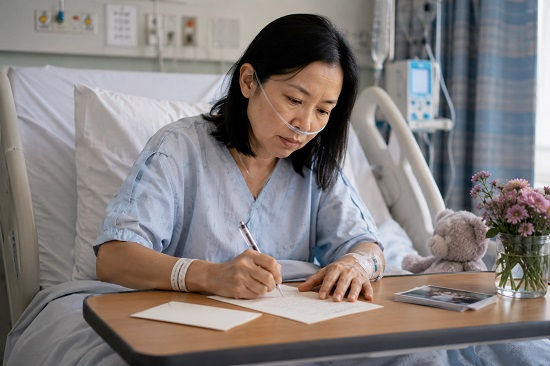
The project has two halves. The first is making sure samples exist: a signature, several of them, on clean paper; a short line in the person's own hand, "I love you," each family member's name, the phrase the person always said; and the rescue side, gathering what is already written, the letters, the margin notes, the cards signed over the years, before they scatter. For hands gone unsteady, the standard is the one this course set long ago: the wobble is the person, and a shaky "I love you" written this month is, if anything, more treasured than a steady one from years past, because the family knows what it cost. Where even a line is too much, a signature alone is a complete project.
The second half is what the samples can become. Simply protected, sleeved or framed, they are already keepsakes. Scanned, they become permanent and reproducible, living by the file rules of the recordings lesson. And reproduced, they turn into the trade's growing catalog: the handwriting engraved onto jewelry, bracelets and pendants carrying "love, Mom" in the actual hand; embroidered, traced onto fabric and stitched, often onto the memory quilts of the next section, a signature in thread on a corner block; or printed onto keepsake objects of every kind. Ines captured exactly one sample before her hands gave out entirely, the word "always," which was what she had signed under her name on every card for fifty years. It is now on four bracelets, a quilt corner, and the title page of the family recipe book, and the family agrees she chose the right word. A few true words in the real hand outweigh pages of type; this section exists so those words get written while writing is still possible.
Memory Quilts, Bears, and Pillows
The largest keepsakes in this lesson are sewn from the most intimate archive a person has: their clothing. Memory quilts pieced from shirts and dresses, stuffed bears cut from a bathrobe or work jacket, pillows from flannels, made so the family can hold, wear, and sleep under the fabric of the person's life. These are now among the most commissioned keepsakes in bereavement, and most are made after a death, from a closet, by a family guessing.
Which is exactly the move this lesson exists to teach: choose the garments now, and say why. The difference is total. A quilt made from a guessed-at closet is fabric; a quilt made from twelve garments the person selected, each with its reason recorded, is an autobiography. The flannel shirt, because it was worn on every fishing trip with the boys. The blue dress, because it was the one their father liked. The threadbare cardigan the family always threatened to throw away, included precisely because of that. The choosing session is a lap or bed project, an hour with a helper holding garments up one at a time, and the reasons get captured the easy way, a phone recording the person talking through the pile, which doubles as a recordings-lesson treasure in its own right. The chosen clothes go into a labeled box with the recording's location noted, and the sewing happens whenever it happens, now or after, by whichever hands.
On the hands: almost nobody sews their own memory quilt, and nobody needs to. A quilter in the family, a church or guild quilter, or any of the many companies that sew memory pieces from shipped clothing will do the construction. The person's authorship is the selection and the stories, and it is complete the moment the box is labeled. Practical notes for the box: garments go in unwashed if their smell matters to the family, in a sealed bag, since scent is part of what these keepsakes carry and it cannot be added back; and one small cousin of this project is worth naming here by attribution, the heartbeat bear from the recordings lesson, where the recorded heartbeat goes inside a bear sewn, often, from exactly this chosen clothing, the two lessons meeting in a single object. June chose fourteen garments in one afternoon, narrating each, including the dress from her wedding reception, "not the wedding, the reception, that's where the marriage actually started," and her sister sewed the quilt that winter. The recording of the choosing runs eighteen minutes and is, by the family's accounting, half the heirloom.
Made-by-Hand Gifts
For the makers, the knitters, woodworkers, painters, crocheters, tinkerers, this section is the home of the project they were probably already planning: the made thing as legacy. The crocheted blanket for each grandchild. The carved bird. The painting of the home place. The cutting board, the birdhouse, the christening gown. For a person whose hands have spent a lifetime making, a final made object is the most natural legacy there is, and the family knows it: the things in this category are introduced for generations with the same sentence, made by hand, by them, for us.
Two teachings govern it, both inherited from the choosing lesson and applied here with feeling. The first is honest sizing: making takes energy, fine motor control, and time in ways the other projects in this lesson do not, so the project gets sized to the actual hands of the actual month, one square, one small carving, one ornament apiece rather than the heirloom-scale piece imagination proposes. A small finished object given warm beats a magnificent one abandoned, and the maker knows better than anyone how rarely the abandoned ones get finished by someone else. The second is the rescue clause, and it deserves its own sentence: the half-made object, plus its story, counts as complete. The blanket at half length, finished by a granddaughter taught the stitch for the purpose; the cabinet assembled but unfinished, sealed exactly as the hands left it; the last project on the workbench, photographed and kept as it sat. Families treasure these without asterisks, because what the object holds was never its doneness; it was the hands. Roy's last birdhouse went to his grandson with one wall unattached and a note from Roy's daughter recording his instructions for it, delivered from the recliner with full confidence: "wood glue, two clamps, overnight, and don't let your mother paint it." The grandson finished it as directed. Both halves of that construction are the keepsake.
Small Keepsakes of the Body
One more category belongs in this lesson, and it is named here plainly and gently, the way hospice nurses name it, because families have practiced it for centuries and most simply do not know it is allowed: the small keepsakes of the body itself, chief among them a lock of hair.
Keeping a lock of hair is one of the oldest mourning customs in the world; the Victorians built an entire art around it, weaving hair into lockets, rings, and brooches, and the impulse has never gone away, only gone quiet. Today it is entirely ordinary, and hospice staff handle the request without blinking: a small lock, tied with thread, kept in a locket, a small glass vial, a folded paper in the family Bible, or set by keepsake jewelers into pendants and glass charms, the same trade that does the fingerprint work. What this lesson adds is the legacy version of the custom: it can be the person's own gift rather than the family's later request. Offered now, with the person's blessing, perhaps a small lock for each child, it arrives as a gift rather than a taking, and it spares the family the awkwardness of wondering whether to ask. The person's cost is nothing; the gesture, families report, lands enormous. It is, in the most literal sense available to this whole course, leaving a part of oneself behind, and there is nothing morbid in it. There is only the oldest human wish on record, met kindly: to keep something.
Through Other Hands
This lesson ends by applying the choosing lesson's standing principle to its own roster, because no module in the course leans on borrowed hands more, and no module's projects are more often skipped by people who wrongly believe they would have to do the crafting. So, plainly: every project above has professionals and volunteers attached to it. Hospice teams and their legacy programs carry the mold kits, the ink, the clay, and the practiced calm. Art therapists exist, in many hospice and hospital programs, precisely to make these things at bedsides. Quilters, in families, churches, and guilds, consider memory pieces an honor, and a whole commercial trade stands ready for the quilts, bears, engraving, and keepsake jewelry. Grandchildren can be deputized for any of it.
None of that dilutes the legacy by a thread, because of the rule this course settled in its choosing lesson and this lesson has demonstrated seven times over: authorship is the choosing and the story. The person who selects the fourteen garments, says why, presses the thumbprint, signs the card, and rules on the birdhouse glue has made every one of those keepsakes, whoever's hands did the sewing and casting. The family will tell the story that way, too, forever: she chose these. He left this. Made, in the way that counts, by them, for us.
Disclaimer: Everything IFS Academy is an independent educational platform and is not affiliated with, endorsed by, or connected to the IFS Institute. While we strive for accuracy, errors can occur, and users are encouraged to cross-reference critical information. These courses, lessons, skills, and practices are offered for educational and self-reflection purposes only. They do not constitute therapy, mental health treatment, clinical training, or crisis support, and they should not be used as a substitute for professional mental health care.
Crisis Support: 🚨 If you are experiencing a mental health crisis, feel unsafe, feel at risk of harming yourself or someone else, or feel too overwhelmed to safely use self-directed practices, please pause this material and reach out for immediate support. Contact a licensed mental health professional, call or text 988 in the U.S. or Canada, or use your local emergency or crisis resources.


Comments