🌱Module 8 — In Vivo Exposure | ERP Course
Updated: 5 days ago

Free Course by Everything IFS Academy | Therapeutic Modalities
Help us reach the people who may need this most by sharing this free course with friends, family, colleagues, online communities, social media or on your own website.
🎧 Audio – Listen on the go
🌱Module 8 — In Vivo Exposure: Running an Exposure Session
In vivo exposure is exposure done in real life, with real doorknobs, real stoves, and real hands. The phrase is Latin for “in the living,” and it names the beating heart of ERP: the deliberate, planned session in which a person walks up to a rung on their ladder and does it, in the physical world, while the fear watches. Everything in this course so far, the cycle, the recognition skills, the thermometer, the ladder, has been preparation for this lesson, because this is where preparation becomes change. An exposure session is a small, structured event, usually under an hour and often far shorter, and it has a precise anatomy worth learning before the first one is ever attempted.
In vivo is one of three forms of exposure in ERP. The other two are imaginal exposure, facing feared thoughts and worst-case stories through writing and imagination, and interoceptive exposure, deliberately bringing on feared body sensations. Those get their own lessons in Modules 9 and 10. In vivo is the one reached for whenever a real-world trigger can be confronted head-on, which is most of the time, and it tends to come first because nothing else gives the brain such direct evidence. A person can be told a hundred times that a doorknob is safe, can reason it through, can even believe it intellectually, and still feel the surge of dread the moment they reach for one. What finally shifts the fear is touching the knob and discovering, in lived experience, that nothing bad follows. When a fear can be met in real life, real life is where it is best met.
The Habituation Curve
First, the phenomenon a session is built to let a person witness. Habituation is the nervous system’s built-in volume-down: when a feared thing keeps failing to bite, the alarm wired to it grows quieter, automatically, without persuasion or effort. It is one of the oldest and most universal learning mechanisms in biology. The thirtieth thunderclap startles less than the first. A house by the train tracks goes silent to its owners within a month. The alarm system is not broken by this; it is doing its actual job, which is updating on evidence.
What makes habituation feel like a miracle in OCD is that most people with the disorder have never once witnessed it, because the ritual always arrives first and takes the credit. Here is what anxiety often does during an exposure when nobody feeds it a ritual, traced as a curve:
The spike. Contact with the trigger sends distress up fast, often within seconds, toward the rung’s rated number and sometimes past it. This part everyone knows; it is why the ritual usually gets called.
The plateau. Then something almost nobody with OCD has stayed long enough to see: the number stops climbing. It hangs there, awful but flat, and the predicted escalation to infinity simply does not occur. Anxiety is physiologically expensive, and the body cannot and does not sustain the peak indefinitely.
The fall. And then, minutes later, without a single ritual being performed, the number starts down. Not to zero, usually, and not on a polite schedule, but unmistakably down. A 70 becomes a 55 becomes a 40, while the doorknob is still under the palm.
That fall is direct, felt, in-the-body evidence that the alarm shuts itself off, which is exactly the fact the ritual has been preventing the nervous system from ever learning. And it compounds across sessions: tomorrow’s spike on the same rung tends to start lower and fall faster, and within days or weeks the rung that was a 60 shrugs in at a 25. This is the classic engine of exposure, and it is how the method was understood for decades. Two things need saying alongside it. Modern research has added a fascinating refinement to the story of why exposure works, and that upgrade has its own lesson waiting in Module 14. And the curve is what a person often feels, not a rule the session has to obey; the fall is the reward, not the requirement, and a section below explains exactly what that means. For now, the curve is the picture worth carrying into a first session.
Running a Session: The Steps
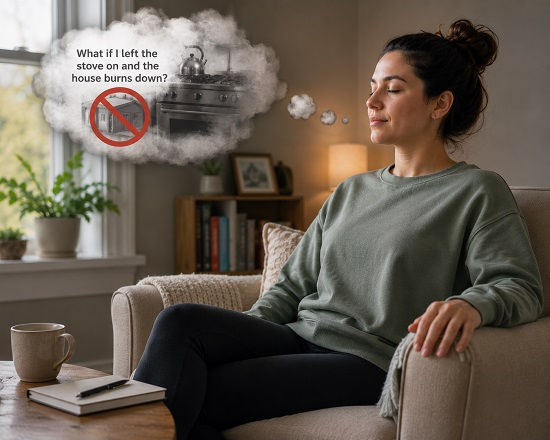
Watch Lauren, the stove-checker from Module 3, run a complete session on rung three of her ladder: “stand at the stove, turn a burner on and off once, then leave the kitchen and stay out for thirty minutes.” Rated 55. Here is the procedure she moves through, step by step:
Choose the rung. Lauren picks tonight’s item in advance, from the ladder, on purpose. Not the scariest thing available and not a random ambush; the planned next rung. Sessions are appointments, not dares.
Stage it. She sets the scene so the exposure can actually happen: evening, home, no guests, phone timer ready. Thirty seconds of logistics that prevent the classic fizzle of “I never found a good moment.”
Enter. She walks to the stove and does the thing: burner on, burner off, one time, and walks out of the kitchen. The entry is clean and committed, no half-touching, no doing it while promising herself it doesn’t count.
Take the first reading. In the living room, the doubt detonates on schedule: did it click fully off, is gas leaking, is the house already burning. She reads her SUDS: 60, a notch above forecast. Normal.
Stay, and hold back every ritual. Now the actual work, which is mostly a kind of active not-doing: no walking back to check, no peeking around the corner, no asking her partner, no mentally replaying the click of the dial, which she recognizes from her Module 5 inventory as checking without hands. The full system for holding this line is Module 11’s territory; tonight the line is simply held.
Keep reading the number. Every five minutes or so, a quick honest read, taken on schedule rather than compulsively: 60. Then 65, a wobble, the doubt found a new angle. Then 55. Then 40. She is watching the curve draw itself with her own distress as the ink.
Remain for the planned time. The session was thirty minutes, and Lauren stays for thirty minutes. Often the number bends well before then; by minute twenty-five her 65 has become a 30. Not calm, not certain, just unmistakably descending. But the session ends because the appointment is over, not because the number gave permission. On a day it refused to bend, the thirty minutes would still have been the session.
Log it. One line in a note: the rung, the peak, the ending number, minutes elapsed. Thirty seconds of record-keeping that will pay for itself many times over, because progress across sessions is exactly what those logs make visible.
That is a complete in vivo session: one rung, one entry, one held line, one planned stay, one line of ink. Modest to look at. It is also, for many people, the first time in years the fear was allowed to finish its sentence, and it turned out the sentence ended.
What Counts as a Session That Worked
Aiming to stay in the situation while the distress comes down is a perfectly good plan, and much of the time it does come down, sometimes to around half of its peak, exactly as the curve promises. But the drop is the reward, not the requirement, and the difference between those two words is not a technicality.
A session succeeds when three plain things happen. The person moved toward the feared thing on purpose. They stayed in contact with it. And they did not perform the compulsion. If those three occurred, the session worked, whatever the number did on the way. Researchers who studied exposure closely found that the drop in distress inside a single session is a poor predictor of whether the treatment helps at all. People get better who never once watch the number fall in the moment, because the real learning settles between sessions and shows itself later, as a lower starting point next time rather than a same-day victory in the room.
There is also a quiet cost to grading a session by whether it calmed down. Treating the falling number as the mark of success teaches a person, without anyone intending it, that anxiety is the enemy and that being anxious means failing. That is a very short walk back to being afraid of fear itself, and to reading every ordinary surge of it as proof the method is broken. The assignment was never to feel better by the end. It was to go toward the thing, stay, and not rescue.
When the Curve Refuses to Behave
The tidy spike, plateau, and fall is one shape a session can take, and a fortunate one. Several other shapes are just as common, and not one of them means the method has failed.
The number that will not drop. Contact, a spike, and then it simply sits there, high and flat, for the entire session. This is ordinary, especially early, on a hard rung, or on a day the system was already stirred up before the exposure began. The win was never the drop. It was the staying, and the staying happened.
The rebound. It falls, and then jumps again when OCD finds a fresh angle, a new “but what if,” some loophole the last twenty minutes did not close. It can do this several times in one sitting. Each new angle gets the identical treatment the first one got: it is allowed to be there, and it is not answered.
The drop that arrives late, or not that day. Sometimes nothing shifts in the room at all, and the payoff turns up a day or two later as a spike that simply starts lower. This is exactly why progress lives in the log kept across sessions, and not in the verdict passed on any single one.
The suspiciously easy drop. The opposite problem, and the one worth watching for. The number falls fast and far, but not because the fear was faced. It falls because a quiet mental ritual did the work underneath. A too-quick, too-clean collapse deserves a second look, and it leads straight into the next section.
What Staying With It Actually Means
There is a subtle skill inside step five, and it separates exposures that work from exposures that merely get endured. Staying with it means present and willing, not white-knuckled and mentally elsewhere.
The distinction matters because a person can technically remain in the room while performing an entirely internal evacuation: gripping the chair, counting ceiling tiles, running tomorrow’s errands in their head, promising themselves it’s almost over, anything but contact with the actual situation. From the outside this looks like a completed exposure. Functionally, it is distraction, and distraction quietly runs the ritual’s errand: it shields the nervous system from the very evidence the session exists to deliver. The alarm never updates on a threat it was never allowed to look at.
The more dangerous form of internal evacuation is quiet reassurance: “I washed this morning, so it is probably fine,” “I would never actually do it,” “the burner looked off, I am sure it was off,” a small silent argument that settles the doubt just enough to take the edge off. A session can look flawless from the outside, a bare palm on the doorknob, no visible checking anywhere, and still teach the nervous system nothing, because this ritual is running silently inside. It steals from the session the single thing it exists to provide: contact with the doubt while the doubt is still unresolved. An exposure only teaches when the question is allowed to stand open the whole way through.
Present and willing looks different, and it is a posture more than a technique: attention resting on the situation itself, the doubt allowed to be there and say its piece, the anxiety permitted to run its course without being either fought or fed. Lauren in her living room isn’t forcing calm or arguing with the gas-leak thought. She’s sitting in the discomfort the way a person sits in a cold pool, in it, feeling it, letting the body do its adjusting. When she notices her mind reaching for the quiet rescue, she lets the reach go and returns her attention to the situation, as many times as it takes. Willingness is not enjoyment. It is the simple, radical stance of not organizing an escape, inside or out.
The One Way Not to End a Session
There is a right way and a wrong way to leave, and the difference is not the number showing on the way out. It is the reason for leaving.
Ending a session by decision, calmly judging that the appointment is over, is completely fine, even with distress still elevated, because a session does not have to end at zero and often should not wait to. Ending a session by escape is another thing entirely. That is bolting from the situation because the distress got loud and relief is needed right now. That is not ending the session. It is performing the largest compulsion in it, and it does real damage, because the flood of relief that arrives the instant a person escapes lands hardest exactly when the distress was highest. That timing stamps in the worst possible lesson, that escape rescued them precisely when it counted most, which is the same negative-reinforcement machinery from Module 3 that built the whole disorder in the first place. Fleeing at the peak can teach the fear more forcefully than never having attempted the exposure at all.
So the one rule worth holding through any session is simple to say: leave by decision, not by rescue. If a session has to be cut short, the move is to let the distress steady even a little and then step out on purpose, rather than to sprint for the exit at the loudest moment.
In Vivo Across the OCD Themes
Lauren’s session was a checking exposure. The same shape, approach the feared thing and decline the ritual, takes a different form in each common theme, and seeing a few side by side makes the shape easier to recognize in one’s own ladder.
Contamination. Deliberately touching a feared surface, a public doorknob, a trash can lid, a stair rail, and then leaving it unwashed. The contact is the exposure; not washing is the response prevention that goes with it. What becomes available to learn is that the touch did not bring on the dreaded illness, and that the feeling of being contaminated can be carried rather than scrubbed away.
Checking. Locking the door a single time and walking away, sending an email without rereading it a dozen times, leaving the kitchen without circling back. The deliberate under-checking is the exposure; resisting the pull to check is the response prevention. What becomes available to learn is that the day does not fall apart without the reassurance the checking was meant to supply.
Symmetry and “just right” fears. Leaving a picture hanging slightly crooked, setting objects out of their usual arrangement, letting something stay “off,” and then leaving it be. Creating and sitting with the wrong state is the exposure; not fixing it is the response prevention. What becomes available to learn is that the maddening sense of incompleteness rises, holds, and eventually loosens on its own.
Themes built on thoughts rather than objects, harm, taboo, scrupulosity, relationship doubt, usually run their exposures through the scripts and open doubts introduced in Module 7, which is the work of the next lesson.
How Often and How Long
Exposure has a dosing schedule, and the principle is easy to remember: frequency beats heroics.
Daily short sessions outperform rare marathons, and it is not close. A twenty-minute session five days running builds more change than a two-hour epic once a fortnight, because the learning consolidates, meaning it settles in and becomes durable, through repetition and decays through absence. The nervous system updates the way muscles train: regular moderate doses, not occasional punishment. For most rungs, twenty to forty-five minutes is ample, and many lower rungs run their course in ten.
The second half of the dosing rule: repeat the same rung until it bores. One successful session on the stove rung is a data point; six sessions across a week, with the peak sliding from 60 to 45 to 30, is a rewiring. The finish line for a rung is not surviving it once. It is the rung becoming dull, and dull is a technical term worth savoring here, because boredom is what a nervous system sounds like when it has fully stopped predicting danger. In this one corner of life, boredom is the trophy.
The third half, if a rule can have one: repeat the rung in different places. The sense of safety the brain takes from one setting has a way of staying tied to that setting. Touching surfaces calmly at home is a real gain, and practicing the same thing at work, in the car, in a stranger’s kitchen is what lets the new learning travel into the messiness of ordinary life. Why that matters so much is part of the Module 14 story; for now, variety of setting is simply part of the dose.
When to Climb to the Next Rung
Three tells announce that a rung is finished and the ladder is ready for the next step up:
The peak has fallen across repetitions. Not necessarily within one session, but session over session: the rung that spiked at 60 now spikes at 30 or less. The log from step eight is where this shows up in writing, which is why the log exists.
The anticipatory dread has shrunk. Anticipatory dread is the fear felt before the thing, not during it. The hour before a session used to be its own ordeal; now it’s an errand on the list. Anticipation is often the last part to quiet down, so its quieting is a strong signal.
Boredom has entered the room. Mid-session, attention wanders to dinner plans. The situation has become what it always actually was: uninteresting. Climb.
When the next rung up looks too big even after the current one bores, that is not a wall; it is a request for an intermediate rung, and the difficulty knobs from Module 7 exist precisely to build one. The ladder is a living document, and skilled climbers edit it constantly.
Feared but Safe: The Line ERP Never Crosses
One principle sits beneath all in vivo work and is never bent: exposure approaches feared-but-safe situations only. It never asks a person to do something dangerous, harmful, or reckless. This is not only an ethical guardrail, it is wired into how the method works. The whole mechanism depends on the feared catastrophe not being a true danger, so that the brain can finally learn the alarm was false. If a situation carried real danger, there would be no false alarm to correct, and approaching it would simply be unwise.
The honest complication is that many fears are not completely baseless. Germs really can cause illness; driving really does carry some risk. ERP does not pretend otherwise, and it does not try to drive risk to zero, which is impossible for anyone. What it targets is the standard OCD actually demands: total certainty, a guarantee of zero risk that no life can ever meet. Most people touch handrails and eat in restaurants without rituals, and most people drive, because they are living at the ordinary, everyday level of risk that comes with being alive. In vivo exposure helps a person settle back at that normal threshold of acceptable risk rather than the unreachable one OCD insists on. Meaningful danger is never the target. The inflated, unmeetable demand for certainty is.
When to Ease Off and When to Get Support
Two care notes belong inside this lesson, woven into the skill itself, because they are part of doing it well rather than caveats around it.
First: “too much” is a signal to shrink the rung, not to push through and not to quit. If a session is leaving a wake of being wrecked for the rest of the day, or the rung feels impossible to enter cleanly, the information is not “this doesn’t work” or “be braver.” The information is “this rung is mis-sized,” and the response is craftsmanlike: dial it down with the knobs, build the 45 version, and climb from there. Easing off is steering, not retreating, and knowing the difference is itself an exposure skill.
Second: self-guided exposure has real limits, and knowing them is wisdom rather than weakness. Severe symptoms, distress that stays overwhelming at even the smallest rungs, co-occurring conditions (other diagnoses present alongside the OCD, such as depression or trauma), or fear domains that feel too tangled to ladder alone are all signals that this work deserves a trained ERP professional alongside it. Therapists who specialize in exposure do this climbing with people every day, calibrate rungs with an expert hand, and hold the line beside someone when holding it alone is too much. A course like this one makes an excellent map and a strong companion to that work; for heavier presentations, it is the companion, not the substitute.
Below this lesson, you’ll find an ERP practice built around one of the skills you just learned, along with a few ways to begin noticing and practicing it in everyday life this week.
ERP Practice: Your First Session
The skill this lesson taught is the session itself, so this practice is exactly that: your first deliberate in vivo exposure, run on the bottom rung of the ladder you drafted in Module 7. Choose a rung in the 30-to-40 range, nothing higher for a first outing, and set aside about thirty minutes. If even your lowest rung feels out of reach today, build a smaller one first with the difficulty knobs, and let that be the whole victory.
Pick your rung and schedule it: a specific time today or tomorrow. Write it down like the appointment it is.
Stage the logistics in advance: the place, any objects involved, a timer, and your log ready to receive one line.
When the time comes, enter cleanly. Do the rung as written, fully, no half-versions and no silent "this doesn't count."
Take your first SUDS reading right after contact, and then every five minutes or so, on schedule. Fast, honest numbers.
Stay present and willing: let the doubt talk, let the number do what it does, and hold back every ritual, including the mental ones. If you notice yourself distracting or white-knuckling, just return your attention to the situation, as many times as it takes. Returning counts as staying.
Remain until the number meaningfully drops, roughly toward half its peak, or until your planned time is up with the number clearly descending.
Log one line: rung, peak, ending number, minutes. Then genuinely close the session and go do something ordinary.
If the distress didn't bend at all, or the session left you wrecked, do not read that as failure. Shrink the rung with the knobs and run the smaller version tomorrow. Steering is the skill. And if every rung, however small, stays overwhelming, take that as this lesson's honest signal that a trained ERP professional belongs on your team.
This Week
Run a session a day if you can, even ten minutes, on the same rung until it starts to bore you. Frequency beats heroics all week long.
Glance at your log every few days and watch the peaks. A falling column of numbers is the most persuasive document you will ever own.
Once, in the middle of a session, see if you can notice the exact moment the number stops climbing. Catching the plateau in the act is catching your own nervous system learning.

Disclaimer: Everything IFS Academy is an independent educational platform and is not affiliated with, endorsed by, or connected to the IFS Institute. While we strive for accuracy, errors can occur, and users are encouraged to cross-reference critical information. These courses, lessons, skills, and practices are offered for educational and self-reflection purposes only. They do not constitute therapy, mental health treatment, clinical training, or crisis support, and they should not be used as a substitute for professional mental health care.
Crisis Support: 🚨 If you are experiencing a mental health crisis, feel unsafe, feel at risk of harming yourself or someone else, or feel too overwhelmed to safely use self-directed practices, please pause this material and reach out for immediate support. Contact a licensed mental health professional, call or text 988 in the U.S. or Canada, or use your local emergency or crisis resources.

Comments