Module 3 — The OCD cycle and the two-factor model | ERP Course
Updated: Jun 7
Free Course by Everything IFS Academy | Therapeutic Modalities Series
Module 3 — The OCD cycle and the Two-Factor Model
To understand why ERP works, a person first has to understand what it is working against. OCD is not random. It runs on a loop with a precise and predictable shape, and once that loop becomes visible, the entire logic of ERP falls into place. This lesson opens up that loop: how it turns, why it tightens over time, and where it can be broken. Nothing here is a technique yet. This is the map of the machine, drawn clearly enough that everything taught afterward will make sense.
The OCD Cycle, Step by Step
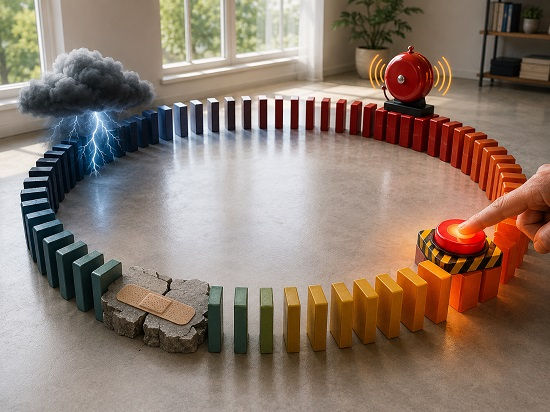
OCD tends to move through the same sequence every time, like a wheel turning through the same five or six positions. Laid out plainly, it looks like this:
A trigger. Something sets the wheel in motion. It might be external, such as touching a door handle or leaving the house, or it might be entirely internal, such as a passing thought or image that drifts into awareness.
An obsession. An unwanted, intrusive thought, image, or urge arises and fixes alarm onto the trigger. Not just "I touched a handle," but "I touched a handle, and now I am contaminated, and I could make someone sick."
Distress. The obsession sets off a sharp spike of anxiety, dread, disgust, or a maddening sense that something is not right. The feeling is intensely uncomfortable and demands to be dealt with.
A compulsion. To get rid of that feeling, a person performs some act, a behavior or a private mental move, aimed at neutralizing the distress or preventing the feared outcome. Washing the hands. Checking the lock. Reviewing a memory. Seeking reassurance.
Relief. The compulsion works, at least for a moment. The distress drops. The wheel seems to stop.
Take a concrete example. A person touches a doorknob in a public building. The thought arrives: "That is covered in germs, I am going to get sick." Anxiety and disgust climb fast. They wash their hands thoroughly, and the discomfort eases. Crisis apparently averted. Except the wheel has not stopped. It has only paused, because of what happens next.
The Hidden Sixth Step: Reinforcement
The relief feels like the end of the story, but it is actually the most important part of how OCD grows. When the compulsion takes the distress away, the brain quietly draws a conclusion: that was dangerous, and the ritual is what saved me. That lesson gets filed away, and the next time the trigger appears, the urge to perform the compulsion returns a little stronger and a little faster.
So the loop does not simply repeat. It compounds. Each turn of the wheel deepens the groove it runs in. What may have started as an occasional worry becomes a daily demand, then an hourly one, as the compulsion becomes the brain's trusted and increasingly automatic answer to a feeling it cannot tolerate. This is why OCD so often worsens over time when it is left alone. The thing that brings relief is the very thing feeding the disorder.
Two-Factor Theory: How the Fear Is Learned and Kept Alive
Behind this loop sits a simple and elegant explanation worked out in mid-twentieth-century learning research, often called two-factor theory. It says that a fear like this is built and maintained by two different mechanisms working in sequence.
Factor one is how the fear gets learned: association. The mind links things that occur together. A neutral thing, a doorknob, a number, a stray thought, becomes paired with a frightening or disgusting experience, and from then on the neutral thing alone can set off the alarm. This is classical conditioning, the same kind of learning that makes a particular song bring back a memory the instant it plays. In OCD, an ordinary cue has gotten wired to a sense of threat.
Factor two is how the fear stays alive: negative reinforcement. This is the reinforcing relief from the step just above, now given its formal name. The term gets widely misunderstood, so it is worth being precise. Negative here does not mean bad or punishing; it means something is being subtracted. A behavior is strengthened because performing it removes something unpleasant, and the compulsion is strengthened every single time, because every single time it subtracts the distress. The fear is not just remembered; it is actively maintained, fed by the relief that follows each ritual.
That two-part picture, a fear first learned by association and then kept alive by relief, is the engine of OCD. It is worth being clear about what this account does and does not claim. It explains how the cycle keeps running once it has started, which is exactly what makes the loop possible to interrupt. It does not claim that conditioning is the whole origin of OCD. The fuller picture includes genetic, neurological, and temperamental factors that can make a person more prone to it in the first place. The encouraging part is that this changes nothing about what helps: ERP acts on the maintaining cycle, and that cycle can be changed regardless of how the vulnerability first arose.
Why Short-Term Relief Is the Trap
It would be reasonable to ask: if the compulsion brings genuine relief, what is the harm? The harm is hidden in plain sight, and it has two parts.
The first is that the relief never lasts. The obsession returns, often within minutes or hours, and the whole cycle has to be run again. What looked like a solution turns out to be a loan against the future, paid back with interest in the form of stronger urges.
The second part is subtler and more important. Every time a person performs a compulsion, they rob themselves of the one thing that could actually free them: the chance to discover that nothing bad was going to happen anyway. The hands would not have led to illness. The lock was fine. The thought meant nothing. But because the ritual was performed, the brain never finds this out. Instead it concludes, again, that catastrophe was looming and the ritual is what held it back. The compulsion does not only relieve the fear. It protects the fear from ever being disproven. That is what makes short-term relief a trap rather than a cure.
Where ERP Breaks the Loop
Here is where the whole point of this lesson pays off. Once the cycle is visible, it becomes clear that it has two links a person can actually take hold of, and ERP grabs both.
The first link is the relief. If the relief is what reinforces the compulsion and keeps the loop spinning, then declining to perform the ritual stops feeding it. This is the response prevention half of the method.
The second link is the contact. If the compulsion is what prevents a person from ever learning the fear was a false alarm, then staying in contact with the trigger long enough, without escaping, finally allows something new to be learned. This is the exposure half.
That is the elegance of ERP in a single idea. Where the OCD cycle escapes and rescues, ERP approaches and refrains. Everything else in this course, the measuring, the planning, the different forms of exposure, the practice of resisting rituals, is the detailed how-to of pulling those two levers well. The levers themselves are simply the cycle, run in reverse.
A False Alarm, Not a Flaw
One reframe matters enough to sit on its own, because it changes how a person can hold the whole experience. OCD is best understood as a false alarm. The brain's threat-detection system, the part meant to flag real danger, is firing when there is no fire. It is a smoke detector going off because of burnt toast, screaming as loudly as it would for a house in flames.
Several things follow from this. The sheer intensity of the fear is not evidence that the feared thing is real or likely; a loud alarm does not mean a big fire, sometimes it just means a sensitive detector, and the feeling of certainty that OCD manufactures is a symptom, not information. The misfiring alarm is also not a character flaw, a moral failing, or a sign of something rotten underneath. A person did not choose it and is not to blame for it. It is a malfunctioning warning system, and warning systems can be retrained.
The same holds for the intrusive thoughts themselves. It is a common and painful belief that having a disturbing, violent, or taboo thought must mean something is wrong with a person. In truth such thoughts are close to universal: research has consistently found that the vast majority of people experience strange, dark, or unwanted thoughts they would never act on and do not want. They are a normal byproduct of how the mind throws up ideas. What sets OCD apart is not the presence of the thought but the meaning placed on it and the alarm that follows. Where most people let a bizarre thought drift past unremarked, OCD seizes it, treats it as urgent and significant, and demands that something be done.
There is a final, telling detail in how the false alarm picks its targets. OCD tends to attack precisely where a person is most tender. A devoted parent is tormented by intrusive thoughts of harming their child, a deeply moral person by blasphemous or violent images, a loving partner by relentless doubt about the relationship. The reason is that a thought is most distressing exactly when it clashes with what a person holds dear, and a thought that violates someone's deepest values sets off the loudest alarm of all. So when an obsession fixes on what a person loves most, that is not a sign the thought is true. It is a sign of how the false alarm works, firing hardest at the things that matter.
Holding OCD this way, as a mechanical false alarm rather than a verdict on who a person is, takes a great deal of unnecessary shame out of the picture and makes the work ahead possible.
Below this lesson, you'll find an ERP practice along with a few ways to begin noticing and practicing it in everyday life this week.
Disclaimer: Everything IFS Academy is an independent educational platform and is not affiliated with, endorsed by, or connected to the IFS Institute. While we strive for accuracy, errors can occur, and users are encouraged to cross-reference critical information. These courses, lessons, skills, and practices are offered for educational and self-reflection purposes only. They do not constitute therapy, mental health treatment, clinical training, or crisis support, and they should not be used as a substitute for professional mental health care.
Crisis Support: 🚨 If you are experiencing a mental health crisis, feel unsafe, feel at risk of harming yourself or someone else, or feel too overwhelmed to safely use self-directed practices, please pause this material and reach out for immediate support. Contact a licensed mental health professional, call or text 988 in the U.S. or Canada, or use your local emergency or crisis resources.


Comments