Module 3 — Types of Candles and Their Uses | Candle Magic Course
- May 6
- 10 min read
Updated: May 15

Free Course by Everything IFS Academy | Witchcraft Series
Module 3 — Types of Candles and Their Uses
The First Decision of Every Spell
Before any working begins, there is a small moment most beginners do not notice as a magical moment at all. The witch stands in front of her supplies: a drawer, a shelf, a cabinet of candles in different forms and reaches for one. That reach is the first decision of the spell. It happens before the carving, before the dressing, before any oil touches wax or any name is written down. The candle she pulls from the drawer is the body the spell will take. Everything else is shaped to that body.
This is the part of candle magic that gets glossed over in most beginner books, where every candle is treated as essentially the same a generic vehicle for whatever color and intention the witch attaches to it. The form is presented as cosmetic, a matter of preference or convenience. It is not. The form a candle takes affects the working's character, its duration, its scale, and the shape of the witch's relationship to it during the burn. A spell cast through a chime candle that finishes in an hour and a half is a different spell, with a different feel, than the same intention cast through a seven-day glass candle that lives on the altar for a week. The intention may be identical. The working will not be.
The Chime: A Working Witch's Workhorse
The candle a witch is most likely to encounter, and the candle she will probably use most across her practice, is the chime candle sometimes called a spell candle. Short and thin, typically about four inches long, designed specifically for magical use. Burn time runs one to two hours, which means a chime is built to finish completely within a single ritual session. The witch lights it, does her working, and the candle burns down through the session and is gone. Nothing left to deal with the next morning, no decision about whether to relight, no half-finished spell sitting on the altar.
Chimes are also cheap, often a dollar or two each, and available in every color the witch could need. A drawer of chime candles in the basic colors is a complete starter kit. The witch who has nothing else can do real candle magic with a stack of chimes and the technique she will learn over the rest of this course. The chime is not training-wheels equipment; it is a finished tool that happens to also be the most accessible entry point. Most experienced practitioners keep a substantial chime collection their whole working lives, even after they have added every other form to their practice.
The Taper: For Day-Long Rituals
The taper is the candle most people picture when they picture a witch's candle — tall, thin, traditionally ten to twelve inches, the kind that goes in a brass candlestick on the altar or in a candelabra at a feast. Tapers burn at roughly one inch per hour, which gives a standard taper around twelve hours of burn time. That puts them in a different category of working from the chime. A taper is not for a single contained session; it is for a working that wants to live with the witch through most of a day, or for an altar candle that watches over an extended ritual.
Tapers are classic, elegant, and versatile. They are also genuinely useful for working, substantial enough to carry weight, slow enough to mark a ritual's full arc without going into multi-day territory. Where the chime is for the spell that needs to finish in one sitting, the taper is for the working that wants room to breathe.
The Pillar: Extended and Stable
Pillars are the thick, self-supporting candles available in a range of heights and diameters. They burn for many hours, a three-inch-tall pillar can easily run eight to twelve hours; a six-inch pillar substantially longer. The wider base makes them stable, harder to knock over than tapers, and the larger wax body means they can be carved with more elaborate inscriptions when the working calls for that. Pillars are useful for extended workings the witch wants to handle in stages, lit in one session, snuffed, relit the next day for another session, and so on across several days. They are also good for longer single-session ceremonies that need a candle to outlast a few hours of ritual without being relit.
The Votive: Moderate Burn, Full Containment
Votives are short and fat, about two inches tall, designed to be burned inside a dedicated votive glass that contains the melted wax entirely. Burn time runs around ten to fifteen hours, which usually ends up meaning the witch burns a votive across two or three sessions rather than continuously. The glass containment is the votive's defining feature: nothing leaks, nothing drips onto the surface beneath, and the burning candle is held inside its own little vessel. Votives are good for workings that need moderate duration with strong fire containment. The candle that wants to burn longer than a chime but does not need the open exposure of a taper or the formality of a pillar.
The Tealight: Quick, Contained, Distributable
Tealights are the small candles in metal cups, the ones a witch is likely to have already in a drawer because they get used for ordinary household purposes too. They burn about four hours. The metal cup contains everything; when the burn finishes, the witch throws the cup away. This makes tealights ideal for quick workings, for travel work where the witch is doing magic somewhere other than her usual altar, for candle grids where she needs many small lights at once (a tealight at each of the four directions, a tealight at each point of a stone arrangement), and for any situation where fire safety matters more than ritual depth. Where the chime is the workhorse for ordinary spellwork, the tealight is the workhorse for any working that needs flame to be contained, disposable, or distributed.
Small and Fast: Birthday Candles and Their Kin
Birthday candles, and the various other small candles a witch might find: the one-hour emergency candles in some hardware stores, the slim taper-stubs that come with cake-decorating kits, burn very briefly, often under thirty minutes. They are useful for fast workings where a moment of focused intention is enough, for candle magic done alongside children (where a chime's hour-long burn is too long for the ritual to hold a child's attention), and for any situation where the witch needs the working to begin and end inside a tight window. A birthday candle worked with full focus does real magic. The small candle is not a lesser candle, only a faster one.
Specialized Forms: Seven-Day, Figure, and Knob Candles
Three forms come up in beginner research that deserve naming here, even though their full how-to belongs later in the course where each can be taught at the depth it needs.
The seven-day glass-encased candle is the tall narrow glass column the witch sees in every botanica, every Latin foods aisle, and increasingly in the candle section of any well-stocked occult shop. Designed to burn continuously for approximately seven days, sealed inside its own glass vessel. The form is inherited from the Catholic novena and was fully developed in hoodoo and Latin American practice into the standard container for sustained magical work. A seven-day candle does not just last longer than a chime; it does a different kind of working entirely. It lives on the altar for a week. It becomes a presence in the home. The witch tends it daily rather than working it through in a single session.
Figure candles are candles molded into representational shapes — human figures (male, female, lovers, sometimes anatomically detailed), skulls, crosses, cats, genitalia, and the seven-knob wishing form. They are used for sympathetic magic where the shape itself is part of the working. A lover candle in the shape of two figures is not just a candle for a love working; it is a small sympathetic body that the working enacts itself upon. Figure candles came from hoodoo and Latin American practice; the credit belongs there.
Knob candles are a specialized form somewhere between the figure and the sustained-work candle: a column of stacked wax balls, or knobs, on a single wick. Seven-knob candles carry seven knobs, used for seven consecutive days or for seven distinct wishes (one per knob, one per session). Three-knob candles do the same in a shorter form. The witch lights, lets one knob burn down to the next, snuffs, and resumes. The candle marks its own progress through the working — a form that comes into its own when the working is layered or sequenced.
Wax Materials: What the Body Is Made Of
The other half of the question — what the candle is made of — matters too, and the materials available to a contemporary witch span a real range with real differences between them.
Beeswax
The oldest candle material humans have used in this form, and the material most traditions hold as the most spiritually potent. Beeswax burns clean, releases a faint natural honey scent that does not interfere with dressing, and lasts longer than other waxes for an equivalent volume. It is also expensive — a single beeswax taper can cost what five paraffin tapers cost, and a beeswax pillar can run into serious money. Many practitioners hold that beeswax is the most powerful option for serious workings, and a witch with the budget for beeswax often chooses it for major workings even while keeping cheaper materials for everyday practice.
The witch on a tighter budget should know something important before she lets price intimidate her: a paraffin candle worked with full intention outperforms a beeswax candle worked carelessly. The material matters, but the witch matters more. The hierarchy of what makes a working effective runs intention first, technique second, and materials somewhere further down. A witch who cannot afford beeswax can produce excellent magic her whole life with cheaper materials, and witches throughout history have done exactly that.
Paraffin
The common material — a petroleum byproduct, cheap, widely available, burning consistently, holding dye well. Most of the commercial candle market is paraffin. The chime candles in the witchcraft shop are usually paraffin. The tapers in the supermarket are usually paraffin. There are real considerations: paraffin is petroleum-derived, and paraffin soot contains trace hydrocarbons (a minor health issue with sustained heavy exposure). For occasional magical use, neither is a serious problem. A witch who burns one or two candles a week, in a ventilated space, is not exposing herself to anything meaningful. Paraffin will carry the witch's working as faithfully as any other material.
Soy Wax
The plant-based alternative that has become widely available in the last twenty years. Soy burns cleaner than paraffin, is renewable, holds fragrance well and dye reasonably well, and has become popular both for ritual and for ordinary household use. Soy candles cost more than paraffin but considerably less than beeswax, which puts them in a useful middle position for the witch who wants something more sustainable than petroleum but cannot afford to candle-magic exclusively in beeswax.
Palm Wax — and Why Sourcing Matters
Palm wax needs a warning. Palm-derived candles are plant-based, technically renewable, and on the surface seem like a sustainable alternative to paraffin. The reality is messier: commercial palm oil production has been responsible for catastrophic deforestation, particularly in Southeast Asia, and the candle industry's palm wax often comes from those supply chains. The witch who prioritizes ethical sourcing — and most witches drawn to a nature-rooted practice tend to — avoids palm wax unless it carries certified sustainable sourcing. Without that certification, a palm-wax candle that looked like the eco-conscious choice on the shelf may actually be the worst choice on the shelf.
Scented vs. Unscented Candles
There is one more practical question about candle materials that does not get discussed often enough. Commercial candles are increasingly sold pre-scented: vanilla, lavender, ocean breeze, holiday spice, whatever the manufacturer thought would sell. For ordinary household use, this is fine. For magical use, it is a problem.
The problem is that the witch cannot control what is in the scent. A mass-produced "vanilla" candle may contain synthetic fragrance oils that have nothing to do with any magical correspondence fragrance compounds engineered to smell pleasant in a living room, with no connection to the herbalism or aromatherapy a witch would draw on intentionally. When the witch tries to dress that candle for a working, her own oils and herbs are now competing with whatever was already in the wax. The synthetic vanilla in a "vanilla bean" candle is not the same energetic substance as actual vanilla, and it does not behave like vanilla in a working.
Plain unscented candles, dressed by the witch herself with oils and herbs she has chosen, give her full control over the working. The tradition's preference, across nearly every stream that has thought about this seriously, is plain unscented candles dressed personally. The pre-scented candle from the home goods store is convenient. It is also working against the witch in subtle ways she may not notice until she has practiced long enough to feel the difference.
A Practical Starter Kit
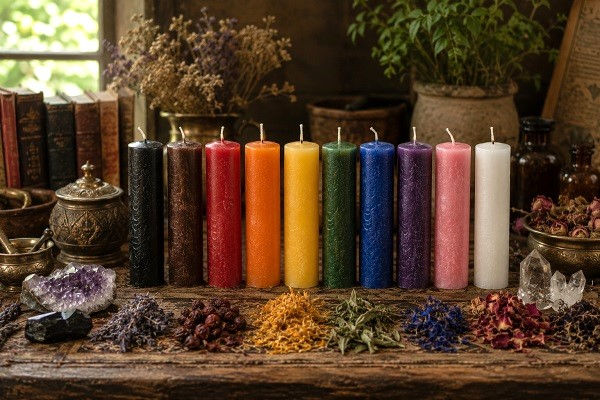
There is no need to acquire every type of candle to begin practicing. Beginners often feel pressure to assemble an elaborate collection before they cast their first real spell, and that pressure is misplaced. A functional starter kit looks something like this: chime candles in the core colors: white, black, red, pink, green, blue, yellow, and purple which gives the witch the ability to design a working for nearly any common intention. A few plain beeswax or soy tapers for occasions that ask for the more substantial form. A package of tealights for fast work and for any working that needs containment. And, when the witch is ready for sustained work, one seven-day glass-encased candle in a neutral color for her first long burn.
That is a complete beginning. Figure candles, knob candles, and specialty forms come in as the witch develops specific use for them when she has a working that genuinely calls for a lover candle or a skull candle, she acquires the right candle for that working. Buying figure candles before the witch has any idea what she would do with them is collecting, not practicing.
Choosing With Awareness
The witch who chooses with awareness chime for the contained working, taper for the day-long ritual, pillar for the extended ceremony, seven-day for the sustained presence, figure for the sympathetic working has already done the first piece of magic before any flame is struck. The body has been chosen. The rest of the working follows.
Internal Family Systems & Parts Work Integration Practice
IFS Parts Journaling
The candle is the body the spell will take.
For this practice, take five to ten minutes, or longer if desired. Find a notebook, journal, or blank page.
Take a moment to think about different kinds of candle bodies:
Chime candle — simple and contained
Taper — elegant and spacious
Pillar — steady and substantial
Tealight — safe, small, and practical
Seven-day candle — sustained and present over time
Figure candle — personal, symbolic, or intense
Notice which candle form your parts feel most drawn to. Choose the response that feels strongest and let that part write first. Have it share what it wants you to understand about the kind of container it would trust for a working.
If it helps, choose one of these questions:
What kind of candle form feels approachable to me right now?
What kind of candle form feels too intense, too long, too exposed, or too much?
What would help a candle working feel simple enough to begin?
Let the writing come in whatever form feels natural: sentences, fragments, questions, objections, images, memories, or simple notes.
When the writing feels complete, pause and read what came through. Notice what this part is showing you about the kind of candle body your system may feel ready to work with.
When you are ready, put the pen down. Take a final moment to acknowledge and thank the parts of you that showed up for this practice.


Comments