📚Module 5 — Socratic questioning and guided discovery | CBT Course
Updated: Oct 9
Free Course by Everything IFS Academy | Therapeutic Modalities Series Help us reach the people who may need this most by sharing this free course with friends, family, colleagues, online communities, social media or on your own website.
🎧 Audio is read by AI — Helen
📚Module 5 — Socratic questioning and Guided Discovery
There is a strange rule about minds that everyone has run into and almost no one has named: arguing with a hot thought makes it stronger. Tell a person mid-spiral that they're being irrational, and they will defend the spiral. Tell yourself "that's ridiculous, stop thinking that," and the thought digs in like a splinter pressed sideways. Socratic questioning is CBT's answer to this rule. Instead of attacking a thought head-on, it examines the thought with open, honest questions, and something remarkable happens: a thought that would have survived any argument begins to loosen on its own. A thought examined outlasts its grip; a thought argued with outlasts the argument.
Guided Discovery
The method takes its name from Socrates, the Athenian philosopher who never lectured anyone. He claimed to know nothing, asked questions instead, and let people walk themselves into discovering that what they were certain of didn't quite hold together. The discovery was the whole trick. A conclusion people reach themselves becomes theirs, while a conclusion handed to them stays someone else's, easy to shrug off the moment the conversation ends.
In CBT this principle is called guided discovery, and it describes how a therapist works: not telling a client their thought is wrong, but asking the questions that let the client find out for themselves what the thought is made of. Self-reached conclusions stick. Imposed ones slide off. Anyone who has ever ignored good advice for years and then "realized" the same thing independently has lived this principle firsthand.
Used solo, the skill means becoming one's own guide, and that requires a specific stance:
Curiosity, not prosecution.
The goal is an investigation, not a cross-examination. A prosecutor already knows the verdict and hunts for whatever supports it; an investigator genuinely doesn't know what they'll find. The questions only work when the answers are allowed to surprise.
The thought is allowed to be right.
This is what separates questioning from arguing. Sometimes examination reveals a thought is largely accurate, and that is a successful outcome too, because now the accuracy is known instead of assumed. A method that can only ever conclude "the thought was wrong" isn't an investigation, it's a script.
Answers in good faith.
The questions below are simple. Their power depends entirely on answering them honestly, especially when the honest answer is inconvenient for the mood.
The Socratic Questioning Toolkit
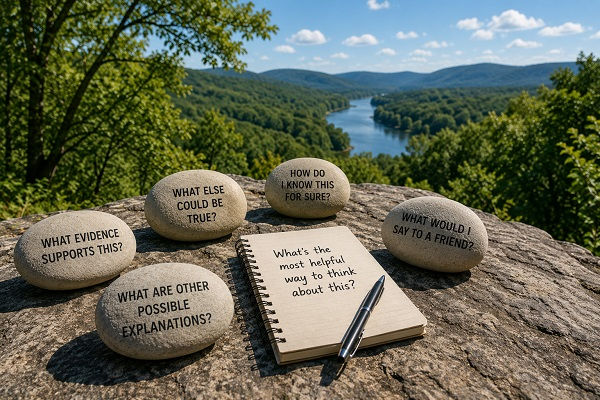
The questions that loosen thoughts cluster into five families, each aimed at a different wall of the thought. Few situations need all five; the skill is knowing the families well enough to reach for the ones that fit.
The Evidence Questions.
What facts support this thought? What facts cut against it? The critical word is facts, and the bar is high on purpose: evidence means what would hold up in court, not what the feeling insists on. "I felt everyone judging me" is testimony about a feeling; "two people checked their phones" is a fact, and so is "three people asked follow-up questions." When a Maya examines her thought "my presentation bombed," the evidence for it turns out to be one yawn and her own churning stomach, while the evidence against includes the follow-ups, a "nice work" from her manager, and a colleague asking for her slides. Stomachs are honest about feelings and unreliable about facts, and the evidence questions are how the two get separated.
The Alternative-Explanation Questions.
What else could account for this? Hot thoughts have a habit of presenting the most personal explanation as the only one. A Devon whose friend hasn't answered a text in two days holds the thought "he's pulling away from me," and the alternative questions simply ask what else fits the same facts: a brutal work week, a friend who famously reads messages and forgets them, a phone on do-not-disturb. Generating alternatives doesn't require believing them yet. It only requires admitting the field of explanations was bigger than one, because a mind that sees three possibilities holds each of them more lightly than a mind that sees one certainty.
The Decatastrophizing Questions.
What's the worst that could realistically happen? What's the best? What's the most likely? And the quiet powerhouse of the family: if the worst did happen, how would I cope? Anxious thoughts live in a foggy, unexamined worst case, and these questions turn the lights on in it. A Priya facing an interview with the thought "if I stumble on one question, it's over" walks the ladder: the realistic worst is fumbling an answer visibly; the best is sailing through; the most likely is a mixture, some strong answers and a shaky one. Then the coping question does its work: if the worst came, she would take a breath, recover, and there would be other interviews. The catastrophe rarely survives being described in detail, and a worst case with a coping plan attached is no longer a cliff, just a hard step.
The Distance Questions.
What would I say to a close friend who had this exact thought about themselves? And: will this matter in five years? In five weeks? These questions work because of a well-documented human asymmetry: people are wildly harsher toward themselves than toward anyone else, and borrowing an outside vantage point restores ordinary fairness. A Jordan who thinks "I made a fool of myself at the dinner" and imagines his sister saying the same thing about herself finds his answer to her arrives instantly, warm and sane: nobody was cataloguing her jokes, everyone was busy worrying about their own. The five-years question adds the second kind of distance, time, and most hot thoughts visibly shrink inside it.
The Usefulness Questions.
What does believing this thought cost? What does it buy? This family is different from the other four, and the difference is worth savoring: it doesn't ask whether the thought is true, it asks whether the thought is doing anything good. Some thoughts are partly true and completely useless. A thought like "I always mess up eventually" might have a few supporting exhibits, and holding it costs motivation, spontaneity, and sleep, while what it buys is a kind of pre-flinching, bracing for a disappointment that hurts just as much braced. When a thought fails the usefulness test, the grip loosens even before the truth question is settled.
One boundary keeps this toolkit honest: every family above examines the thought sideways, testing its walls where it stands. There is a different question that digs straight down beneath a thought, and that deeper move has its own lesson later in this course.
One Thought, Fully Questioned
The families come alive when they run in sequence on a single real thought, so here is one, start to finish.
Sam sends a quarterly report to a client and, an hour later, gets an email: one of the figures is outdated. The client is polite about it. Sam's stomach drops, and the catch (the skill from Module 3) surfaces the hot thought: "Everyone now sees I can't be trusted with anything important." It feels about 85 percent true.
The investigation:
Evidence for? The mistake is real. The figure was wrong, the client noticed, and a correction had to be sent. That stays on the table; an honest investigation doesn't dissolve facts.
Evidence against? Sam has sent roughly forty reports this year, and this is the first correction. The same client renewed their contract last month. Sam's manager routed a sensitive account to Sam specifically in the spring. "Everyone sees I can't be trusted" is being held up by one email and contradicted by a year of quiet, boring reliability that never announced itself.
What else could this mean, besides untrustworthiness? That a checking step failed once under a heavy week, or that the report pipeline pulls numbers from a file that updates late. Both fit the facts at least as well as a character verdict does.
Worst, best, most likely? Worst: the client mentions it to Sam's manager, and there's an awkward conversation. Best: the correction is absorbed and forgotten by Friday. Most likely: the client, who is polite and busy, has already moved on. And if the worst came? Sam would own it, describe the fix, and the conversation would be uncomfortable and survivable, the way such conversations have always been.
What would Sam say to a colleague who sent one wrong figure in forty reports? Something like: that's a 97.5 percent clean record, fix it and go to lunch. The gap between that sentence and "can't be trusted with anything important" is the whole finding of the investigation.
And usefulness? Believing the hot thought for the rest of the day costs focus, makes the next report slower and more fearful, and buys exactly nothing the correction email didn't already handle.
Notice what happened and what didn't. The thought was not defeated, silenced, or replaced with a pep talk. The mistake is still real, and Sam will probably add a checking step, which is the useful residue of the whole event. But "everyone," "can't be trusted," and "anything important" have all wobbled under questioning, and the thought that felt 85 percent true now hangs looser, no longer wearing the costume of plain fact. Building the more accurate thought that belongs in its place is its own complete skill, and it is exactly where the next lesson begins.
Below this lesson, you'll find a CBT practice built around one of the skills you just learned, along with a few ways to begin noticing and practicing it in everyday life this week.
CBT Practice: Questioning One Thought
This practice runs a real investigation on one of your own thoughts. You'll need a pen and paper (writing matters here; answers in the head evaporate, answers on paper hold still), and about ten minutes.
Pick your thought. A fresh catch from today is ideal, or reach back to a recent hot thought you can still feel a flicker of. Write it at the top of the page in its natural wording, and jot how true it feels right now, 0 to 100.
Choose two or three question families that fit it. A thought making claims about facts calls for the evidence questions. A thought predicting disaster calls for decatastrophizing. A harsh self-verdict calls for the distance questions. Trust your read.
Write the questions down, and answer them in writing, honestly. Facts, not feelings, where facts are called for. If evidence supports the thought, write that down too; this is an investigation, and the thought is allowed to be partly right.
If one answer surprises you, sit with that one an extra moment. Surprise is the sound of discovery, and discovery is the entire method.
Finish by reading the thought at the top of the page one more time and simply noticing how it feels now. No verdict is required, and no replacement thought is needed yet. Looser is the goal, and looser is enough.
If the thought you picked turns out to connect to something heavy or old and the questioning stirs more than it settles, ease off. That's information, not failure, and thoughts with deep roots deserve gentler pacing, sometimes with a professional alongside.
This Week
Once this week, when you notice yourself arguing with a thought, try swapping the argument for a single question from any family, and see what the thought does.
Try the friend question in the wild once: catch a harsh self-verdict and ask what you'd say to someone you love who said it about themselves. Notice the speed of your answer.
If a worry starts inflating, walk it once through worst, best, most likely. Even done casually in line at the store, it counts.
Disclaimer: Everything IFS Academy is an independent educational platform and is not affiliated with, endorsed by, or connected to the IFS Institute. While we strive for accuracy, errors can occur, and users are encouraged to cross-reference critical information. These courses, lessons, skills, and practices are offered for educational and self-reflection purposes only. They do not constitute therapy, mental health treatment, clinical training, or crisis support, and they should not be used as a substitute for professional mental health care.
Crisis Support: 🚨 If you are experiencing a mental health crisis, feel unsafe, feel at risk of harming yourself or someone else, or feel too overwhelmed to safely use self-directed practices, please pause this material and reach out for immediate support. Contact a licensed mental health professional, call or text 988 in the U.S. or Canada, or use your local emergency or crisis resources.



Comments