🦋Module 15 — Putting Your Legacy Plan Together | Legacy Projects for the Dying Course
Updated: 9 hours ago

Free Course by Everything IFS Academy | Death and Dying Series
Help us reach the people who may need this most by sharing this free course with friends, family, colleagues, online communities, social media or on your own website.
🎧 Audio – listen on the go - (coming soon)
🦋Module 15 — Putting Your Legacy Plan Together
The library is now open: fourteen lessons of projects, from a two-minute voice memo to a
scholarship that outlives everyone. What remains is the judgment work that no single project lesson could own, the questions that only arise when the whole shelf is visible at once. What comes first when time is short? How does limited energy buy the most legacy? What becomes of the projects that will not get finished? And how does a person know when they have done enough? This closing lesson teaches those four judgments, and ends the course where it should end, with the last one.
If Time Is Short, Do These First
Every project in this course was taught as if there were time to choose freely, and for many people there is. But this lesson owes an honest answer to the other situation, the one where weeks have become days, or where energy has collapsed faster than anyone planned, and the library must be triaged. The triage rests on a single sorting question, and it sorts the entire course cleanly: which legacies can no one else ever supply?
Most of the library, it turns out, is recoverable by others. The quilt can be sewn after; the tree can be planted after; the memory fund, the photo book, the printed cookbook, even much of the family history can be assembled, finished, or started by family later, imperfectly but truly. Three things cannot, because their entire substance is the person, and they vanish with the person, completely and forever. They are the triage list, in order:
The voice, first. A recording, today, of any length, by the voice and video lesson's craft. First because it is the highest treasure per minute that exists in this course, the thing the bereaved say they would trade everything else to have, and because it costs the least: two minutes, flat in bed, a phone someone else holds. The story always told, names said aloud, a goodnight. If only one project in this entire course ever happens, it is this one.
The short legacy letter, second. The ethical will lesson's smallest honest form: a page, or a dictated paragraph, of what mattered and what is hoped for them. Not the full document with all its sections; the core of it, the part only this person knows, in their words, with their name signed or spoken at the end. A letter like that has been written in an afternoon ten thousand times, and dictated from bed at least as often.
The photo names, third. The photographs lesson's irreplaceable act: the faces named, as many as energy allows, a helper dealing the pictures and writing while the person does the only part that requires them, the knowing. Every named photo is a face saved from becoming a stranger; an hour of this can rescue three generations.
Voice, letter, names. Everything else in the library waits politely behind these three, and the family can be told so directly: protect the person's energy for the irreplaceables, and claim the rest of the library, the keepsakes lesson's molds and prints very much included, since those ask nothing of the person at all, as their own work, now or later. Triage is not a sad, reduced version of this course. It is this course, distilled: the things only one person can give, given.
One Good Hour, Several Legacies
The second judgment is the multiplier, and it is the most practical page in this lesson: a well-chosen session produces several legacies at once, and planning for that multiplication is how limited energy buys a full legacy. The insight is simple once seen. Most of this course's projects share the same raw materials, the person, talking, doing, being recorded, and a session designed around those materials feeds many lessons' projects simultaneously, where the same energy spent on projects one at a time would feed only one.
The kitchen afternoon is the proven model, the one the recipes lesson's Earl demonstrated without knowing it. One dish, cooked or directed, with a phone propped and recording: that single session yields the pinned-down recipe, a recipes project; the voice and the hands at work, a voice and video treasure; the stories that pots reliably summon, which is the life story lesson's material arriving unprompted; and the photographs someone takes of the day, which join the family archive with their captions already known. Four lessons' worth of legacy, one afternoon, one energy expenditure. The same multiplication runs through the course's other natural sessions: the photo-sorting visit, where the photographs lesson's naming, the life story lesson's photo-key telling, and a recorded voice all happen in the same chair at the same time; the heirloom-giving afternoon, where the heirlooms lesson's handing-over, its recorded stories, and the keepsake of the moment itself all arrive together; the choosing of the quilt clothes, which produces the keepsakes lesson's labeled box and an eighteen-minute recording in one sitting, as it did for June.
The planning rule that captures all of it: design sessions, not tasks, and put a running recorder in every session. A family helping with legacy work should almost never schedule "label photos" as a chore; they should schedule a visit that happens to have the photo box on the table and a phone recording, and let the multiplication do its work. One good hour a week, designed this way, outproduces a month of dutiful single-purpose tasks, and, not incidentally, the hours themselves are the visits the family will remember.
Handing Off the Unfinished
The third judgment concerns the projects that will not be finished, and it begins by overturning the assumption that makes them painful: in legacy work, the half-done project with instructions is a finished legacy. Not a consolation, not a salvage, finished, by the same authorship principle the choosing lesson established on day one and the keepsakes lesson proved with Roy's birdhouse: the person's part of any project was always the choosing, the knowing, and the meaning. When those are captured, the person's work is complete, whether or not the labor is.
So the craft of handing off is the craft of capturing those three things in writing, and the note that does it has three lines' worth of jobs: what this is and what it was meant to become ("these fourteen garments are for a quilt; the recording of why each one is in the box is in the family folder, same name"); how to carry it across the line, in whatever detail exists, the system half-used, the names half-written, the outline of the letter that a daughter can now complete in her mother's spirit ("the photos in the red box are named; the green box isn't; Aunt Pearl can identify the lake people"); and the blessing on the finisher, one sentence releasing the project into their hands without guilt attached ("whoever finishes this, it was always going to be ours together; thank you"). With that note, the chosen-but-unsewn fabrics, the half-named photo box, the outlined-but-unwritten letter, the fund intended but not yet founded, every one of them transfers whole.
And here is the quiet truth hospice families would add: the handed-off project often binds a family more than a finished one would have. The granddaughter taught the stitch to finish the blanket, the son who completes the letter from the outline, the family that plants the tree the person chose but never saw delivered, they describe the finishing as the most meaningful thing they did in the first year of grief, because it gave the love a job, and grief with a job heals differently than grief without one. A person who deliberately leaves a project at the handoff stage, instructions written, blessing attached, has not fallen short of a legacy. They have left one with a door in it.
A Plan on One Page
Now the whole course's judgment, run start to finish through one fresh example, because a plan on one page is what all of this becomes in practice.
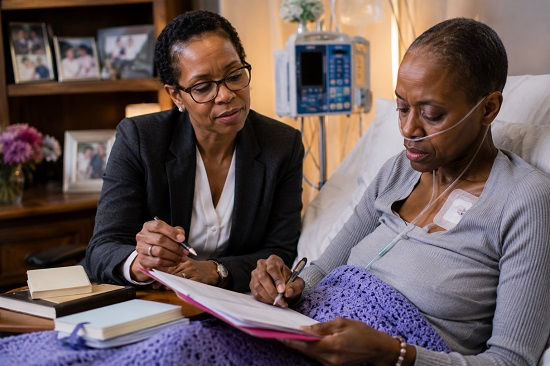
Nora is seventy-eight, four months into hospice at her daughter's house, honest with herself about her energy: one good stretch most mornings, flat by two, hands too unsteady for sustained writing. She has two children, five grandchildren, a sister, and a kitchen reputation. Her plan, made in one sitting with her daughter and a notepad, runs the course's judgments in order. The triage first, because energy is not guaranteed: this week, the voice, three short recordings, the wedding story, everyone's names said aloud, and a goodnight, made tomorrow morning from the recliner; the short letter, dictated, one page, signed in her own shaky hand because the keepsakes lesson taught them both what the shake is worth; and the photo names, begun, red box first, her daughter dealing.
Then the chosen projects beyond the triage, three of them, deliberately spread across the three sizes the choosing lesson defined. Her table project, planned for the next good Saturday: the kitchen afternoon, her gravy, directed from the stool, recorded, designed as a multiplier session in full. Her lap project, ongoing, a little most mornings: the memory boxes, one per grandchild, candidates supplied by her daughter, stories recorded as she curates, per the heirlooms lesson. Her bed project, for the flat afternoons: the future letters lesson's open-when set, dictated two lines at a time, starting with five envelopes per grandchild. And the handoffs, written into the plan from the start rather than discovered at the end: the quilt clothes chosen and boxed with their recording for her sister to sew, and the green photo box explicitly bequeathed, with its note about Aunt Pearl, to whichever grandchild proves nosiest.
The page ends the way every plan must: the machinery. Keeper, her daughter, named out loud, accepting. Home, the one drawer, plus the shared family folder the recordings already live in. Line, one sentence added to the folder with her papers, saying the drawer and the folder exist. The whole plan fills one page of the notepad, and it is worth noticing what made it work, because it is everything this course has taught compressed to a sentence each: irreplaceables first, sessions over tasks, sizes matched to real energy, authorship kept while hands are borrowed, handoffs written as completions, and every finished thing findable.
Letting Done Be Enough
The course ends with its final teaching, and the final teaching is a measure. After fifteen lessons of projects, the honest question arrives on its own: how much of this is enough? And the answer this entire course has been building toward is that the measure of legacy work was never volume. It is love, transmitted. A legacy is not a body of work to be completed; it is a connection to be carried forward, and connection does not weigh its vessels.
One true letter is a legacy, entire. Ten photographs with names on the back are a legacy. A thumbprint in clay, a recipe card with a grease spot, a tree, a taught knot, four sentences said in time to one person, any one of these, alone, is the whole assignment fulfilled, because each one carries the person forward into hands that will hold it for decades, and that was the entire job. The library was never a syllabus. It was a menu, and nobody eats the whole menu.
So the course closes by saying plainly what every hospice worker, every bereaved family, and every lesson here knows from the inside. The person who read all of this and then recorded two minutes of their own laugh has done the work. Not a sample of the work, not a start on it, the work: a voice, saved, on purpose, for people who will play it on the hard nights and the good ones, fifty years from now, in kitchens that do not exist yet, for children not yet born who will know, because of two minutes, exactly how their great-grandmother laughed. Done, in legacy work, was always going to be enough, because the person was always the legacy, and the projects were only ever ways of writing that down.
Disclaimer: Everything IFS Academy is an independent educational platform and is not affiliated with, endorsed by, or connected to the IFS Institute. While we strive for accuracy, errors can occur, and users are encouraged to cross-reference critical information. These courses, lessons, skills, and practices are offered for educational and self-reflection purposes only. They do not constitute therapy, mental health treatment, clinical training, or crisis support, and they should not be used as a substitute for professional mental health care.
Crisis Support: 🚨 If you are experiencing a mental health crisis, feel unsafe, feel at risk of harming yourself or someone else, or feel too overwhelmed to safely use self-directed practices, please pause this material and reach out for immediate support. Contact a licensed mental health professional, call or text 988 in the U.S. or Canada, or use your local emergency or crisis resources.


Comments