🦋Module 8 — Recipes, Food, and Family Traditions | Legacy Projects for the Dying Course
Updated: 1 day ago

Free Course by Everything IFS Academy | Death and Dying Series
Help us reach the people who may need this most by sharing this free course with friends, family, colleagues, online communities, social media or on your own website.
🎧 Audio – Listen on the go
🦋Module 8 — Recipes, Food, and Family Traditions
In most families there is at least one dish that is not really food. It is a person, in casserole form. This lesson teaches the legacy work of the family table and everything that surrounds it: the recipe collection and why the handwriting matters as much as the ingredients, the craft of pinning down recipes that exist only as a pinch and a glug, the cooking video that captures hands and corrections together, the stories that turn a cookbook into a family document, and the wider layer this lesson also owns, the holidays, sayings, songs, and small rituals that nobody ever wrote down.
Why Food Carries Memory
Smell and taste reach memory by a shorter road than anything else; a whiff of cinnamon and browned butter can put a grown adult back in a kitchen forty years gone, faster and more completely than any photograph of that kitchen ever could. Every family knows this from the inside. The dish appears, and so does the person: the way the kitchen sounded, the apron, the argument about whether it needed more salt, the particular fullness of being fed by someone who loved feeding people.
This is why the food legacy earns a full lesson, and why hospice workers and bereavement counselors list recipes among the most requested and most used legacies in practice, used being the operative word. A letter gets read; a recording gets played; but a recipe gets cooked, every holiday, forever, and the cooking is a ritual of resurrection the family performs together. The first holiday after a death, in house after house, someone makes the dish, and for an hour the person is at the table again. Families who have the recipe describe that hour as a mercy. Families who do not describe standing in the kitchen with all the ingredients and no way in, because the recipe lived in the hands, and the hands are gone. The whole purpose of this lesson is to make sure the recipe does not live only in the hands.
The Family Recipe Collection
The core project is the collection: gathering the dishes that mean something, in one place, in a form the family can cook from. Not every dish; the choosing lesson's sizing rule governs here as everywhere, and the working number is the same spirit as the photographs lesson's fifty that matter. For most families that means the eight or twelve dishes with names attached to them: the sauce, the holiday bird and its sides, the soup that meant someone was sick and loved, the birthday cake, the bread, the thing nobody else has ever made right.
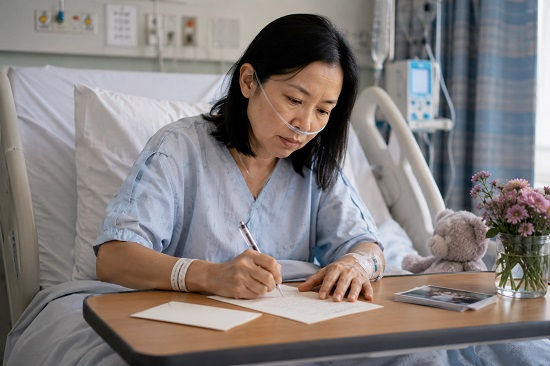
And wherever the hands allow, the recipes go down in the person's own handwriting, because a family recipe in familiar handwriting is two legacies on one card. There is a reason the framed recipe card has become one of the most common keepsakes in American kitchens: the daughter who frames her mother's pie crust card is not framing instructions, she is framing the hand, the loops and slants and the grease spot in the corner, and she will cook from a photocopy to protect the original. The wider craft of preserving handwriting, engraving it, embroidering it, belongs to the keepsakes lesson ahead; here the teaching is simpler: write the cards by hand if the hands can do it, in pen on real cards, and let them be imperfect, because the crossed-out quantity and the cramped margin note ("more vanilla than this, always") are the person on the page. Where the hands cannot, the person dictates and someone else writes, and a signature at the bottom of each card, if even that much writing is possible, keeps a trace of the hand on every recipe. Authorship, as the choosing lesson settled once for the whole course, is the knowing, not the penmanship.
Pinning Down the Vague Ones
Now the craft problem at the center of all family food, the one every reader will recognize: the best recipes are not written anywhere because they were never measured in the first place. A pinch of this. A glug of that. Flour until it feels right. Cook it until it looks done, you'll know. These instructions work perfectly, for exactly one person, and they are the recipes most likely to die, because what gets passed down is a card that says "some flour" and a granddaughter who stands in her kitchen years later, defeated by it.
The fix is one session, and it is almost embarrassingly simple: cook the dish once while someone measures and writes. The person cooks exactly as always, by feel, by eye, changing nothing. The helper's job is interception: before the pinch goes in, it lands in a measuring spoon; before the glug pours, it pours into a cup; the "until it looks right" gets a time and a description written down ("about eight minutes, until it pulls from the sides and smells nutty"). The person never has to translate their knowledge into numbers, which is the step that defeats everyone; the helper does the translating in real time, and by the end of one cooking, "some flour" has become "about two and a quarter cups, less on a humid day," which is a recipe a granddaughter can actually make.
Sofia's sauce had been famous and unwritten for fifty years; she genuinely did not know what was in it, in the sense that she had never once thought about it in quantities. Her niece cooked alongside her one Sunday with a notebook and every measuring cup in the house, intercepting and scribbling, and the resulting two pages, complete with Sofia's running commentary faithfully recorded ("if the garlic browns you've ruined it, start over, I mean it"), are now photocopied in four states. One Sunday. That is the entire cost of saving a fifty-year recipe, and for dishes that are too much for the person to cook anymore, the session works in directed form: a family member's hands at the stove, the person in a chair beside them, ruling on every pinch. The knowing supervises; the measuring happens; the recipe gets caught either way.
Cooking It Together One More Time
The pinning-down session has a sibling, and it is one of the warmest projects in this entire course: the cooking video. One dish, one afternoon, the phone propped in the kitchen, recording the whole thing, the hands working, the corrections, the stories that always come out over a pot, the taste test, the verdict. The written recipe preserves the dish; the video preserves the cooking, which is a different and in some ways larger thing, because so much of family cooking lives below the recipe line: how thin the dough actually gets rolled, what "golden" actually looks like in that family's oven, the speed of the stir, the way the cook hovers.
The recording craft is owned by the recordings lesson and applies here unchanged: phone propped steady, daylight from a window if the kitchen has one, close enough to hear, and absolutely no performance, because the point is the person cooking the way they cook, interruptions and flour handprints included. The one addition this lesson makes is about coverage: the camera should spend real time on the hands. Faces are precious and the recordings lesson covers them; in the kitchen, the hands are the archive, kneading, folding, testing, and families rewatching these videos report pausing on the hands more than anything else.
What makes this project special is what it is while it is happening. Earl's last big cooking was his barbecue, directed mostly from a kitchen stool by then, his two sons doing the lifting while he ruled on the rub and told the stories the rub always brought up, and his daughter-in-law filmed two hours of it. The family got the recipe, the technique, his voice, his laugh, and the stories, all in one afternoon, and the afternoon itself, everyone in the kitchen, the smell, the eating after, is the day the family talks about now. The closing lesson of this course will name this kind of session as the model of one good hour feeding several legacies at once; the kitchen is where that multiplying works best, and a family planning one big legacy day could do far worse than to plan it around a stove.
The Stories Behind the Dishes
A stack of accurate recipes is a cookbook. What turns it into a family document is one paragraph per dish: whose it was, where it came from, when it showed up in the family, and the story attached to it, the same one-line-story principle the photographs lesson established, given a little more room. The pot roast came from a grandmother who made it every Sunday of the Depression and considered it proof things were not as bad as they could be. The almond cake entered the family with a great-aunt's marriage and never left. The famous disaster year, when the turkey caught fire or the salt was sugar, goes in too, because the disasters are load-bearing; families retell the failures more than the triumphs, and a cookbook honest enough to include "the year I ruined it" teaches the next cook the most loving lesson in cooking, which is that the table matters more than the dish.
These paragraphs can be written on the back of each card, dictated while someone writes, or, where one dish opens into real telling, captured by the story formats taught in the life story lesson, a recipe in the lap being every bit the story key a photograph is. A header note for the whole collection, a few lines from the person about what feeding this family meant to them, finishes the document; more than one family cookbook opens with a paragraph the family now quotes at every gathering, and it cost its author ten minutes.
Traditions Beyond Food
This lesson owns one more territory, wider than the kitchen: the family's traditions, the how-we-do-things layer that nobody ever writes down because everyone assumes everyone knows it, right up until the one who really knew it is gone. The first holiday after a death is where families discover this, mid-ritual, stalled on a question with no living answer: what order did the ornaments go on, what was the blessing, why do we eat that on that day, who taught us this.
The project is the tradition record, and it is a list, not a literature. The holidays, as they were actually done and in what order, and why, where the why is known; the origin of each tradition, because half of them turn out to have started as accidents or jokes, and that origin story is usually the best part. The family sayings, the phrases everyone uses without knowing where they came from, with their stories attached; in Dottie's family, "good enough for the dance" had been said for sixty years, and only Dottie knew it came from her father's verdict on a haircut in 1949, a fact she dictated to a granddaughter along with two dozen other entries in what the family now calls the dictionary. The songs, the ones sung at birthdays and bedsides and in the car, named, and better yet sung once into a recorder, which is a recordings-lesson project this lesson is happy to assign. And the small rituals, the specific goodnight, the lucky whatever, the way leaving the house was always done. Captured as a handwritten list, a letter, or a recording, by whichever format the energy allows, this becomes one of the cheapest and most consulted documents a family can own: two pages that let the rituals keep running on schedule, in the right order, with their reasons attached, for generations that would otherwise have to guess.
Formats
The food and tradition legacy can live in several physical forms, and the choice is genuinely just a sizing decision under the choosing lesson's rules:
The handwritten card box. The classic, and the lowest-effort full version: cards in the person's hand, in a box, in the kitchen where they belong. Maximum handwriting, minimum production. Done in lap-project sittings, a card or two at a time.
The scrapbook. Cards or written pages combined with photographs, of the dishes, the table, the cook, and the story paragraphs alongside. The richest single-copy version, and a natural project to assemble with a grandchild.
The typed and printed book. The recipes and stories typed up (by anyone; the person supplies, a family member types) and printed through any photo-book or print service, which solves the one-original problem the same way the photographs lesson solved it: a copy for every household, and the handwritten originals preserved separately as the keepsakes they are.
The shared digital document. A living version in a shared family folder, where the recipes and traditions go in now and the family keeps adding, corrections, new disasters, the next generation's entries. It lives by the file rules of the recordings lesson, two places and a keeper, and it has one quality no printed version has: it stays alive.
Any of these is a complete project. The card box alone, eight dishes in a familiar hand with their stories on the back, is a magnificent legacy, and for many people it is the right-sized one. The family that holds it will tell anyone who asks: it is not a cookbook. It is the person, in the kitchen, still feeding them.
Disclaimer: Everything IFS Academy is an independent educational platform and is not affiliated with, endorsed by, or connected to the IFS Institute. While we strive for accuracy, errors can occur, and users are encouraged to cross-reference critical information. These courses, lessons, skills, and practices are offered for educational and self-reflection purposes only. They do not constitute therapy, mental health treatment, clinical training, or crisis support, and they should not be used as a substitute for professional mental health care.
Crisis Support: 🚨 If you are experiencing a mental health crisis, feel unsafe, feel at risk of harming yourself or someone else, or feel too overwhelmed to safely use self-directed practices, please pause this material and reach out for immediate support. Contact a licensed mental health professional, call or text 988 in the U.S. or Canada, or use your local emergency or crisis resources.


Comments