Module 4 — Color Correspondences | Candle Magic Course
Updated: Sep 28
Free Course by Everything IFS Academy Witchcraft Series
Help us reach the people who may need this most by sharing this free course with friends, family, colleagues, online communities, social media or on your own website.
🎧 Audio - listen on the go (coming soon)
🕯️Module 4 — Color Correspondences
The question arrives early in every witch’s practice, usually within the first few workings, and it tends to feel small. She wants to do a love working, and what she has on hand is a white chime. She wants to do a prosperity working, and the only green candle in the drawer is spoken for. She is going to work anyway. So how much does the color actually matter?
The honest answer: it matters more than beginners think and less than rigid practitioners insist. Color is one of the most powerful design choices in candle magic, and it is also a choice the white-substitute rule will rescue whenever the drawer runs thin, as you are about to learn properly.
Here is the way of thinking about color that will serve you for the rest of your practice. Color is frequency. The witch chooses color the way a musician chooses a key: not as decoration, but as the tonal field the spell will play in. A working in green plays in a different key than the same working in red. The intention may be identical; the music is not. And the wrong color is not a fatal flaw. It is the wrong note. The working still plays, only out of tune, and a witch with a developed ear comes to hear the difference.
What a Correspondence Is, and Where This System Came From
First, the word this whole lesson is named for, because no witch should use it cold. A correspondence is a traditional link between a physical thing and an intention or energy: this color for that purpose, this herb for that aim, this day for that kind of work. Correspondences are the craft’s shared dictionary, and the color-to-purpose link you are learning today is the most used entry in it.
And as promised back in the lineages lesson, this system arrives with its credit attached. The contemporary color correspondences are largely a twentieth-century synthesis, drawing on older ceremonial magic and its color scales, on planetary and grimoire associations, on assorted folk traditions, and then sorted into their current tidy shape by the same paperback-era revival writers who systematized so much of modern witchcraft. Some threads are genuinely ancient and cross-cultural; red has carried blood, passion, life force, and danger across nearly every documented human culture, and no candle tradition on earth disagrees with red for those purposes. Other entries are newer consolidations. So hold the system honestly: it is a working system rather than an unbroken ancient inheritance. It works. It just was not handed down whole from antiquity, and a witch who knows that trusts it for the right reasons.
The Core Candle Colors
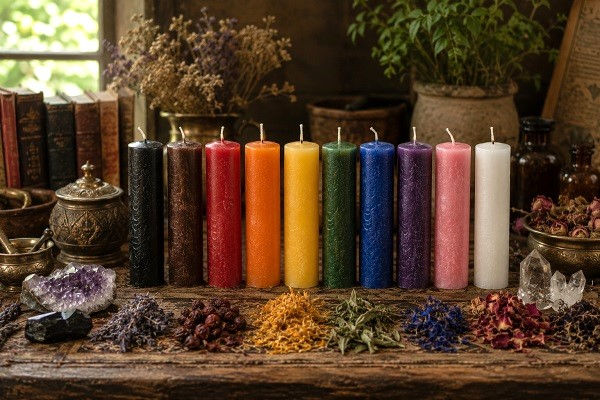
Here is the working palette most modern witches use. Each color below opens with a Carries line for the day you come scrolling back mid-planning, wondering what black means again, and then the depth follows. Read it all now; scan it forever after.
White: The Universal Candle
Carries: purity, clarity, peace, spirit connection, new beginnings, cleansing, healing, truth. Substitutes for: every other color.
Where most colors specialize, white generalizes. It is clean energy without a particular flavor, which is exactly why it can stand in for any other color when the right one is not on hand. Hear the substitute rule at full strength, because it is not an emergency fallback; it is a real principle of the system. A white candle lit for a love working is not a worse love working. It is the same working in the simplest possible key, and witches in sparse circumstances have run effective practices on white candles alone for whole lifetimes. White also leads for spirit contact, ancestor work, deity invocation (invocation meaning the calling of a deity or spirit into presence), and any working that wants the energy clean and uncomplicated. When in doubt, white is rarely the wrong answer, which is why your starter kit leans on it.
Black: Protection, Banishing, Endings
Carries: protection, banishing, absorbing negativity, shadow work, endings, breaking of crossed conditions.
The most misunderstood color in the craft. New witches often arrive carrying cultural baggage: black is sinister, black is for hexes, black candles are dangerous. Almost none of it survives contact with the actual tradition. Black is the color that absorbs and transmutes difficult energy, the one the witch reaches for when she needs protection against a threat, when something needs to end, when she is releasing what she has carried too long, or when she is doing shadow work, which, defined plainly, is inner work with the parts of herself she has been avoiding. It is true that traditions practicing baneful work, baneful meaning magic meant to harm, use black too, and that is where the reputation leaked from. But refusing black out of superstition is like refusing bandages because hospitals also contain scalpels. Black does work no other color can do, and your drawer needs it.
Red: Action, Passion, Vitality
Carries: passion, sexual love, courage, physical vitality, strength, life force, swift action.
The most active color in the entire palette. Red carries the blood; across cultures it is the color of life beating in the body, of desire that wants something now, of force that breaks through. The witch reaches for red when the working concerns lust and attraction, physical energy and bodily healing, motivation, courage, or anything that needs to move. Red is neither subtle nor patient, and it does not pretend to be.
Know also what red is not: the color of gentle love. The sweet, tender, holding kind of love, friendship, nurture, belongs to pink, and the fork between them is one of the craft’s classic choices, taught fully a few inches below.
Pink: Affection, Self-Love, Tenderness
Carries: gentle love, friendship, self-love, tenderness, emotional healing, reconciliation, kindness.
Pink is red softened by white: affection rather than fire. This is the color for relationship healing when two people who already love each other have hurt each other, for friendship workings, for self-compassion after a hard season, for the inner child, for any love working that is not about desire and pursuit. Carmen, one of my students, came to the drawer after a bruising argument with her sister, and her hand went first to red, because the feelings were certainly hot enough. But her working’s true aim was mending, not igniting, and mending is pink’s country. She worked a soft rose chime, and what she asked for was warmth restored, not fire started. Red or pink is the question of whether a love working calls forth fire or warmth. Both are holy. They are not interchangeable.
One shade note the tradition enjoys: the hotter pinks, magenta and deep rose, carry pink’s affection with real heat in it, flirtation, sexual confidence, attraction with a smile, sitting halfway along the road to red.
Orange: Creativity, Breakthrough, Momentum
Carries: creativity, joy, confidence, encouragement, quick success, opportunity, momentum, sudden change.
The bridge between red’s force and yellow’s mind, and the color of sunrise: things beginning, things opening, momentum building from nothing. Where red pushes through, orange unblocks. The stalled project, the creative work gone flat, the job hunt that needs a door to open, the moment that needs encouragement more than power: orange country, all of it. Career breakthroughs often call for orange, and so do creative blocks and every working that needs a burst of fresh beginning.
Yellow: Mind, Communication, Clarity
Carries: communication, intellect, memory, learning, mental clarity, happiness, travel, everyday solar energy.
The color of sunlight and thought. Where orange is the burst of beginning, yellow is the steady warmth of clear thinking. Light yellow for study and tests, for difficult conversations that need clean expression, for business communication, for travel workings, for any spell that wants the mind sharp and the words right. Yellow is solar, but it is the everyday solar of mental brightness; the full-force solar of triumph and lasting success belongs to gold, further down the palette.
Green: Prosperity, Growth, Heart-Healing
Carries: money, prosperity, abundance, luck, growth, fertility, nature work, healing of the heart.
One of the two or three most-worked colors in modern candle magic, mostly because prosperity is one of the most-requested workings in the entire craft. Green holds two threads, the green of growing things and the green of cash, and the tradition honors both without embarrassment, because they are the same energy expressed in different rooms of a life. The witch lights green for the harvest, for the seed, for the bank account, for the heart that needs to open like a leaf to sun. And that last one is real: in systems that use chakras, an energy-center map inherited from Indian tantric and yogic traditions and widely adopted in modern practice, green sits at the heart, and green candle work shows up wherever healing is specifically heart-shaped, grief mending, love restored after loss.
Blue: Peace, Truth, Intuition
Carries: peace, calm, sleep, truth, emotional communication, healing, intuition, water workings. Shade matters here.
Blue spans a wider range than most colors, so notice which blue your hand is reaching for. Light blue serves the gentle end: sleep, peace, the soothing of anxiety, the cooling of an overheated situation.
Deep blue serves the serious end of the same family: truth-telling, wisdom, psychic work, the kind of spiritual insight that asks the witch to sit with hard things. A pale dreamy blue and a deep navy are nominally one color and do quite different work, which makes blue the palette’s best training ground for the shade-reading skill taught just below.
Purple: Spirituality, Mastery, Deep Knowing
Carries: psychic development, wisdom, deep intuition, spiritual connection, mastery, high ambition.
The color of spirituality at altitude. Where blue’s intuition is gentle and relational, purple’s is the kind that connects the witch to spirit, to deity, to her own deepest knowing, which is why meditation and spirit-work candles are so often purple. Purple also carries the old royal register: mastery, and ambition at its most meaningful, the working that wants real achievement rather than mere gain. In chakra systems purple sits at the crown, and that placement matches how it reads in wax: the energy at the top, where the witch reaches up.
Brown: Grounding, Home, Everyday Stability
Carries: grounding, home, animals, stability, practical matters, endurance, earth energy.
The everyday color, and the one beginners skip because it has no flash and no glamour. What brown has instead is quiet reliability. This is the candle for house blessings, the flame on the kitchen counter the week of a move, for the unwell dog or cat, for steadying work when life feels wobbly, for every spell about rooting down rather than reaching out. Witches who work brown over time find it among the most dependable colors in the drawer. The unflashy tool usually is.
Gold: Solar Magic at Full Force
Carries: major success, recognition, lasting wealth, triumph, solar deity work, traditionally the masculine divine.
One step beyond yellow. Where yellow handles the mind’s daily sunlight, gold handles the sun at full force: the major career working, the recognition that endures, the wealth that outlasts the immediate need, the invocation of solar deities. The witch lights gold when the working is not asking merely for success but for the kind of achievement that sticks.
Silver: Lunar Magic and the Reflective Light
Carries: lunar work, intuition, psychic development, dreams, reflection, traditionally the feminine divine.
Gold’s lunar counterpart. Silver serves moon rituals, dream work, the deepening of intuition and psychic sense, and invocations of lunar deities, all the work that wants the cool reflective light rather than the bright direct sun. A silver candle on the altar during full moon work is old custom and works the way it always has. The craft of timing workings to the moon itself has a whole lesson waiting ahead.
Gray: Neutralizing and Balance
Carries: neutrality, balance, the neutralizing of difficult energy, the canceling of unwanted workings, stalemate.
The least-used color in the palette, and the witch who never touches it is sometimes missing the one right tool for a specific job. Gray neither draws nor banishes; it neutralizes, which is its own kind of magic. The working you now wish you had not done can sometimes be quieted with gray. The situation where two forces pull with equal strength can sometimes be balanced with it. Rarely needed, irreplaceable when needed: that is gray’s whole resume, and it is enough.
Reading Shades Within a Family
Beyond the named colors lies the matter of shade, and you have already met it twice: pale blue against navy, soft rose against magenta. Deep red and pink are one color to a chemist and two tools to a witch. Burgundy, red tempered by brown, leans toward determination, endurance, and grounded personal power rather than red’s sprint. The eye for shades grows through use. After a few months, most witches stop choosing by category name and start choosing by what the actual color in their hand feels like, the pale calming blue versus the deeper truth-telling one, the red that runs hot versus the red that softens toward the heart. Buying in person feeds this skill; keep noticing, and your Color Pages below will give the noticing somewhere to live.
Answers at the Shelf
Four questions ambush every beginner in the candle aisle, so here are the plain answers, filed where you can find them again.
Do dipped candles count, or must the color go all the way through? Plenty of chimes and tapers are dipped: a colored coat over a paler core. They count. The color your eye reads is the key your working plays in, and the tradition has never audited cross-sections. Some witches prefer solid color as a personal standard, and that is a preference, not a rule.
My seven-day candle is colored glass around white wax. Is that cheating? Not at all. The colored-glass form is standard equipment across the very traditions that built sustained candle work, and the color is fully present in the working. Green glass, green key.
Can one working use two colors, two candles? Yes, and it is common: a white candle for clean spirit alongside a green for the aim, say. Designing multi-candle workings properly is part of the spell-design lesson near the end of this course; for now, know the door exists and one well-chosen candle is plenty.
Do I need to match the holder, the cloth, the flowers? No. The candle’s color is the working’s key. Everything else is atmosphere, welcome if it pleases you, required never. And yes, the colored birthday candles in the cake drawer are real colored candles. The craft does not check where equipment went to school.
The Layered Colors
The shelf also holds candles wearing more than one color at once, and they deserve naming now because their colors are their logic. A double-action candle is poured in two layers, and the reading rule is the physical one: the top burns first, so the upper color is what the working does first and the lower color is what the situation becomes. Black over red: harm absorbed, then life restored. White over black: cleansing, then clarity. Reversible candles, a cousin form, are built specifically to turn a harmful working back on its sender, a defensive craft with its own considerations. And seven-color candles stack one band per day or stage, the candle marking its own progress through a sequenced working. All three are specialty forms, and their full methods, construction, use, and the ethics that come with reversal work, belong to the specialty forms lesson ahead. Today you can read their colors on sight, which is exactly enough.
Your Own Colors
The traditional system is a starting place, not a cage, and mature practice knows the difference. Over years, some witches develop personal associations that diverge from the book. A witch for whom blue has always meant abundance, because blue meant abundance in the house she grew up in, can work blue for prosperity successfully, even though the textbook points at green, because her own charged meaning is part of what charges the candle.
But mark the line, because it matters. A witch who worked the traditional system for years and then diverged with reason is making a master’s move. A witch who never learned the system and just picks colors she likes the look of is not adjusting anything; she is skipping the foundation, and it shows up in the working. Learn the key signatures first. Improvise after. Every musician you admire did it in that order.
How to Choose the Color: Four Steps
Now the method, small enough to run at the drawer in under a minute.
Say the working in one sentence. The same skill your First Flame taught, doing new work here. A vague working cannot be colored; a clear sentence nearly colors itself.
Find the sentence’s verb. What is the working actually doing? Drawing something in, banishing something out, healing, calming, growing, opening, ending, protecting, saying? The verb is the pointer.
Match the verb to the family, and take the famous forks with your eyes open. Love verbs fork at fire or warmth: pursuing and igniting is red, mending and holding is pink. Money verbs fork three ways: cash and growth now is green, breakthrough and open doors is orange, lasting triumph is gold. Ending and protecting verbs go to black, calming and truth verbs to blue, and so on around the palette above.
Check the shade, and when unsure, go white. Ask whether the working wants the gentle end of the family or the deep end. And if two colors still argue, or the drawer is bare, the universal candle stands ready. White is never a failure. It is the key of C.
That is the whole method. Sentence, verb, family, shade. Run it a handful of times and it stops being steps and becomes the way your hand moves at the drawer.
The Candle Log: The Color Pages
Open the log and give the palette a home: the Color Pages. For each of the thirteen colors above, write the color’s name and its handful of keywords in your own hand, because a palette copied by your own pen is learned twice. Then, under each color, add one line the tradition cannot supply: what this color means to you, from your own life. The color of a grandmother’s kitchen, a hospital corridor, a first car. Some of those personal lines will agree with the tradition and some will argue with it, and both are worth knowing, because the arguments are where your mature personal palette will someday come from. Leave a little room under each color for observations as your practice grows. These pages will end up among the most-thumbed in the whole book.
Witch Practice: Making the Palette Yours
Four assignments this week, and the palette moves from the page into your hands.
Build the Color Pages as described above, all thirteen, keywords plus your one personal line each. Take your time with the personal lines; they are the real work, and a question worth sitting with as you write is what each color meant in the house where you grew up.
Run the Four Steps on paper for five real intentions from your own life, including at least one love working and one money working, so you have to take both famous forks deliberately. Log the sentence, the verb, the color, and one line of why, for each.
⦁ Then perform one of them: your full First Flame rite, through a form chosen by the Three
Questions, in a color chosen by the Four Steps. This is the first working of your practice where every choice was deliberate, rite, body, and key, and it deserves a careful log entry, including what the deliberateness itself felt like.
Keep a shade eye out all week, in shops, at home, anywhere candles live. Find one pair of same-color-different-shade candles and write one line in the log about the different work each would do. You are training the eye that will serve you for decades.
Close the week with three questions answered in the log, in your own first-person words:
Which color’s traditional meaning most surprised me, and which one did I feel I already knew in my bones?
Where did my personal color lines agree with the tradition, and where did they argue with it?
When every choice in my working was deliberate for the first time, what changed in how the working felt?
Your candle now has a chosen body and a chosen key. Next, the craft picks up a knife, in the gentlest possible way: carving and inscribing, where the working gets written into the wax itself, and where your candle stops being a candle you chose and becomes a candle no one else on earth could have made.
Disclaimer: Everything IFS Academy is an independent educational platform and is not affiliated with, endorsed by, or connected to the IFS Institute. While we strive for accuracy, errors can occur, and users are encouraged to cross-reference critical information. The courses in the Witchcraft & Folk Magic Series explore witchcraft, folk magic, and related spiritual and cultural practices for educational and personal-interest purposes only. Nothing in them guarantees any particular result, and no ritual, spell, correspondence, or practice is offered as a substitute for professional medical, psychological, legal, or financial advice. Practices that involve fire, candles, herbs, plants, or other physical materials carry real risks such as burns, allergic reaction, or toxicity, and any practice is undertaken at your own discretion and risk. They do not constitute therapy, mental health treatment, clinical training, or crisis support, and they should not be used as a substitute for professional mental health care.
Crisis Support: 🚨 If you are experiencing a mental health crisis, feel unsafe, feel at risk of harming yourself or someone else, or feel too overwhelmed to safely use self-directed practices, please pause this material and reach out for immediate support. Contact a licensed mental health professional, call or text 988 in the U.S. or Canada, or use your local emergency or crisis resources.


Comments