Module 5 — Death in Hinduism | Death in the World's Religions Course
- Jun 14
- 9 min read

Free Course by Everything IFS Academy | Death and Dying Series
Module 5 — Death in Hinduism
This lesson opens the Hindu map of death, and the map's first move is its boldest: Hinduism teaches that the deepest part of a person cannot die at all. Everything else in the tradition's vast account, the cycle of rebirth, the law of karma, the temporary heavens and hells, the great liberation at the end of the road, unfolds from that single claim. Hinduism is the world's oldest living major religion and one of its largest, and over thousands of years it has thought about death with a thoroughness few traditions can match. This lesson teaches the whole arc: what a person is, what travels when the body falls away, where it goes, and where the journey finally ends.
The Atman
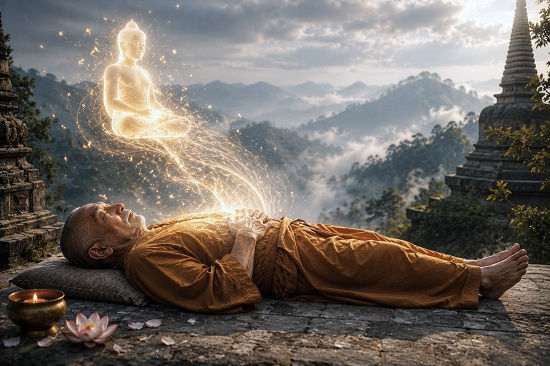
Hinduism teaches that beneath the body, beneath even the thinking mind, there is the atman: the true self, the unchanging witness behind a lifetime of changing experience. The atman, in this teaching, was never born and never dies. It cannot be cut, burned, drowned, or dried; it does not age when the body ages and is not touched when the body fails.
The tradition's most beloved statement of this comes from the Bhagavad Gita, a scripture set, fittingly, on the edge of a battlefield, where the warrior Arjuna is paralyzed by grief at the death about to unfold around him. Krishna, whom the text presents as God himself, teaches Arjuna that the self within is unborn and undying, and gives the image Hindus have carried to deathbeds ever since: just as a person discards worn-out clothes and puts on new ones, the embodied self casts off worn-out bodies and enters new ones. Death, in this teaching, is a change of garments. The wearer is untouched.
It is hard to overstate how much this reframes. In Hindu teaching, no one has ever actually watched a person die. What the bedside witnesses is a person setting something down.
Karma
If the self does not die, what determines where it goes next? The tradition's answer is karma, and the word deserves to be rescued from its casual uses. Karma in Hindu teaching is not luck, not fate, and not a cosmic judge handing down sentences. It is cause and effect, as impersonal and reliable in the moral world as gravity is in the physical one. The word itself simply means action. Every action, and the intention inside it, plants a seed, and seeds, in their own time, bear fruit that matches their kind.
A few everyday shapes of it make the teaching concrete. When Priya spends years meeting her coworkers with patience, she is not earning points with a judge; she is becoming a patient person, and a life built of patient actions ripens into circumstances and a character shaped by them. When her neighbor Ravi cuts corners and cuts people for years, no one needs to sentence him to anything; he is already constructing the person, and eventually the life, that those actions add up to. Karma teaches that nothing is lost in the accounting, that no good action is wasted and no harmful one is free, and that the account does not close at death.
The tradition refines this with a detail worth knowing: not all karma ripens at once. Hindu teaching speaks of a vast store of accumulated karma from all past actions, the portion of it that has ripened into this particular lifetime, its body and circumstances, and the fresh karma being created right now by present choices. The first explains why lives begin so differently; the last is why the teaching is the opposite of fatalism. The hand was dealt by old actions; how it is played is entirely new action, and the player is free.
Samsara and What Travels
Karma needs more than one lifetime to ripen, and Hinduism teaches that it gets exactly that. The self moves through samsara, the wheel of birth, death, and rebirth, life after life after life, each one shaped by the karma of the lives before it. Samsara is the tradition's name for the whole long journey, and the word carries a quiet judgment: it means wandering.
What actually travels from life to life? Not the body, which is left behind entirely, and the answer is more precise than "the soul." Hindu teaching says the atman travels wrapped in the subtle body: the mind, the intellect, and the deep impressions, tendencies, and desires a lifetime lays down. The subtle body is the luggage. It is why, in this teaching, a new life is not a blank slate; the newborn arrives with inclinations already packed, the residue of journeys the conscious mind does not remember.
And the question every newcomer asks deserves a straight answer: yes, in traditional Hindu teaching the wheel includes nonhuman births. A self can rise or descend across lifetimes, into animal births and out of them, according to its karma. The tradition draws a striking lesson from this, not horror but urgency: among the countless forms a self can wear, a human birth is rare and precious, because the human form is the one in which a being can understand the wheel and act to be free of it. The teaching is regularly put this way: the human birth is the doorway, and a wise person does not waste a doorway.
The Journey After Death
When the body is set down, Hindu teaching says the subtle body begins a journey, and the tradition's accounts of it center on Yama, the lord of death. Yama is not a devil. In the old texts he is the first mortal ever to die, the one who found the path to the other world and now presides over it as a king of justice, called the lord of dharma, of rightness itself. His role is the perfect accounting of a life, and the destinations his judgment opens are the lokas, the realms. Three matter most here.
The Svarga realms. The heavens. Realms of light and pleasure where a self enjoys the fruit of its accumulated merit, classically pictured as the paradise of Indra, king of the gods. They are real, in this teaching, and they are magnificent, and they end. The Gita itself states the rule: when the merit is spent, the self returns to the world of mortals. Heaven, in Hindu teaching, is a vacation funded by good karma, and every vacation budget runs out.
The Naraka realms. The hells, presided over by Yama, where heavy harmful karma is burned off through suffering matched to the deeds. The reframe a beginner needs is the same one: Naraka is temporary. It is not damnation but purification, a debt being paid down, and when it is paid, the self returns to the wheel and is born again.
The realm of the ancestors. Pitru-loka, the world of the fathers, where the honored dead dwell among their lineage, sustained, the tradition teaches, partly by the remembrance and offerings of their descendants. It too is a station on the journey rather than its end.
Here is the detail that reframes everything a newcomer assumed: in Hindu teaching, nothing short of liberation is permanent. Heaven is temporary. Hell is temporary. The ancestor world is temporary. Every realm is a stop, every stay is funded by karma, and when the karma is spent, the wheel turns again. Which raises the only question the tradition considers final, and it is answered two sections below.
The First Days After Death
One belief about the journey's very beginning is worth knowing because it shapes what Hindu families do in the first two weeks. The tradition teaches that immediately after death, before the journey to the realms can begin, the departed exists in a tender in-between condition, and that the living can help. In the days after the cremation, the family performs shraddha rites, offering rice balls and water with the departed's name, and the teaching is that these offerings actually nourish and help assemble the subtle vehicle the departed needs to travel onward and join the ancestors. The rites then continue annually, remembrance with substance to it.
The ceremonies themselves belong to the world of Hindu ritual, but the belief underneath them belongs here, and it is a moving one: in this teaching, the family's love is not merely consoling itself. For those first days, it is logistics. The living are provisioning a traveler.
Moksha
Everything so far, the realms, the returns, the wandering, is the problem. Moksha is the solution, and it is the goal beneath the entire Hindu map: liberation, full release from the wheel of birth and death. Not a better next life. No next life needed. The self, free.
What liberation actually looks like is the great honest difference inside Hinduism, and the tradition's major schools answer it in two main voices. Both are taught here, each with the traditions that hold it, so a reader stirred by one knows exactly where to look next.
Merging: liberation as oneness. The school called Advaita Vedanta, given its classic form by the philosopher Shankara, teaches that the atman was never actually separate from Brahman, the infinite divine reality, in the first place. The sense of being a separate self was the misunderstanding that kept the wheel turning. Liberation is the falling away of that misunderstanding, and at the body's death the freed self does not go somewhere; it is the ocean, as it always was, the drop's edges gone. This is the famous teaching of the drop and the ocean, and it is the root from which this course's later nonduality lesson grows.
Closeness: liberation as eternal loving relationship. The great devotional schools teach otherwise: the self is eternally real and eternally distinct from God, and liberation is not dissolving into God but arriving home with him, forever. The school of Ramanuja and the tradition of Madhva, along with the Vaishnava devotional movements, picture the freed soul in Vaikuntha, the realm of Vishnu, or in Goloka, the realm of Krishna, in an everlasting relationship of love and service; Shaiva traditions picture union in the presence of Shiva. In these schools, the drop does not vanish into the ocean. The lover does not want to become the Beloved. The lover wants to be with the Beloved, and liberation is exactly that, unending.
Both voices are fully Hindu, both ancient, both alive in temples today, and Hindu families may hold either, or hold them loosely together. A reader drawn to the first will find its trail in Advaita Vedanta; a reader drawn to the second will find it in the devotional traditions of Vishnu, Krishna, and Shiva.
The Paths and the Final Thought
How does a self actually move toward moksha? The tradition names several great paths, and at a glance they are: jnana yoga, the path of knowledge, penetrating insight into what the self really is; bhakti yoga, the path of devotion, love of God carried through everything; and karma yoga, the path of selfless action, doing one's duty fully while releasing all grasping at the results. Different temperaments, the tradition teaches, walk different paths up the same mountain.
And then Hinduism adds a teaching about dying itself that explains what happens at its deathbeds. The Gita teaches that whatever a person remembers at the final moment, leaving the body, that state they attain, because the last thought is the truest summary of where a lifetime's attention actually lived. This is why the tradition prizes a lifetime of remembrance, so that the final thought needs no arranging, and it is why, when Kavita's grandfather Arun reached his last hours, the family did what Hindu families do: kept the room peaceful, placed Ganga water and a sacred basil leaf at his lips, and softly repeated the names of God near his ear, lending him their remembrance in case his own was flickering.
It is also why, for centuries, the old and the dying have traveled to Varanasi, the holy city on the Ganges also called Kashi. Hindu teaching holds that to die there is to be released, that Shiva himself whispers the crossing-over teaching into the ear of whoever dies in his city, granting moksha directly. There are guesthouses in Varanasi where people go, openly and at peace, to wait for death the way one waits for an honored guest. In the tradition this is not grim in the slightest. It is the entire map of this lesson, trusted completely: the garment is worn out, the wearer is unborn and undying, and the city by the river is where the wheel, at last, lets go.
Below this lesson, you'll find an IFS & Parts Work Practice along with a few ways to begin noticing and applying it in everyday life this week.
Disclaimer: Everything IFS Academy is an independent educational platform and is not affiliated with, endorsed by, or connected to the IFS Institute. While we strive for accuracy, errors can occur, and users are encouraged to cross-reference critical information. These courses, lessons, skills, and practices are offered for educational and self-reflection purposes only. They do not constitute therapy, mental health treatment, clinical training, or crisis support, and they should not be used as a substitute for professional mental health care.
Crisis Support: 🚨 If you are experiencing a mental health crisis, feel unsafe, feel at risk of harming yourself or someone else, or feel too overwhelmed to safely use self-directed practices, please pause this material and reach out for immediate support. Contact a licensed mental health professional, call or text 988 in the U.S. or Canada, or use your local emergency or crisis resources.


Comments