🏛️ Module 2 — The Life and World of Zeno of Citium | Zeno of Citium Course
Updated: Oct 9
Free Course by Everything IFS Academy | Stoicism Series
Help us reach the people who may need this most by sharing this free course with friends, family, colleagues, online communities, social media or on your own website.
🎧 Audio - listen on the go (coming soon)
Module 2 — The Life and World of Zeno of Citium
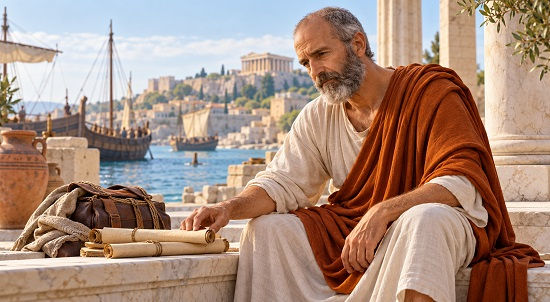
Sometime around the start of the third century BCE, a merchant stood near the coast of Athens and watched his entire fortune dissolve into the sea. The cargo was Tyrian purple, a dye worth more than its weight in silver, and it was gone. The man was in his twenties, far from home, ruined. Years later, established in Athens as the most respected teacher in the city, he was said to call that wreck the luckiest thing that ever happened to him. "I made a prosperous voyage," he reportedly said, "when I was shipwrecked."
This module is the life behind that line: the world Zeno came from, the teachers who formed him, the school he built on a public porch, the honors a foreign city heaped on him while he lived, and the deliberate death the Stoics took as a final lesson. It also tells the truth about how little of him survives, and why that matters for everything ahead.
A Merchant's Son From Citium
Zeno was born around 334 BCE in Citium, a port city on the southern coast of Cyprus. Citium was a meeting point of worlds. It had been founded by Phoenicians, the great seafaring traders of the eastern Mediterranean, and it sat inside the orbit of Greek language and culture. Zeno grew up an outsider to both at once, a Phoenician by descent living in a Greek world. His father, Mnaseas, was a merchant who traded with Athens and, by one account, carried home books about Socrates from his voyages.
The family trade was dye, specifically the rare purple drawn from the murex sea snail. It took thousands of crushed shells to produce a few grams of it, which is why it clothed kings and priests and almost no one else. To deal in it was to deal in concentrated wealth. Zeno took up the trade, as a merchant's son would, and for a time he was simply a prosperous dealer in the most expensive color in the ancient world.
His Phoenician origin followed him. In Athens he remained a metic, a resident foreigner without citizenship, and ancient writers describe him with a faint condescension, noting his dark complexion and calling him, even fondly, "the little Phoenician." That he became, as an outsider, the moral authority of the city that looked down on him is one of the quiet ironies of his life.
The Shipwreck and the Bookshop
The voyage that changed everything was a routine one, carrying dye from Phoenicia toward the Piraeus, the port of Athens. The ship went down. Zeno survived; the cargo did not.
Stranded and idle in the city, he wandered into a bookseller's shop and began reading Xenophon's Memorabilia, an account of the conversations of Socrates. The portrait of a man indifferent to wealth and comfort, unshakable in his sense of what mattered, struck Zeno with peculiar force in the days after he had lost everything that wealth could buy. He asked the bookseller where such men could still be found. As the story goes, a rough-looking philosopher named Crates was passing at that very moment, and the bookseller simply pointed: "Follow that man." Zeno followed, and never returned to trade.
Honesty requires a note here. Not every ancient source includes the shipwreck. Some say Zeno simply sold his cargo, settled in Athens, and took up philosophy without any disaster at all. But the shipwreck is the version his own tradition kept, and the line credited to him, that he sailed best when he was wrecked, suggests he understood his ruin as the hinge of his life. Whether or not the sea actually took his fortune, he taught as a man who had learned to hold loosely the things that can be lost.
The Teachers Who Made Him
Zeno did not invent Stoicism in a flash of insight. He spent close to twenty years studying under teachers from rival schools, taking what he judged true from each and welding it into one system. Three influences mattered most.
Crates the Cynic. Zeno's first teacher was Crates of Thebes, the leading Cynic of the age. The Cynics held that virtue was the only good and that all external things, wealth, status, comfort, reputation, were worthless distractions, and they practiced a deliberate shamelessness, flouting every social convention to prove their freedom from it. From Crates, Zeno took the conviction that virtue alone is good. The shamelessness he could not take. The famous test of this is the lentil soup: Crates, trying to cure Zeno of his sense of embarrassment, handed him a pot of soup to carry through the crowded potters' quarter. When Zeno, mortified, tried to hide it under his cloak, Crates smashed the pot with his staff, and the soup ran down Zeno's legs as he fled. "Why run away, my little Phoenician?" Crates called after him. "Nothing terrible has happened to you." Zeno kept the Cynic ethics and quietly dropped the Cynic theater.
Stilpo and the Megarians. From Stilpo of Megara and the Megarian logicians, Zeno took rigor. These were masters of dialectic, of careful argument and the close analysis of language and inference. Where the Cynics had ethics and little else, the Megarians gave Zeno the tools to defend a position and to build a system that could survive attack.
Polemo and the Academy. From Polemo, head of Plato's Academy, Zeno absorbed the wider Platonic and Socratic tradition, including the older idea that the goal of life is to live according to nature. Polemo is said to have accused his pupil, half in jest, of stealing his doctrines and dressing them in Phoenician colors. The charge holds a truth: Zeno was a synthesizer, and his genius lay less in any single original idea than in the architecture that bound the borrowed pieces into one coherent whole.
The Painted Porch
Around 300 BCE, after years of study, Zeno began to teach in his own voice. He did not buy a building or found a walled school the way Plato had with the Academy or Aristotle with the Lyceum. He chose a public colonnade in the heart of the Athenian marketplace: the Stoa Poikilē, the Painted Porch, named for the murals of famous battles that ran the length of its wall.
The choice was telling. A walled garden says philosophy is a retreat for initiates. An open porch in the middle of the agora, where merchants haggled and citizens argued and everyone passed through, says philosophy belongs to public life and to ordinary people. The site even carried a dark memory, for in an earlier era of political violence hundreds of citizens had been killed there. Zeno took that bloodstained public porch and made it the birthplace of a philosophy about living well under any conditions at all.
His students were first called Zenonians, and then, after the porch, Stoics, the men of the Stoa. The accident of a place name became the name of the philosophy itself.
Zeno himself was austere to the edge of severity. He ate plain food that needed no cooking, wore thin clothing in every season, and kept an even, unhurried temper. He disliked large crowds and is said to have thinned his audiences on purpose, charging a fee and seating beggars around himself to discourage the merely curious. He wanted students, not spectators.
The Honors of a Foreigner
For all his severity, Zeno was beloved. King Antigonus Gonatas of Macedon, one of the most powerful men of the age, attended his lectures when he was in Athens, enjoyed his company, and once invited him to the Macedonian court. Zeno, old by then, declined and sent two of his students in his place.
Athens honored him as it rarely honored anyone, least of all a foreigner. The city gave him a golden crown and, while he still lived, raised a bronze statue in his likeness. It entrusted him with the keys to the city walls, a mark of extraordinary public trust. And it passed a formal decree praising him, the surviving text of which singles out not his brilliance but his consistency, the fact that for the whole of his long life in Athens he had lived in accord with the philosophy he taught. The man who taught that character is the only true good was honored, fittingly, for his character.
He never became an Athenian. He remained a metic, a resident foreigner from Cyprus, until the day he died, and seems to have wanted it so. The founder of a philosophy that would one day call all rational beings citizens of a single world declined the citizenship of the city that adored him.
The Death of Zeno
Zeno died around 262 BCE, an old man, having led the school for decades. The tradition of his death is characteristically Stoic. Leaving the school one day, he tripped and fell, breaking a toe. Taking the small accident as a sign that his time had come, he struck the ground with his hand and quoted a line from an old tragedy about Niobe: "I come, why do you call me?" Then, the story says, he stopped his own breath and died.
The account may be more legend than fact, and the sources disagree even about his age, some saying seventy-two, others closer to ninety-eight. But the shape of the story matters as much as its accuracy, because it shows how the Stoics understood their founder. They did not tell a tale of a great man clinging to life. They told of a man who met death the way he had taught his students to meet everything, without panic, on his own terms, as a natural event rather than a catastrophe. The Stoics looked at death steadily, neither hurrying toward it nor fleeing from it, and they made Zeno's quiet, willing end the first proof of their own teaching.
How We Know Any of This
A reader has every right to ask how much of this can be trusted, and the honest answer is one of the most important facts in the whole course: almost nothing Zeno wrote survives. He was a prolific author. He wrote on ethics, on nature, on logic, on the ideal society. Not one of his books has reached us whole. What remains are quotations, paraphrases, and summaries scattered through the works of later writers.
The single richest source is Diogenes Laertius, a biographer who compiled his Lives of the Eminent Philosophers around five hundred years after Zeno died, stitching together earlier reports of uneven reliability. Beyond him, fragments survive in Cicero, who admired the Stoics, in the anthologist Stobaeus, who preserved long extracts, and in Sextus Empiricus, a skeptic who quoted the Stoics mainly in order to attack them. Zeno reaches a modern reader, in other words, through friendly hands and hostile ones, centuries removed, none of them his own.
This is not a reason to distrust the philosophy. It is a reason to read it the way it deserves, alert to where the record is firm and where it softens into tradition. Where the sources agree and the reasoning is preserved, the teaching stands on solid ground. Where they pass along only a striking story or a single line, this course says so plainly. Part of the work of meeting Zeno is the work of reconstruction, and that, far from diminishing him, is part of what makes the founder of Stoicism such a compelling figure to study.
Disclaimer:
Everything IFS Academy is an independent educational platform and is not affiliated with, endorsed by, or connected to the IFS Institute. While we strive for accuracy, errors can occur, and users are encouraged to cross-reference critical information. These courses present the ideas of historical Stoic philosophers for educational and self-reflection purposes only. They describe what these thinkers taught and argued and do not constitute an endorsement of any philosophical position, nor do they constitute religious instruction or professional advice of any kind. They do not constitute therapy, mental health treatment, clinical training, or crisis support, and they should not be used as a substitute for professional mental health care.
Crisis Support: 🚨
If you are experiencing a mental health crisis, feel unsafe, feel at risk of harming yourself or someone else, or feel too overwhelmed to safely use self-directed practices, please pause this material and reach out for immediate support. Contact a licensed mental health professional, call or text 988 in the U.S. or Canada, or use your local emergency or crisis resources.


Comments