Religious OCD / Scrupulosity
Updated: Jul 25
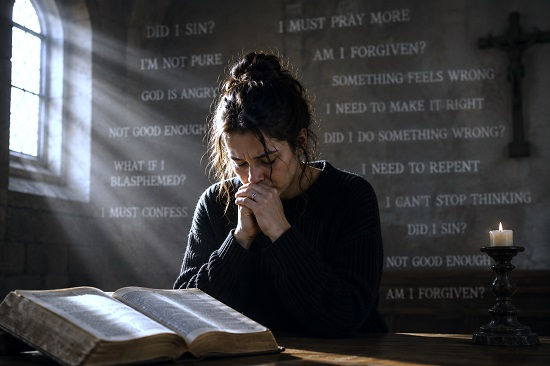
Religious OCD / Scrupulosity: A Clear, Compassionate Guide
Whether it's you, someone you love, or something you're here to learn about, this page outlines what scrupulosity actually is, in plain terms, with no judgment. Read this page straight through or scroll to the part you need. There's no right or wrong way to take it in. One quick note before we go further. If you scroll down to the very bottom of this page you'll find a Further Help and Resources section which are not read aloud here.
Scrupulosity is a recognized form of a mental-health condition, not a verdict on who anyone is, and not a flaw in anyone's faith. It is more common than people realize, it is treatable, and no one who has it is the first to walk this road.
1. What Is Scrupulosity?
Scrupulosity, also called religious or moral OCD, is the form of OCD where the obsessions fix on sin, blasphemy, salvation, or being a bad person, and the compulsions are the praying, confessing, checking, and reassurance-seeking a person does to try to feel certain they're right with God or with their own conscience.
It runs in two overlapping directions. Religious scrupulosity centers on faith: fear of having sinned, offended God, prayed "wrong," or doomed one's soul. Moral scrupulosity centers on character: fear of being dishonest, having harmed someone, or being secretly a bad person, and it shows up in people of every faith and no faith at all. The content follows whatever a person holds sacred. The cycle underneath is the same.
This is faith turned into fear, not devotion. The cruel part of this theme is that it targets what a person most wants to honor. From the outside the praying and confessing can look unusually devout. On the inside they don't bring peace; they bring dread, and a compulsion to do it again until it feels "just right." That is the line: real practice tends to settle a person, while scrupulosity traps them.
It is not a sign of weak or strong faith. Scrupulosity isn't caused by believing too much or too little, and treating it isn't an attack on anyone's religion. Good treatment works with a person's values, helping them return to a faith or moral life that feels like theirs again rather than one ruled by fear. Many clergy understand this and treat it as the illness it is.
It is a recognized pattern, even if it isn't its own DSM label. OCD is defined in the DSM-5, the manual clinicians use in the U.S., and recognized worldwide in the ICD-11. Scrupulosity isn't listed separately; it's the same OCD working on religious and moral content. And it is not an identity. People are far more than the fears their conscience hands them.
How common it is. Religious and moral themes are a recognized and far from rare way OCD shows up, and a meaningful share of people with OCD experience some scrupulosity. It reaches every faith tradition and every background, often begins in adolescence or young adulthood, and many carry it silently for years, certain their struggle is a spiritual failing rather than a treatable condition. Whatever brought a person to this page, they are in very large and very ordinary company.
2. The Symptoms
The recognized signs tend to fall into a few areas. Many people relate hard to some and not at all to others, and that is completely normal.
The Fears That Won't Quiet (the obsessions)
Fear of sin, blasphemy, or offending God. Intrusive blasphemous thoughts or images during prayer or worship, and dread that a thought alone has condemned you.
Fear of being a bad or immoral person. Doubt about whether you lied, cheated, harmed someone, or had a "wrong" intention, scrutinized for proof either way.
Fear of having gotten it wrong. A gnawing uncertainty about whether you prayed, confessed, or acted correctly, with the standard always just out of reach.
The Rituals That Try to Make You Right (the compulsions)
Repeating and "perfecting" religious acts. Praying over and over until it feels right, restarting rituals, or performing ablution or observance with exhausting exactness.
Confessing and reassurance-seeking. Confessing minor or imagined sins repeatedly, or asking clergy, family, and friends again and again whether something was wrong or whether you're forgiven.
Mental reviewing and avoidance. Replaying past actions to be sure they were moral, and avoiding services, scripture, or situations that might trigger a feared thought.
The Toll It Takes (the inner weather)
Exhaustion and constant guilt. A mind that never gets to rest in being "okay," and a heaviness that follows everywhere.
Distance from faith and community. A relationship with God or one's own conscience that has become a source of fear, sometimes pulling a person away from the very community that once brought comfort.
The parts that rarely make the list. Some experiences come up again and again even though no checklist names them: how the rituals can look like deep piety while feeling like torment; how reassurance from clergy soothes for a moment and then feeds the loop; how blasphemous intrusive thoughts horrify the very people who'd never want them, which is the point of how OCD works; how isolating it is to fear that this struggle means God has rejected you; and the relief of learning it's a known, treatable form of OCD.
No one has all of these. This is not a test anyone passes or fails. Recognizing these patterns is information, not a diagnosis. It is exactly the kind of thing worth bringing to a professional, because only a qualified professional who sees the whole picture can assess any one person.
One thing worth naming plainly. Scrupulosity often comes with intrusive blasphemous, sexual, or violent thoughts aimed straight at what a person holds sacred. These are symptoms of OCD, not desires, not intentions, and not evidence of a corrupt heart. They torment people precisely because they run against everything that person values, which is the opposite of wanting them. Saying them out loud to someone who understands OCD, a specialist or an informed clergy member, tends to bring relief, not condemnation. And if the guilt or despair ever turns into thoughts of harming yourself, that is a moment to reach out promptly, to a professional or a crisis line, rather than wait it out. Reaching for help early is the strong choice, not the weak one.
3. How Did I Get This?
Somewhere early on, a quiet question tends to show up: what did I do to cause this? The honest answer is that there is no single cause. The research points instead to a handful of forces that combine differently in every person, most of them in place long before any fear of sin ever took hold.
Genetics and family history. OCD tends to run in families, and a meaningful share of the risk appears to be inherited. A person can carry that loading without ever having known it was there.
Brain and biology. The systems that handle doubt and the sense of when something is "resolved" work differently in OCD, which is why no amount of prayer or confession ever feels like enough. That is biology, not a spiritual defect.
Temperament. Some people lean toward a strong conscience, a deep sense of responsibility, or a high need for certainty. That wiring is not a flaw, and it often travels with real strengths like sincerity, care, and integrity.
Environment and stress. A high-stakes moral or religious upbringing, a frightening message about sin or punishment, major life stress, or early hardship can help bring OCD forward in someone already prone to it, and hand it a religious or moral theme to latch onto. No one authors the world they came up in.
The part that matters most. No one chooses to fear God or their own conscience, and the praying and confessing aren't insincerity; they're an attempt to quiet a fear that feels genuinely dangerous to the soul. This is a health condition with traceable contributors, the kind a person can have without it meaning a single thing about their worth or their standing with God. Putting that weight down is often where the room to actually move first opens up.
4. Treatment and Finding the Right Help for Scrupulosity
Here is the part worth hearing plainly: there is far more help for scrupulosity than the old picture suggests, and this theme responds well to the right approach. The work isn't to settle every theological question or prove you're forgiven. It's to loosen OCD's demand for total certainty so faith and conscience can become yours again instead of a fear to manage. That is a learnable skill, and it doesn't ask you to give up your beliefs.
An honest word about the search. True OCD specialists aren't on every corner, and scrupulosity is especially easy to mishandle. A well-meaning therapist or clergy member who keeps offering reassurance, "no, that wasn't a sin, you're fine," is feeding the exact loop the condition runs on. So the search can feel discouraging. That doesn't mean help isn't there. It means the right help is specific, and worth holding out for. No one is past the point of no return.
ERP, the approach to search for by name. Exposure and response prevention, or ERP, is the most established, first-line approach for OCD. For scrupulosity it means facing a feared thought or situation on purpose, sitting with "maybe I can't be certain I didn't sin," while resisting the urge to pray again, confess, or seek reassurance. A skilled, faith-respecting therapist designs exposures with your beliefs in mind; the goal is never irreverence, it's to break OCD's grip so genuine practice can return. It's paced and collaborative, done with you rather than to you. Getting to a therapist actually trained in it genuinely matters.
► Free ERP Course - Click Here
ACT, which fits this theme especially well. Acceptance and Commitment Therapy pairs naturally with ERP here, helping a person hold an uncertain thought without treating it as an emergency to resolve, and keep living out their actual values rather than chasing perfect moral certainty. It tends to sit comfortably alongside a person's faith.
I-CBT, a gentler door. Inference-based CBT works on the reasoning underneath the fear, the leap from "I had a blasphemous thought" to "I must be wicked," without front-loading exposures. Many people find it lands well, and find it an easier first step if ERP feels like too much right now.
► Free I-CBT Course - Click Here
DBT skills, to make the hard parts doable. DBT isn't a standalone OCD treatment, but its skills for riding out intense emotion pair powerfully with exposure work. Staying steady through a wave of guilt without rushing to pray or confess is exactly what makes resisting the compulsion possible.
► Free DBT Course - Click Here
IFS, a kinder inner approach. Internal Family Systems works with the part of you that prays and confesses on a loop, usually a frightened protector trying to keep you safe from condemnation. Rather than fighting that part, IFS gets curious about its fear and meets it with understanding. Offered with no pressure.
► Free IFS Course - Click Here
Medication is one of the doors. For many people, medication overseen by a prescriber is a genuinely helpful part of the picture, sometimes on its own, often alongside therapy. What fits is a conversation for a qualified prescriber who knows your whole situation, and nothing here is a reason to start, stop, or change anything on your own.
A faith-informed clergy member can be an ally. Many pastors, priests, rabbis, and imams now understand scrupulosity and can support recovery, for instance by affirming once that a particular thought doesn't need confessing, rather than supplying the endless reassurance the OCD craves. A clergy member who grasps the difference between devotion and compulsion can be a real partner alongside a specialist.
What to actually search for. The words that land you with the right person are "ERP therapist," "ERP specialist," or "OCD specialist." It's worth asking specifically whether they work with scrupulosity or religious and moral OCD, and whether they respect your faith, and whether they offer ACT or I-CBT. A clinician who lights up at those terms rather than going vague is the signal you want. If your first few calls turn up little, that's expected, not a sign help isn't there.
Support that isn't a therapist still counts. Peer-led OCD groups, faith-and-OCD communities, family support, and specialist helplines are real help in their own right, and most run online so they reach you wherever you are. Hearing someone describe the exact intrusive thought you were certain damned you can be an enormous relief. If one group doesn't click, that just means you haven't found your room yet. Specific organizations are in the resources below.
Teletherapy counts too. OCD specialists are spread thin, and a faith-respecting one may not live near you, so video and phone sessions are now one of the most important doors there is, and research finds ERP delivered online works just as well as in person.
Fit isn't failure. The approach everyone swears by may not be the one that clicks, and that's information pointing toward a better fit, not a personal failure. Fit can also change over time. To see the approaches a therapist might use, explore them.
► Learn Therapeutic Modalities - Click Here
For a full walkthrough on finding and vetting someone who fits, the Finding a Therapist guide in the resources below goes deep on exactly that.
5. Higher Levels of Care: IOP, PHP, and Residential
Most people picture only two options: weekly therapy, or nothing more intensive. There's a whole middle ground, and a lot of people never find out it's there. If weekly sessions aren't holding things steady, or the praying, confessing, and avoiding have swallowed most of the day, stepping up doesn't mean anyone failed. It means matching the level of care to what's needed right now.
Here is the range, from most independent to most intensive.
Intensive Outpatient Program (IOP). Several hours at a time, a few days a week, while you live at home and keep up much of your normal life. A real step up from weekly therapy without taking over everything.
Partial Hospitalization Program (PHP), also called day treatment. Most of the day, most days of the week, but you still sleep in your own bed at night. The name is misleading; it doesn't mean being admitted to a hospital. It's the most support you can get while still living at home.
Residential treatment. You live at the center for a while, with around-the-clock support and ERP woven through the day. It's for severe or stubborn cases, or when being at home makes the work nearly impossible.
Inpatient or hospital care. Short-term care focused on safety when things have become overwhelming, usually a brief step before moving to one of the levels above.
These are a season, not a forever. Higher levels of care are meant to be time-limited. The goal is to get steady enough to step back down, not to stay indefinitely.
A lot of this is virtual now. There are fully virtual IOP and even PHP options for OCD, so where you live is far less of a wall than it used to be. What usually decides access is state licensing and insurance, not your zip code. For virtual programs, ask "Are you licensed where I live?" For in-person residential, people travel across state lines all the time, so the bigger question is whether your insurance covers that specific program. Confirm that before committing to anything.
Words that help when you search: "OCD intensive outpatient," "OCD IOP," "OCD PHP" or "day treatment," "OCD residential treatment," and "virtual OCD IOP," along with your state or "near me." When you call your insurance, ask which levels they cover, which specific programs are in-network, whether virtual counts, and whether you need pre-authorization. Jot down what they tell you and the date.
One last thing. Scrupulosity is isolating in a particular way, because the fear says your struggle is between you and God and shouldn't be spoken aloud. Being in a room, in person or on a screen, with others who know the same fears loosens that isolation in a way that's hard to do alone. Reaching for this much help isn't a last resort. It's one of the bravest, most practical things a person can do.
6. What's Next?
Scrupulosity is treatable, and none of it has to be solved this week. Large numbers of people with this theme go on to build full, ordinary lives, with faith or conscience restored to something that steadies them rather than torments them, and a great many of them once stood right where you are, unsure it was even possible.
The diagnosis is best held as information, not identity. Something a person has, not something they are.
In the early going, the steps that help most are small and concrete. You only need to pick one:
Doctor, therapist, or mental health professional — the safest, most private place to start, ideally someone who understands OCD and exposure-based work.
Peer support group — a peer-led OCD community, in person or online, so the road is less lonely. A few worth knowing are in the resources below.
Clergy member — a pastor, priest, rabbi, imam, or other faith leader, ideally one who understands scrupulosity as OCD. Often a trusted, confidential ear and a real ally.
School counselor or a trusted teacher — if you're in high school or college. Campus health and counseling centers are usually free or low-cost.
Employee assistance program (EAP) — if your workplace has one. A confidential service, often free, separate from the rest of work.
One trusted person — so the weight isn't carried entirely alone, if and when that feels right.
A quiet week where the only thing managed was not giving up still counts. Gentle and steady tends to outlast urgent and forced.
Just below, you'll find the Further Help and Resources section: communities, helplines, tips, and pathways worth coming back to.
Further Help & Resources
Everything below is here when you're ready, and not before.
International OCD Foundation (IOCDF) (the central hub for OCD: free education, plus a Resource Directory to search therapists, clinics, intensive and residential programs, support groups, and teletherapy by your location, insurance, and level of care)
IOCDF Faith & OCD Resource Center
(free, faith-sensitive education on scrupulosity, with resources for people of many traditions and for clergy)
IOCDF Free Online Support Groups
(free, facilitated groups for people with OCD and their loved ones)
NOCD
(specialized virtual ERP therapy in all 50 states, covered by most major insurance, with a free intro consultation and free weekly therapist-led support groups)
An IFS Demo Session for Scrupulosity
Mapping Your Scrupulosity Parts With IFS
National OCD Treatment Centers
These are established programs that offer the higher levels of care described above, meaning IOP, PHP, and in some cases residential, most with virtual options too. Who each serves, which states they reach, and what insurance they take all vary, so the surest path is to contact a program directly, or use the IOCDF Resource Directory above to filter by your state, insurance, and level of care. Listing here isn't an endorsement, just a starting point. Whether a program serves you where you live is noted for each.
The OCD & Anxiety Treatment Center (TOATC)
(ERP-based IOP, PHP, and virtual IOP for ages five and up; in-person in Utah, plus Virginia, Washington, and Arizona, with virtual care where licensed)
Rogers Behavioral Health
(residential care for all ages at its Wisconsin campus, which people travel to from across the country, plus PHP and IOP at locations in several states)
McLean Hospital OCD Institute (OCDI)
(a Harvard-affiliated leader in OCD care; residential, PHP, and outpatient for adults in Massachusetts and Texas, with residential programming for children and teens; people travel in from anywhere)
Sheppard Pratt – The Retreat
(specialized residential treatment for severe OCD in Maryland, drawing residents from across the country; largely private-pay)
The Gateway Institute
(a three-week intensive ERP program with travel packages, so people come from out of state; sites in California and Arizona)
If you don't see one near you or one that fits, the IOCDF Resource Directory (linked above) lets you search programs and specialists across the country by location, insurance, and level of care.
See why so many people are turning to IFS therapy for help...
Disclaimer:
Everything IFS Academy is an independent educational platform and is not affiliated with, endorsed by, or connected to the IFS Institute. While we strive for accuracy, errors can occur, and users are encouraged to cross-reference critical information. These courses, lessons, skills, and practices are offered for educational and self-reflection purposes only. They do not constitute medical advice, diagnosis, therapy, mental health treatment, clinical training, or crisis support, and they should not be used as a substitute for professional medical or mental health care. Only a qualified professional who knows your situation can diagnose, treat, or advise you, and nothing here should be used to make decisions about starting, stopping, or changing any treatment or medication.
Crisis Support:🚨
If you are experiencing a mental health crisis, feel unsafe, feel at risk of harming yourself or someone else, or feel too overwhelmed to safely use self-directed material, please pause and reach out for immediate support. Contact a licensed mental health professional, call or text 988 in the U.S. or Canada, or use your local emergency or crisis resources.
Comments