📚Bonus module — The ABC and ABCDE Models | CBT Course
Updated: Oct 9
Free Course by Everything IFS Academy | Therapeutic Modalities Series
Help us reach the people who may need this most by sharing this free course with friends, family, colleagues, online communities, social media or on your own website.
🎧 Audio is read by AI — Helen
📚Bonus module — The ABC and ABCDE models
Years before cognitive therapy had its name, a psychologist in New York built a three-letter frame that says the same radical thing this whole course has been saying: it is not the event that disturbs a person, it is the belief about the event. The psychologist was Albert Ellis, the frame is the ABC model, and it has earned its bonus lesson here for a simple reason: it is the most portable version of the cognitive work ever designed. Everything this course taught across five cognitive lessons, Ellis's frame folds down to something that fits on a napkin, in a memory, in the thirty seconds after a bad moment. Learning it at the end of this course is like being handed the pocket edition of a book already read: everything in it is familiar, and now it travels.
Albert Ellis and Where ABC Comes Froms
Credit where history puts it: Albert Ellis got to the cognitive turn first. In 1955, a decade before Aaron Beck's cognitive therapy took shape, Ellis, a New York psychologist trained in psychoanalysis and openly frustrated with how slowly it worked, launched what became Rational Emotive Behavior Therapy, REBT, built on the conviction that people are disturbed less by events than by the beliefs they hold about events. He was brash where Beck was methodical, famously blunt in session where Beck was gentle, and the two arrived at their kindred revolutions independently, later acknowledging each other as fellow travelers. Ellis's ideas, his fascinating and colorful life, and REBT's full toolkit belong to the REBT course in this series; this lesson borrows only his most famous invention.
The ABC Model
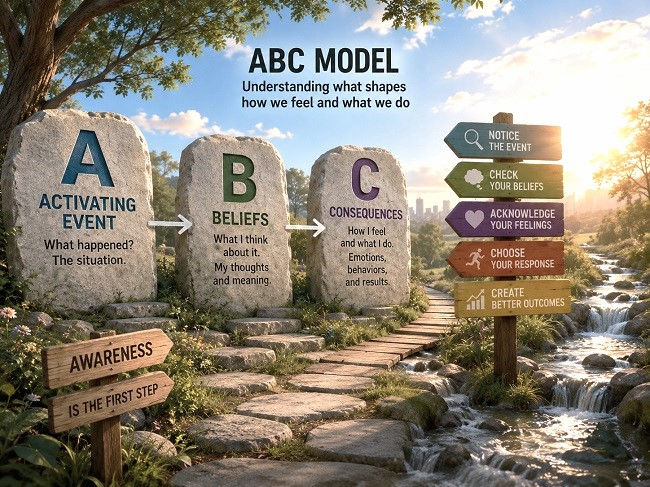
The model names three points on a chain:
A is the Activating event.
The thing that happens: the email, the silence, the traffic, the comment. A is the part of the story people usually blame.
B is the Belief.
What the mind does with A: the interpretation, the evaluation, the rule applied. B is the part of the story people usually skip, because it runs fast and feels invisible.
C is the Consequence.
The emotional and behavioral result: the dread and the evening lost to it, the anger and the sharp reply sent.
Everyday thinking runs A straight to C: "the traffic made me furious." The model's punchline, the entire cognitive revolution in one line, is that A does not cause C. B does. The traffic supplied an occasion; the fury was manufactured at B.
The proof is the same event run through two different Bs. Marcus and Dana are both stuck in the same dead-stop traffic, twenty minutes before their respective meetings.
Marcus:
A: dead-stop traffic, meeting in twenty minutes.
B: "This is a disaster. I'll look unprofessional, and I can't stand looking unprofessional."
C: heart pounding, fists on the wheel, arrives frazzled and snaps at the receptionist.
Dana:
A: dead-stop traffic, meeting in twenty minutes. Identical.
B: "Not ideal. I'll message them now, people hit traffic, this is recoverable."
C: mild annoyance, sends the message, arrives composed three minutes late to a meeting that hasn't started.
One A, two Bs, two entirely different Cs. Whatever was disturbing in that traffic jam was not sitting on the asphalt; it was manufactured in one of the two cars.
Adding D and E
Ellis extended the frame from a diagnosis into a treatment by adding two letters:
D is Disputing the belief.
Once B is visible, it gets challenged: is this belief accurate? Where's the evidence? Is "disaster" the honest word for a late arrival? Is "I can't stand it" literally true of something currently being stood? Ellis loved that last dispute; he found people declaring things unbearable while visibly bearing them.
E is the Effective new belief.
Disputing that lands produces a replacement, and with it, a new emotional consequence: "Being late is inconvenient, not catastrophic, and it says little about me" arrives with a very different body than "disaster" did.
A-B-C to see the machinery, D to challenge it, E to replace it: the complete arc of the cognitive work, five letters long, runnable at a red light. That is why therapists across every lineage still teach it seventy years on, and why it makes a fitting final gift from this course.
How ABC Maps Onto the CBT Toolkit
For a graduate of this course, the frame should feel deeply familiar, because the mapping is nearly one to one:
B is the automatic thought of Module 3, wearing Ellis's letter.
D is the questioning of Module 5, and building E is the rebalancing of Module 6.
The whole ABCDE sequence is, in effect, a thought record folded to fit a napkin (Module 7).
The mapping runs the other way too, and that is its real use: on days when the full tools feel heavy, the letters are the light version, and on thoughts where the letters feel thin, the full tools are waiting. Same revolution, two dialects, and a practitioner fluent in both can meet almost any moment at whatever weight the moment deserves.
Below this lesson, you'll find a CBT practice built around one of the skills you just learned, along with a few ways to begin noticing and practicing it in everyday life this week.
CBT Practice: One ABC on Paper
The pocket frame, run once at full size. Paper and five minutes.
Pick a recent moment that left a mark, this week's irritation, sting, or spiral of nerves. Ordinary sized is perfect.
Write A, the activating event, in one factual line: what happened, camera-level, no interpretation smuggled in.
Write C next, skipping B for a moment, the consequence: what you felt (a word or two) and what you did. Writing C before B is a classic ABC move, because the feeling is usually easier to find than the belief that built it.
Now write B, the bridge: what did you believe about A that could produce exactly that C? Ask it almost like a puzzle: "what would someone have to believe about this event to feel what I felt?" Write the belief plainly, in its real wording.
Look at the chain assembled: A, B, C, in ink. Notice, without forcing anything, that the arrow from A to C runs through B, and that B was the one part of the chain that was yours.
If you'd like the full pocket arc, add one D: a single disputing question aimed at B, is it accurate? would "inconvenient" be more honest than "disaster"? And if a sturdier belief suggests itself, write it as your E, along with what it would have changed about that C.
This Week
Run one ABC in your head at the scene of a small annoyance, traffic, a slow line, a curt email, just naming the three letters as they happen.
Once, when someone tells you a story of "X made me so angry," silently spot the B in it. (Spotting quietly is the exercise; announcing it is not recommended.)
If you find you like this frame, the REBT course in this series opens up the whole world it came from, Ellis included, in his full unfiltered glory.
Disclaimer: Everything IFS Academy is an independent educational platform and is not affiliated with, endorsed by, or connected to the IFS Institute. While we strive for accuracy, errors can occur, and users are encouraged to cross-reference critical information. These courses, lessons, skills, and practices are offered for educational and self-reflection purposes only. They do not constitute therapy, mental health treatment, clinical training, or crisis support, and they should not be used as a substitute for professional mental health care.
Crisis Support: 🚨 If you are experiencing a mental health crisis, feel unsafe, feel at risk of harming yourself or someone else, or feel too overwhelmed to safely use self-directed practices, please pause this material and reach out for immediate support. Contact a licensed mental health professional, call or text 988 in the U.S. or Canada, or use your local emergency or crisis resources.


Comments