🏛️ Module 10 — Thinking Like Zeno: The Lens in Everyday Life | Zeno of Citium Course
Updated: Oct 9

Free Course by Everything IFS Academy | Stoicism Series
Help us reach the people who may need this most by sharing this free course with friends, family, colleagues, online communities, social media or on your own website.
🎧 Audio - listen on the go (coming soon)
Module 10 — Thinking Like Zeno: The Lens in Everyday Life
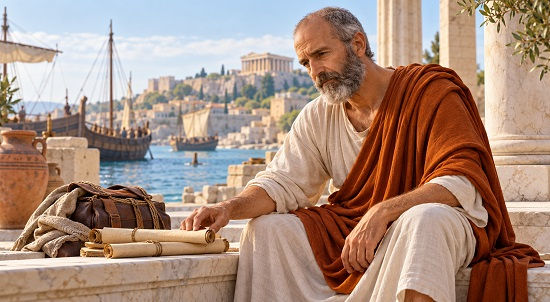
It is worth returning, at the end, to the beach where this began. A merchant in his twenties stands on the shore near Athens and watches the sea swallow everything he owns. The purple dye, the ship, the fortune, the plan for his life, all of it gone in an afternoon to water that did not care. Most people, standing there, would feel only the loss. Zeno felt a question, and he spent the next forty years answering it. The question was simple, and it is the one his entire philosophy exists to address: when everything that can be taken has been taken, what, if anything, is left that is truly a person's own?
This course has walked through the pieces of his answer one at a time. This final lesson does something different. It does not add a new teaching or repeat the old ones. It steps back to watch the separate pieces lock into a single thing, the one steady way of standing in the world they were always building toward, and then asks the honest questions a modern reader has every right to ask: how much of this still holds, what the popular version keeps and loses, and what it would mean to live by any of it.
The Lens Assembled
Seen from the end, the teachings of this course are not a list of separate doctrines. They are one apparatus, and each part needs the others to function.
Underneath everything sits the picture of the cosmos as a single rational order, the subject of this course's lesson on God, the Logos, and the designing fire. That picture is the ground. Because reality is an order a person belongs to rather than a chaos a person is thrown into, it makes sense to speak of living in agreement with it, which is the goal Zeno set for a human life and the subject of its own lesson here. Agreement, in turn, requires knowing what is good and worth wanting, and Zeno's radical answer, that the only true good is the state of one's own character and that everything else is indifferent, is the lesson on virtue and the indifferents. That value theory is what tells a person, standing on the beach, that the cargo was never the good in the first place.
The remaining two pieces are the working machinery that makes the rest usable in real time. The lesson on the cataleptic impression supplies the lever: that between an impression and belief lies assent, a moment that is always a person's own, in which reality can be aligned with or refused. And the lesson on the passions and apatheia shows what happens when that lever is pulled wrongly, how a destructive emotion is simply a false value-judgment caught in motion, and how correcting the judgment dissolves it. Put together, the system describes a single posture. A person stands inside an order they did not make and cannot command, holds loosely everything in it that can be taken, pours their whole effort into the one thing that is theirs, the quality of their own judgments and through them their character, and meets each impression with the small saving pause before assent. That posture is the lens. Everything in the course was a facet of it.
What Zeno Trains a Person to Notice
A philosophy is finally a way of seeing, and the test of whether it has taken hold is what a person starts to notice without trying. Zeno's lens, once it has been worn for a while, trains attention onto one thing in three forms.
It catches the judgment hiding inside an upset, the way distress over a loss is never the bare loss but a verdict laid on top of it. It catches the indifferent dressed up as a good, the promotion or the approval the mind has quietly upgraded from a thing worth preferring to a thing worth needing. And it catches the impression still waiting for assent, the stab of he disrespected me or this is a disaster while it is still only a presentation, not yet a belief, still resting in the open hand. These three may sound like three separate skills, but they are one. Each is the act of noticing the seam, the hairline gap between what has in fact happened and the story the mind reflexively builds on top of it. Untrained, a person never sees the seam at all. Event and verdict arrive fused, and the verdict is simply mistaken for the world. The whole discipline Zeno founded is, in practice, the slow growth of the ability to see that seam in ordinary moments and to work in the space it opens. That is what thinking like Zeno really is. Not a set of quotes to recall, but a trained second sight that separates the fact from the fear stitched to it.
Ancient Stoicism and the Modern Revival
This is the place to be fully honest about the strange afterlife of Zeno's philosophy, because a modern reader meets Stoicism long before meeting Zeno, and meets a version of it he might not recognize.
Stoicism is in the middle of an enormous revival. It fills bestsellers, fuels a vast online following, and turns up as a kind of mental operating system for athletes, entrepreneurs, and anyone trying to perform under pressure. This modern Stoicism has preserved something real and valuable, and the debt should be stated plainly. It keeps the practical ethics almost intact: the focus on what is within one's control, the separation of events from judgments about them, the training of resilience, the steadiness under hardship. These tools work, they have helped a great many people, and the ancient Stoics themselves, the Roman ones especially, leaned hard on exactly this practical core. There is no shame in using the inheritance, and no contempt is owed to those who do.
But two large things tend to fall away in the translation, and both are in this course.
The first is everything underneath the ethics: the rational, living, providential cosmos, the Logos, the physics that made living in agreement with nature mean something specific. Stripped of that ground, the famous phrase has to be re-anchored on something else, and modern Stoics have done that re-anchoring thoughtfully, on human reason and human society rather than a divine order. It can be done. It is worth knowing that it is being done, and that the original stood on a foundation most of the modern versions have quietly removed.
The second loss is larger and less noticed. The Zeno of this course was not, at root, a philosopher of individual self-optimization. His ideal was the city of friends, a radically communal and cosmopolitan vision in which justice and duty to others sit at the center and all human beings are citizens of one world. A great deal of popular Stoicism has inverted exactly this. In its grindset form it can become a tool for acquiring the very externals Zeno called indifferent, harder and more relentlessly, a teaching about not needing the prize repurposed to help win it. That inversion is worth seeing clearly, and worth saying without a sneer, because the people drawn to it are reaching for something real. The point is not that the modern revival is false and the ancient article true. It is that the ancient article is larger, stranger, and more demanding than the revival usually shows, communal where the popular version is individual, cosmic where it is practical, and aimed at becoming good rather than at becoming effective. A reader can use every practical tool the revival offers and still know that the founder was building something bigger than a performance technique.
The Long Game
One last thing has to be said, because it guards against a misreading this final lesson could invite. None of this is a course to be completed. The Stoics were emphatic that their philosophy is not a body of information to be learned but a training to be undertaken, a lifelong practice with no graduation. The fully wise person, the sage who holds the whole interlocked system in an unbreakable grip, was for them an ideal held up to aim at, not a club anyone was confident of joining. What is available to an ordinary person is to be a prokoptōn, one making progress, someone moving in the right direction without ever quite arriving.
Zeno seems to have understood this from the start. One of the few sayings reliably attributed to him is that well-being is realized by small steps, and yet is no small thing. The line holds the whole temperament of the philosophy in a sentence. The steps are small, daily, unglamorous: one impression examined instead of swallowed, one indifferent seen for what it is, one passion caught before it sets. And the thing they build toward is the largest there is, a life lived in agreement with itself and with the world, steady under what cannot be controlled, free in the one place freedom was ever available. The work of treating philosophy as exactly this kind of daily training would be carried furthest by a later Stoic, Musonius Rufus, in his own course. But the shape of it was there on the porch from the beginning, in a founder who taught, by the way he lived and the way he died, that the point was never to know these things. It was to become them.
Disclaimer:
Everything IFS Academy is an independent educational platform and is not affiliated with, endorsed by, or connected to the IFS Institute. While we strive for accuracy, errors can occur, and users are encouraged to cross-reference critical information. These courses present the ideas of historical Stoic philosophers for educational and self-reflection purposes only. They describe what these thinkers taught and argued and do not constitute an endorsement of any philosophical position, nor do they constitute religious instruction or professional advice of any kind. They do not constitute therapy, mental health treatment, clinical training, or crisis support, and they should not be used as a substitute for professional mental health care.
Crisis Support: 🚨
If you are experiencing a mental health crisis, feel unsafe, feel at risk of harming yourself or someone else, or feel too overwhelmed to safely use self-directed practices, please pause this material and reach out for immediate support. Contact a licensed mental health professional, call or text 988 in the U.S. or Canada, or use your local emergency or crisis resources.


Comments